


ASCP ASCP-MLT - MEDICAL LABORATORY TECHNICIAN - MLT(ASCP)
Stuart Prower factor, or factor X, would cause abnormal PT, aPTT, and dRVVT test results as factor X is part of the common coagulation pathway and therefore measured in both the PT and aPTT test. In the dRVVT test, factor X is directly activated in the test principle; therefore an abnormal result would be expected in this test as well if there was a deficiency in factor X.
What tests will be abnormal in a patient with Stuart-Prower Factor deficiency?
Monoclonal antibodies are usually produced by:
Convert the following temperature from Celsius to Fahrenheit
-10 degrees C
Question options:
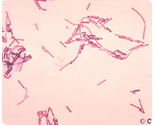
The organisms in this image are demonstrating a gram-variable phenomenon. For the most part, the organisms are staining primarily gram-negative, however, on the tips of some of the rods, there is a gram-positive staining morphology. This can be defined as gram-variable.
Which of the following best describes the organisms seen in this illustration:
Serum amylase and lipase levels may be slightly elevated in chronic pancreatitis, but not diagnostic enough to predict chronic pancreatitis; wheras high levels are found only during acute pancreatitis episodes. In the later stages of chronic pancreatitis, normal to decreased levels of amylase and lipase are caused by the gradual inability of the pancreas to secrete the enzyme
All of the statements below regarding amylase and lipase in pancreatitis are TRUE EXCEPT:
Thrombocytes, or platelets, are of course involved with hemostasis, not immunity.
Immunology
Which of the following would not be considered a part of the body's cellular immune system:
UA & Body Fluids
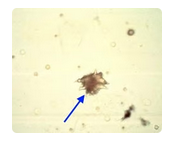
What is the identification of this crystal seen in a urine with an alkaline pH?
Isolation and detection of Gardnerella vaginalis from vaginal secretions is improved by which of the following?
Two CSF specimens were sent to the Lab with the following results:
Tube #1 = 11,200 rbc/µL
Tube #2 = 300 rbc/µL
The results on these CSF specimens are indicative of:
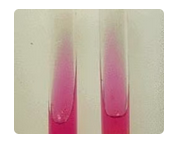
Conversion of only the slant to a pink color in a Christensen's urea agar slant is produced by bacterial species that have weak urease activity. The reaction in the slant to the right is often produced by Klebsiella species, as an example. Strong urease activity is indicated by conversion of the slant and the butt of the tube to a pink color, as seen in the tube to the left. The slant only reaction in the right tube may be seen early on if only the slant had been inoculated; however, with a strong urease producer, both the slant and the butt would turn. Therefore, the reaction is dependent on the strength of urease activity. If the media had outdated for a prolonged period, either there would be no reaction or the appearance of only a faint pink tinge, either in the slant, the butt or both, again depending on the strength of urease production by the unknown organism.
The urease reaction seen in the Christensen's urea agar slant on the far right indicates:
Flow cytometry employs a combination of fluorescent antibody tagging of cells and analysis with laser light scatter.
What principle(s) of flow cytometry are employed when performing immunophenotyping:
Myoglobin rises typically within 2-4 hours after a myocardial infarction and stay elevated for days, with a peak at the 6-9-hour mark post-MI. After myoglobin, troponin is the next fastest to rise afer a mycardial infarction and can rise within 3-4 hours with a peak around 12 hours post-MI. LD (8-12 hours, 24-48 hour peak) and CK (4-6 hours with peak at 24-36 hours) will also rise after MI, but are not as fast to rise as myoglobin and troponin.
Chemistry
A patient is admitted to the hospital with acute chest pain, but which of the following cardiac markers will be elevated FIRST if the patient had an MI?
The body compensates for alkalosis or acidosis of the blood PRIMARILY to regain a normal pH, between 7.35 - 7.45.
When the body compensates for a respiratory or metabolic disorder, the MAIN goal is to achieve:
The term universal precautions refers to:
Match each virus with its appropriate nucleic acid content.
1. Paramyxovirus
2. Rhabdovirus
3. Poxvirus
4. Orthomyxovirus
