Microsoft AZ-120 - Planning and Administering Microsoft Azure for SAP Workloads
You plan to deploy an SAP environment on Azure that will use Azure Availability Zones.
Which load balancing solution supports the deployment?
You have an SAP production landscape on-premises and an SAP development landscape on Azure.
You deploy a network virtual appliance to act as a firewall between the Azure subnet and the on-premises network.
Solution: You configure a user-defined route table.
Does this meet the goal?
You have a single-instance SAP NetWeaver deployment hosted on Azure virtual machines that run Windows Server 2022.
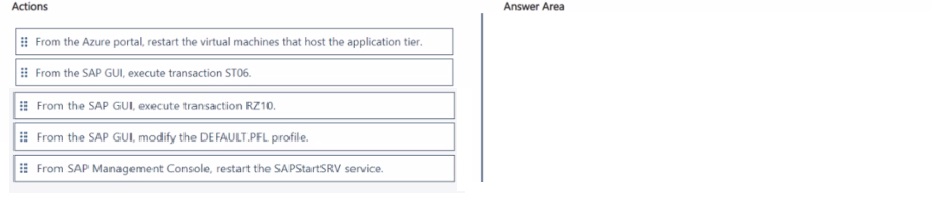
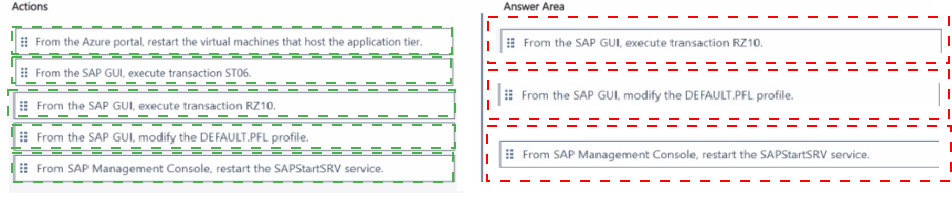
You plan to implement Azure Monitor for SAP Solutions to monitor the application tier.
You need to ensure that Azure Monitor (or SAP Solutions can access the SAPControl web service methods on the application tier. The solution must minimize application downtime.
Which three actions should you perform in sequence? To answer, move the appropriate actions from the list of actions to the answer area and arrange them in the correct order.
You have an SAP ERP Central Component (SAP ECO deployment on Azure virtual machines. The virtual machines run Windows Server 2022 and are members of an Active Directory domain named contoso.com.
You install SAP GUI on an Azure virtual machine named VM1 that runs Windows 10.
You need to ensure that contoso.com users can sign in to SAP ECC via SAP GUI on VM1 by using their domain credentials.
What should you do? To answer, drag the appropriate components to the correct tasks. Each component may be used once, more than once, or not at all. You may need to drag the split bar between panes or scroll to view content.


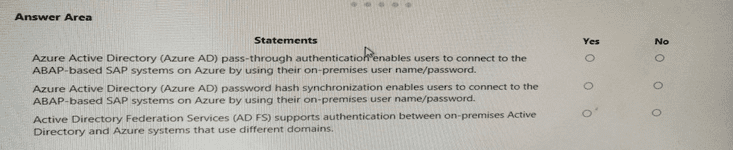
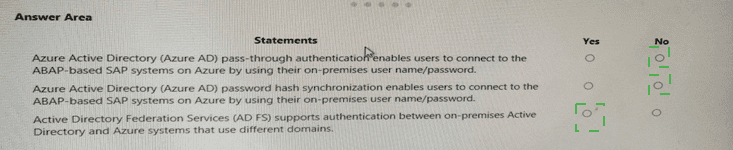
Your on-premises network contains SAP and non-SAP applications. ABAP-based SAP systems are integrated with IDAP and use user name/password-based authentication for logon.
You plan to migrate the SAP applications to Azure.
For each of the following statements, select Yes if the statement is true. Otherwise, select No. NOTE: Each correct selection is worth one point.
You plan to deploy SAP application servers that run Windows Server 2016.
You need to use PowerShell Desired State Configuration (DSC) to configure the SAP application server once
the servers are deployed.
Which Azure virtual machine extension should you install on the servers?
You have a Hyper-V virtual machine named VM1 that runs Windows Server 2019.
You plan to deploy 10 Azure virtual machines based on VM1. The virtual machines will host instances of SAP NetWeaver.
You need to create an image of VM1 for the deployment.
What should you do first?
You have an on-premises SAP landscape that contains a 20-TB IBM DB2 database. The database contains large tables that are optimized for read operations via secondary indexes.
You plan to migrate the database platform to SQL Server on Azure virtual machines.
You need to recommend a database migration approach that minimizes the time of the export stage.
What should you recommend?
You have an SAP production landscape on Azure that contains the virtual machines shown in the following table.

VM1 cannot connect to an employee self-service application hosted on VM2.
You need to identify what is causing the issue.
Which two options in Azure Network Watcher should you use? Each correct answer presents part of the solution.
NOTE: Each correct selection is worth one point
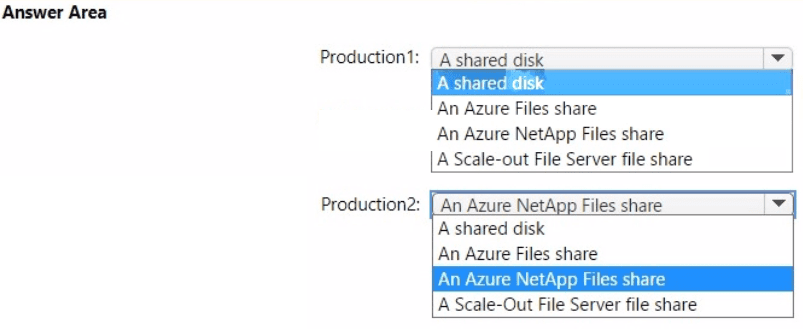
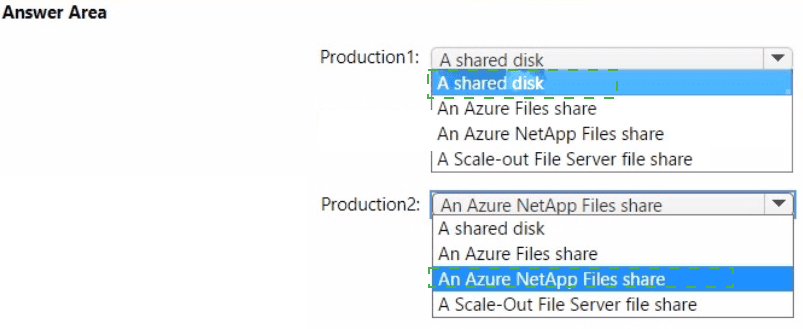
You plan to deploy two SAP NetWeaver landscapes named Production1 and Production2 to Azure. Production! will contain an SAP NetWeaver central services (ASCS/SCS) instance hosted on a Windows failover cluster. Production2 will contain an SAP ASCS/SCS instance hosted on a Linux Pacemaker cluster.
You need to recommend a shared storage solution for each landscape. The solutions must meet the following requirements:
• Minimize administrative effort.
• Minimize costs.
What should you include in the recommend? To answer, select the appropriate options in the answer area. NOTE: Each correct selection is worth one point.