

Summer Sale Special Limited Time 70% Discount Offer - Ends in 0d 00h 00m 00s - Coupon code: xmas50

Anthropic CCAR-P - Claude Certified Architect - Professional

Page: 2 / 4
Total 114 questions

You are compiling a diagnostic toolkit for Claude Code operational issues.

Which two diagnostic actions belong in the toolkit? (Select two.)

Each correct answer presents a complete solution.

A.

Increase the model sampling temperature so that intermittent issues surface more frequently for analysis.

B.

File a support ticket with vendor support before any local reproduction or evidence collection.

C.

Reproduce the issue with a minimal reproduction case that isolates one variable at a time.

D.

Roll back to the previous Claude Code version immediately to confirm whether the issue is version specific.

E.

List the configured Model Context Protocol (MCP) servers and inspect server status to identify connection failures.

A senior architect is managing stakeholder expectations for a Claude-based reporting assistant midway through development. Stakeholders have escalating concerns about response latency.

Which two actions most directly address stakeholder expectation alignment in this situation? (Select two.)

A.

Present measured p50 and p95 latency baselines against the agreed SLA thresholds so stakeholders have accurate data.

B.

Pause all development and reallocate engineering resources entirely to latency optimization.

C.

Communicate that latency concerns are a known LLM limitation and outside the architecture team’s control.

D.

Replace the current Claude model with a third-party model that may offer lower latency without evaluation.

E.

Revise the SLA definition collaboratively with stakeholders if current targets are not achievable given production constraints.

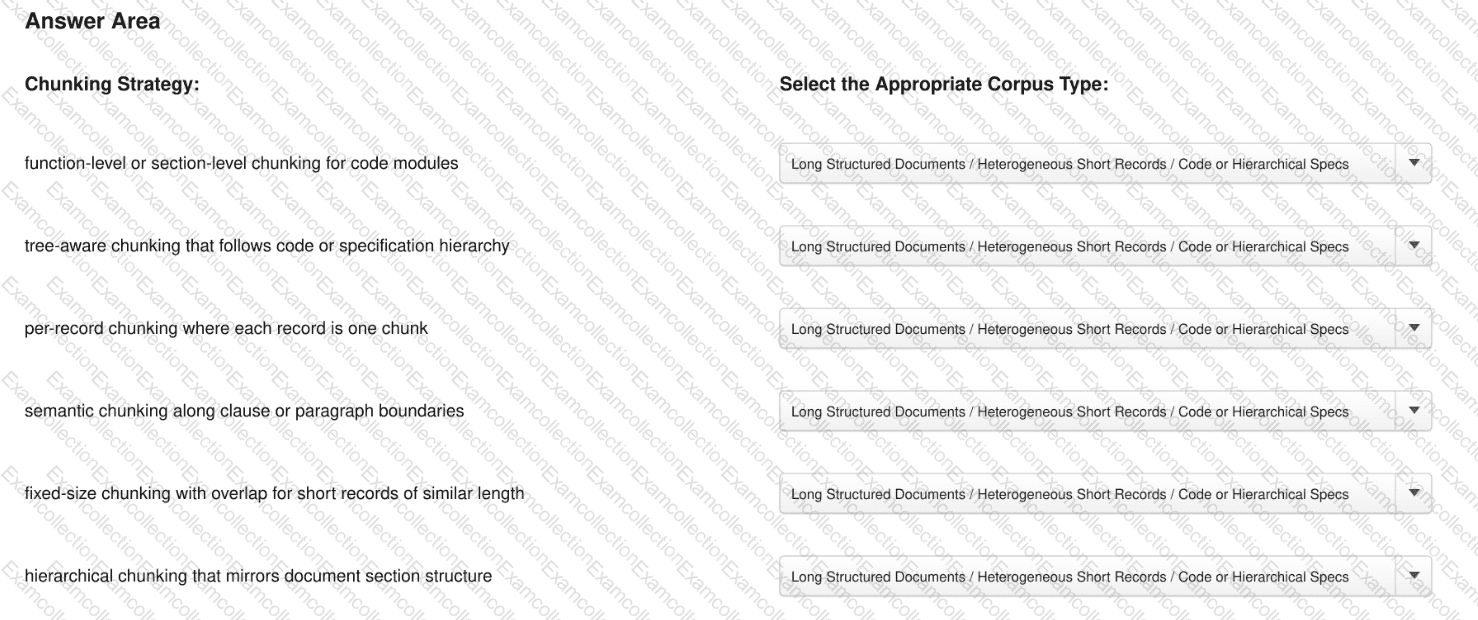
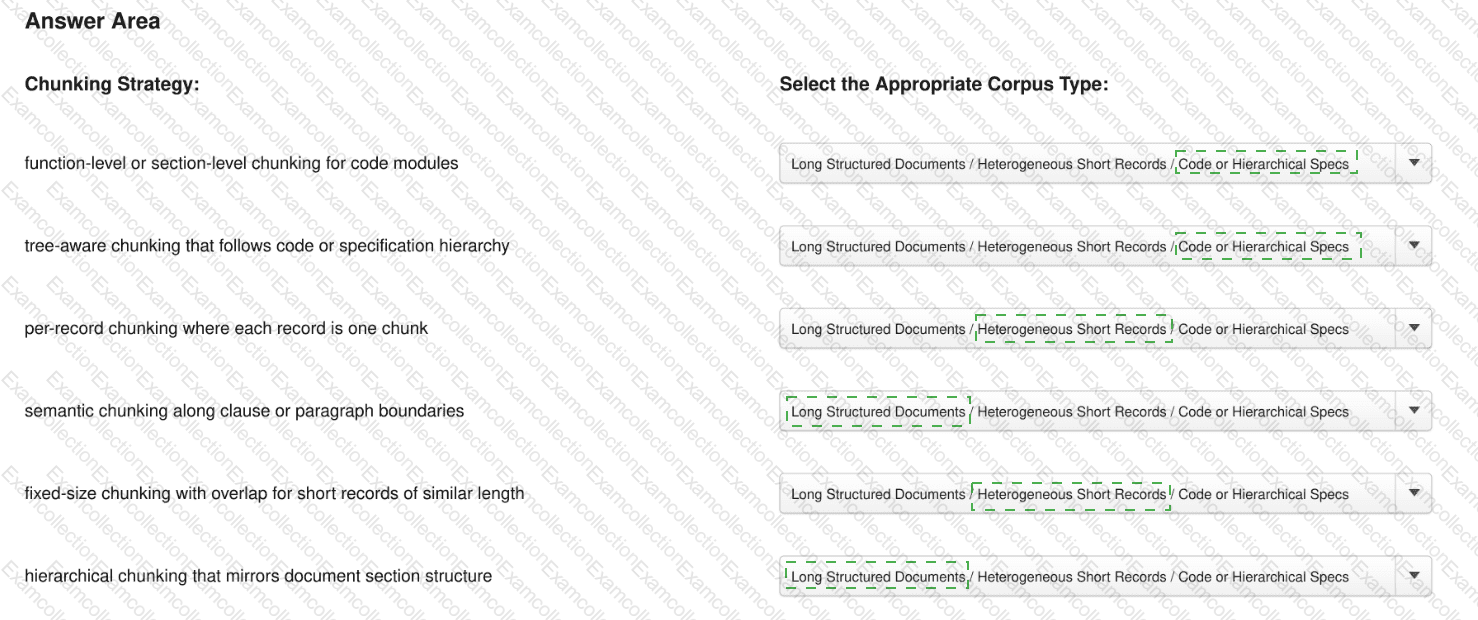
You are evaluating retrieval-strategy claims used by a peer team.

For each claim, select yes if the statement is generally accurate. Otherwise, select no.

A Claude Architect is reviewing a post-deployment performance report for an AI-assisted legal-document summarization system. The report includes these observations:

    Average summarization time decreased from 47 minutes to 6 minutes per document.

    Associates spend less time on summaries, but overall billable output has not measurably changed.

    Infrastructure costs increased by 22% because redundant retry logic generated additional API calls.

    Some summaries require attorney correction, adding an average of 8 minutes of review per document.

Which analysis correctly attributes each observation to the appropriate business-value pillar?

A.

Observations 1 and 2 both indicate efficiency gains; Observation 3 is a solution-cost issue; Observation 4 is a performance-SLA issue.

B.

Observation 1 is a transformation outcome; Observation 2 is an efficiency gain; Observation 3 is a performance-SLA degradation; Observation 4 is a solution-cost issue.

C.

Observations 1 and 4 together indicate a net performance-SLA improvement; Observation 2 is a transformation gap; Observation 3 is a productivity drain from over-engineering.

D.

Observation 1 indicates an efficiency gain; Observation 2 shows that productivity has not yet been realized; Observation 3 is a solution-cost issue; Observation 4 is an efficiency loss that partially offsets Observation 1.

You are running a controlled experiment to compare two prompts and must complete the design steps before executing the experiment.

Which two steps must be completed BEFORE running the experiment with random assignment? (Select two.)

Each correct answer presents part of the solution.

A.

Determine the minimum detectable effect size and the sample size needed for power.

B.

Decide whether to promote, reject, or iterate the candidate based on the analysis.

C.

Define the hypothesis and the primary success metric for the comparison.

D.

Analyze the results against the predefined success metric and significance threshold.

E.

Document the recommendation, the trade-offs accepted, and the alternatives considered.

You are integrating Claude Code into the team’s pull-request workflow. The team wants AI-assisted review without removing human approval.

Which integration design best fits this requirement?

A.

Claude Code reviews the pull request and posts a structured analysis as a comment, while a human reviewer retains the approval decision under the existing branch-protection rules.

B.

Claude Code merges every pull request automatically after completing its analysis, bypassing human approval and the existing branch-protection rules.

C.

Claude Code disables all existing branch-protection rules to streamline the merge process, removing human approval as a required gate.

D.

Claude Code silently deletes pull requests it assesses as low quality without posting a comment or notifying the author.

A loan pre-qualification assistant shows 94 percent approval recommendations that match the human underwriter decision. The fairness team has reviewed approval rate parity across protected groups and reported no significant difference. A board member has asked whether this evidence is sufficient to declare the assistant fair.

Which two Discernment-competency findings should you report? (Select two.)

Each correct answer presents part of the solution.

A.

Approval rate parity does not by itself assess error rate parity across protected groups.

B.

Match with human underwriters does not establish freedom from underwriter-introduced bias.

C.

The 94 percent match rate is sufficient evidence of fairness for the assistant’s decisions.

D.

The fairness team’s review process likely missed at least some of the protected groups studied.

E.

A larger sample is needed before any meaningful fairness claim can be made about the model.

You are listing characteristics of strong architectural-decision communication.

Which two characteristics belong on the list? (Select two.)

Each correct answer presents a complete solution.

A.

Ownership and review cadence for revisiting the decision when conditions or assumptions change.

B.

Distribution to a standing review forum with mandatory attendance from senior engineering leaders.

C.

Omission of rejected alternatives to keep the decision document focused and concise for readers.

D.

Alternatives considered along with the criteria that were used to evaluate each alternative.

E.

Use of a consistent template across the team to standardize the visual presentation of decisions.

A document analysis service processes legal filings averaging 80,000 tokens each. Each filing is queried by attorneys an average of 14 times during a case. The current architecture sends the full filing on every query. The CFO has asked you to reduce per-query costs while preserving response quality. The security officer requires that filing contents not be stored outside Fabrikam's tenancy.

Which optimization approach should you recommend?

A.

Summarize each filing once at intake and run all subsequent queries against the summary.

B.

Cache the filing as the prompt prefix for reuse across the 14 queries per case.

C.

Index filings in a vector store and retrieve only the relevant passages per query.

D.

Move the workload to a smaller Claude model to reduce the per-token cost paid.

You are building a feedback-and-alignment routine for a multi-stakeholder deployment.

Which two practices belong in the routine? (Select two.)

Each correct answer presents a complete solution.

A.

Record each session and distribute the recording to stakeholders who could not attend live.

B.

Escalate any disagreement among stakeholders to the executive sponsor for binding resolution.

C.

Rotate facilitation among the participating stakeholder groups to share ownership of the routine.

D.

Set a regular cadence for revisiting expectations and assumptions as conditions evolve over time.

E.

Reconcile divergent stakeholder positions explicitly rather than papering over them in the moment.