


NAHQ CPHQ - Certified Professional in Healthcare Quality Examination
The facility's compliance rate on pain assessment is shown below:
Compliance Rate on Pain Assessment
January
February
March
Physicians
40%
50%
20%
Nurses
80%
75%
83%
Physical Therapists
60%
55%
50%
To improve performance, what should be done next?
The purpose of a tracer is to:
A positive correlation Is seen in a scatter diagram when
A blood transfusion study shows:
100 patients
Transfusion time range: 2.5–5.0 hours
50% transfused within 4 hours
Which tool best displays the distribution of transfusion hours?
In a confidential reporting system, the reporter's Identity Is
Which of the following approaches to training for a new quality and performance improvement initiative is most likely to succeed based on adult learning principles?
A facility plans to provide a new specialty. Which of the following will best provide information on the effectiveness of the specialty?
Which of the following is a social determinant of health?
A root cause analysts (RCA) was conducted tor an event related to a delayed high-priority alarm response. Alarm fatigue was determined to be a root cause. Which of the following Is the most appropriate first Intervention?
An organization is shifting paradigms from top-down leadership to participatory management. The process of moving forward includes the four identified phases below:
gathering baseline data
evaluating effectiveness and improvement
making the commitment
implementing the program
Which of the following is the most logical sequence for these phases?
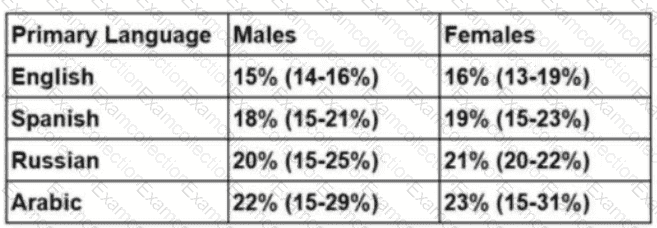
The data below shows 30-day readmission rates for heart failure patients by the primary language spoken and by gender with 95% confidence intervals in parentheses. Which group should be the priority target for reducing disparities in readmission rates?
The national benchmark for catheter-associated urinary tract infections (CAUTI) is 1.00. An organization’s rate is 1.50. When beginning a process improvement project to reduce CAUTI, what rate should be set as the goal?
The quality professional has been asked to perform chart audits on a population to assess how often hypertension is being addressed by clinicians when hypertensive patients presented to the clinic in the last year. The clinic has over 8,000 patients diagnosed with hypertension. Which of the following would be most appropriate for the quality professional to consider when selecting a sampling methodology?
Leadership has selected a team to address barriers to filling prescriptions. Prior to finalization of the charter, what necessary step must be completed?
What tool displays performance outside of expected values to merit a deeper analysis?