Pre-Summer Sale Special Limited Time 70% Discount Offer - Ends in 0d 00h 00m 00s - Coupon code: xmas50

The Beryl Institute CPXP - Certified Patient Experience Professional

Page: 2 / 5
Total 152 questions

Which BEST describes a team that has reached consensus?

A.

At least 90% of the team members totally agree with the decision.

B.

At least 90% of the team members felt included and participated in discussions, sharing their opinions about the issue.

C.

All team members are involved in the final solution and are committed to supporting the decision.

D.

All team members answer that they are happy with the decision.

Which is the MOST effective use of real-time data collection?

A.

Shaping organizational strategy

B.

Providing opportunity for immediate recognition

C.

Identifying patterns and trends for organizational change

D.

Revealing needed facility-wide improvements

During times of change, leaders need to effectively engage across what three levels of communication in order to maintain and heighten employee support?

A.

Employee relations, strategic planning, and project management

B.

Leaders, managers, and front line

C.

Providers, nurses, and allied health staff

D.

Aspirational, factual, and inspirational

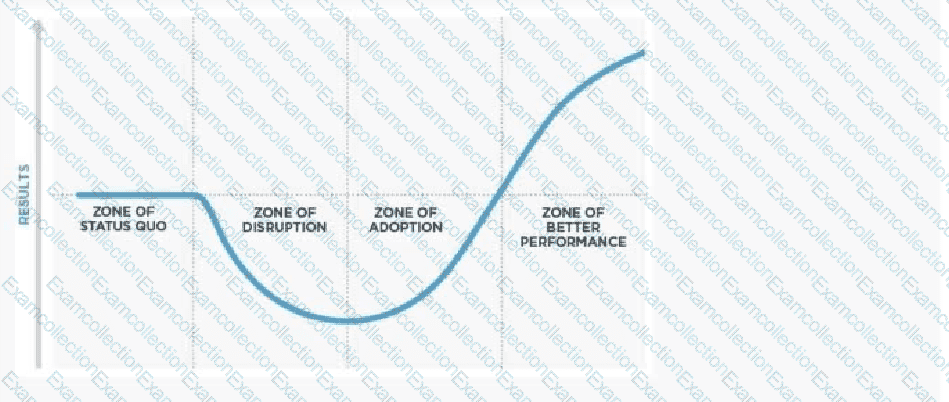
Referencing the Change Model graph below, where in these zones does “The Point of Decision” usually occur?

A.

At the midpoint of the “Zone of Status Quo”

B.

In between the “Zone of Status Quo” and “Zone of Disruption”

C.

In between the “Zone of Disruption” and “Zone of Adoption”

D.

In between the “Zone of Adoption” and “Zone of Better Performance”

Which is the BEST description of a histogram?

A.

A continuous line that represents the frequencies of scores within a class interval

B.

A visual representation of the frequency distribution where the frequencies are represented by bars

C.

A chart with categories organized vertically on the y-axis and values shown horizontally on the x-axis

D.

A chart that shows the proportion of an item that makes up a series of data points

Patient Experience Mapping identifies the ideal state defined by which of the following four dimensions of care?

A.

Patient assessment of safety, access to care, availability of information, and patient engagement

B.

Patient assessment of outcomes, physical environment, communication, and family/care partner participation

C.

Patient perceptions on quality of care, communication, physical environment, and emotional support

D.

Patient perceptions of process efficiency, access to care, patient engagement, and presence of teamwork

A non-English-speaking patient is asking questions that indicate a lack of understanding of the procedure that the patient is about to undergo. Which component of the patient ' s rights has been neglected?

A.

Respect for cultural diversity

B.

Confidentiality of personal health information

C.

Informed consent

D.

Patient’s right to file a complaint

The patient experience professional identifies experience-based co-design (EBCD) as the best approach to understand and ease growing challenges in an outpatient oncology setting. Which of the following is the BEST strategy to increase stakeholder collaboration in the process?

A.

Meet with a project manager and define tactics for an outpatient oncology action plan.

B.

Develop a series of staff and patient workshops to capture dialogue about different aspects of outpatient oncology services.

C.

Schedule exclusively in-person focus groups for current patients to redesign the process.

D.

Develop a questionnaire for patients to learn about their exam room experience in the outpatient oncology care setting.

What practice BEST demonstrates anticipating patient needs?

A.

Follow-up phone calls

B.

Bedside shift report

C.

Hourly rounding

D.

Staff huddles

An increasing number of patients and family members believe that their treatment plans are wrong. Unit leaders report high census, staffing challenges, and difficult patient behaviors. What is the FIRST step a patient experience professional should take to address this situation?

A.

Create communications training for front-line staff and physicians.

B.

Seek additional information by reaching out to patients and families to ask about their involvement in the care process.

C.

Work with unit leaders to develop and add a custom question to the patient experience survey.

D.

Seek additional information by reaching out to friends and colleagues who have been patients and ask whether they have had similar experiences.