


AAFM CWM_LEVEL_2 - Chartered Wealth Manager (CWM) Certification Level II Examination
Section B (2 Mark)
Withholding Tax Rates for payments made to Non-Residents are determined by the Finance Act passed by the Parliament for various years. The current rates for Companies are:
Section A (1 Mark)
Surender is a driver who causes injuries to a pedestrian by his rash driving. The injured victim had to spend Rs.1000 in treating his injuries. Surender ‘s act has created liabilities under:
Section A (1 Mark)
The inventory turnover ratio and days sales outstanding (DSO) are two ratios that can be used to assess how effectively the firm is managing its assets in consideration of current and projected operating levels.
Section B (2 Mark)
Ramesh living in Kolkata is a trustee for Brijesh living in Mumbai, Ramesh remits trust funds to Brijesh by bills drawn by a person of high creditworthiness in favor of the trustee as such and payable at Mumbai. The bills later got dishonored. Is Ramesh bound to make good the loss?
Section A (1 Mark)
______________is a risk whenever a decision maker commits resources to a course of action (thereby making an “investmentâ€) in the hope of achieving a positive outcome and experiences disappointing results
Section C (4 Mark)
As a CWM you are required to calculate the tax liability of an individual whose taxable income is:
• $ 81250 in SGD and he is a Singapore citizen
• £ 67158p.a (only employment)and he is a UK citizen
Section A (1 Mark)
The organizations make their special offer to the customers who will provide the highest profit margins, greatest response rate and __________.
Section C (4 Mark)
Mudra Financial is a large financial firm which owns several mutual funds. The funds are managed individually by portfolio managers but it has an investment committee that overseas all of the funds. This committee is responsible for evaluating the performance of the funds relative to the appropriate benchmark and relative to stated investment objectives of each individual fund. During a recent investment committee meeting, the poor performance of Its Equity Funds were discussed. In particular, the inability of the portfolio managers to outperform their benchmarks was highlighted. The net conclusion of the committee was to review the performance of the manager responsible for each fund and dismiss those managers whose performance had lagged substantially behind the appropriate benchmark.
The fund with the worst relative performance is the Mudra Large Cap Fund which invests in large cap stocks. A review of the operations of the fund found the following:
• The turnover of the fund was almost double that of other similar style mutual funds
• The fund’s portfolio manager solicited input from her entire staff prior to making any decision to sell an existing holding
• The beta of the Mudra Large Cap Fund’s portfolio was 65% higher than the beta of other similar style mutual funds
• The portfolio manager refuses to increase the Capital Goods sector weighting because of past losses the fund incurred in the sector
• The portfolio manager sold all the fund’s Oil Marketing Companies stocks as the price per barrel of oil rose above $105. He expects oil prices to fall back to the $80 to $85 per barrel
• No stock is considered for purchase in the Large Cap Fund unless the portfolio manager has 10 years of financial information on that company.
The underweighting of the Capital Goods sector and selling off Oil Marketing Stocks could be best described as an example of:
Section C (4 Mark)
Rhona has a daughter Zena five years old. She wants to plan for Zena’s education and has found out that she would be requiring 2,75,000 at her age 18 and another 4,50,000 on her age 25. She also wants to have Rs. 10,00,000 for Zena’s Marriage which she expects at the age of 28. She wants to deposit the entire amount for these expenses today in an account that pays a ROI of 15% per annum compounded annually. What would this amount be?
Section A (1 Mark)
Which one of the following statements is false?
Section A (1 Mark)
Income accruing in Sri Lanka and received there is taxable in India in case of
Section B (2 Mark)
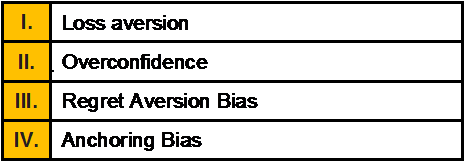
Which of the following two outcomes is an example of Loss Aversion Bias:

Section B (2 Mark)
The Wilson Corporation has the following relationships:
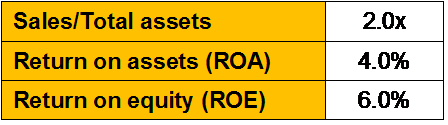
What is Wilson’s profit margin and debt ratio?
Section A (1 Mark)
In US which of the following does not count as an itemized deduction on income tax?
Section A (1 Mark)
Which of the following comes at the high end of product margin in the value added pyramid of wealth management?
Section B (2 Mark)
The Sachdeva family includes a financially well-informed couple, both aged thirty-two, and two children aged four and six. They are financially sound, but were not in the market during the bull market of the 2003 to 2007 as many of their neighbors were. The couple’s total income, Rs.12,00,000 which is not expected to grow significantly. They have saved Rs.15,00,000, which they hope will be the financial foundation from which they will send their children to college and retire comfortably. The Sachdeva’s suffer from:
Section B (2 Mark)
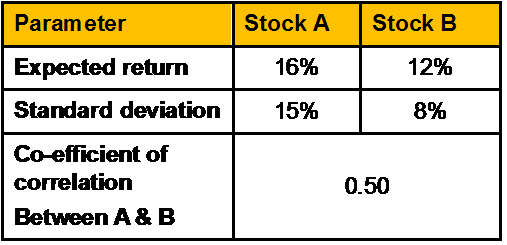
From the following data calculate the covariance between stock A and stock B
Section B (2 Mark)
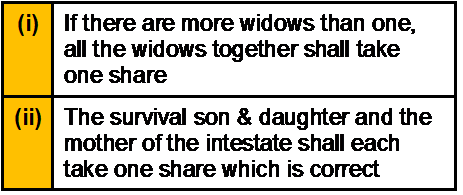
Which one of the following statements is/are correct?
Section C (4 Mark)
Blair Company has Rs5 million in total assets. The company’s assets are financed with Rs1 million of debt, and Rs4 million of common equity. The company’s income statement is summarized below:
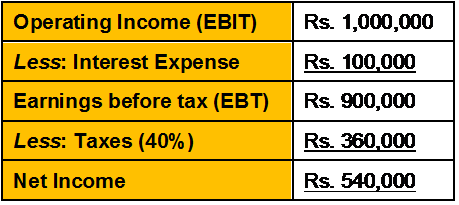
The company wants to increase its assets by Rs1 million, and it plans to finance this increase by issuing Rs1 million in new debt. This action will double the company’s interest expense, but its operating income will remain at 20 percent of its total assets, and its average tax rate will remain at 40 percent. If the company takes this action, which of the following will occur?
Section A (1 Mark)
Wealth Erosion can happen due to _______
Section A (1 Mark)
The best way to maintain your credit rating is to:
Section B (2 Mark)
The assumptions concerning the shape of utility functions of investors differ between conventional theory and prospect theory. Conventional theory assumes that utility functions are __________ whereas prospect theory assumes that utility functions are __________.
Section B (2 Mark)
Why do share prices usually drop when news about decline in a company’s earnings per share is reported?
Section B (2 Mark)
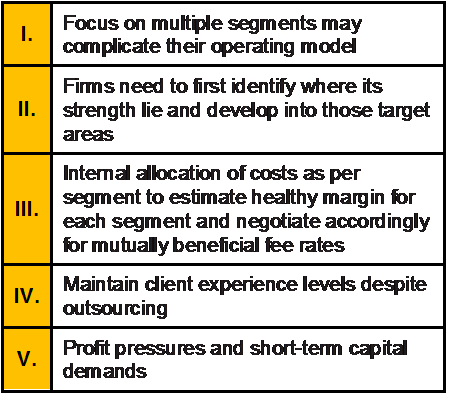
Which of the following is/are the Potential Challenges for wealth management players in India:
Section A (1 Mark)
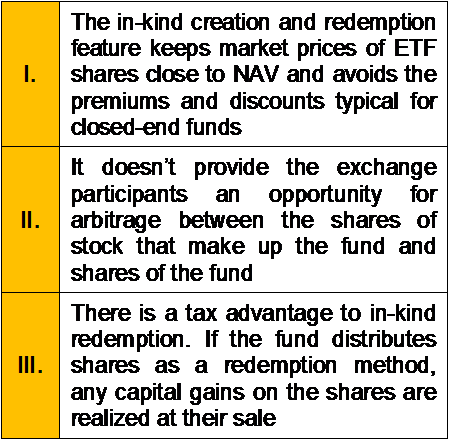
Which of the following is not a Key Benefit of the In-kind process used by the ETFs?
Section A (1 Mark)
A ____________________ tax system places a relatively large tax burden on lower-income people and a relatively small tax burden on upper-income people.
Section A (1 Mark)
Which of the following is not true with respect to H model of equity valuation?
Section A (1 Mark)
A “Family Office†segment client has investible assets worth of
Section C (4 Mark)
Read the senario and answer to the question.
You have reviewed the investments of Nimita for the purview of retirement. You advise that a balance be restored from risk perspective and accordingly Rs. 15 lakh be shifted to a Debt MF scheme. You advise to further start SIPs immediately in the ratio of 60:40 in the newly started debt MF scheme and the existing Equity MF scheme for the next 21 years to accumulate a corpus so that the same sustains for the next 25 years if invested in an investment instrument yielding 7.50%. What approximate amount of SIPs should be made in Debt and Equity MF schemes?
Section A (1 Mark)
Garima deposits Rs. 2,000/- every month in an account and is getting interest @ 12 % per annum compounded monthly. How much will be her nest egg after 10 years ?
Section C (4 Mark)
Read the senario and answer to the question.
Nimita wants to know if she were to meet with an accident and get permanent disability in the third year of her Term Insurance policy, what amount of the premium due in the fourth year would be payable by her if the premium being paid towards the policy is Rs. 15,000 with sum assured of Rs. 50 lakh?
Section B (2 Mark)
An assessee was allowed deduction of unrealized rent to the extent of Rs. 40,000 in the past although the total unrealized rent was Rs. 60,000. He is able to recover from the tenant Rs.45,000 during the previous year on account of such unrealized rent. He shall be liable to tax to the extent of:
Section A (1 Mark)
An appealing feature of options on futures contracts is that:
Section A (1 Mark)
The critical variable in the determination of the success of the active portfolio is ________.
Section B (2 Mark)
Resident but not ordinary resident (RNOR) is ____________ on Indian Income and ___________ on Foreign Income.
Section A (1 Mark)
As per ARTICLE 12 in DTTA with US , the maximum tax rate on the gross amount of the royalties or fees for included services in the Article is:
Section A (1 Mark)
Which of the following act is done by the most dissatisfied customers?
Section B (2 Mark)
Mr. A gifted debenture of Rs. 100000 to his wife. She received Rs. 10000 interest which she reinvests and earns Rs. 1000. This Rs. 1000 will be taxable in the hands of
Section B (2 Mark)
An investment opportunity having a market price of Rs. 100,000 is available. You could obtain a Rs. 75,000, 25-year mortgage loan requiring equal monthly payments with interest at 9.5 percent. The following operating results are expected during the first year.
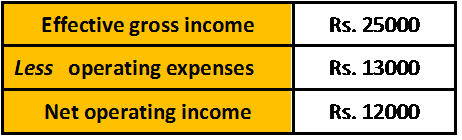
What is the Overall capitalization rate?
Section B (2 Mark)
If one earns 10% on investment but inflation is 2%, real rate of return is
Section C (4 Mark)
Assume the following;
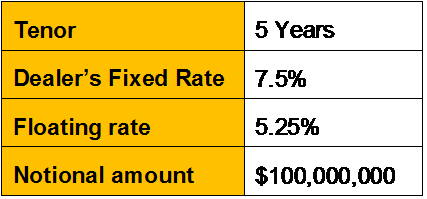
With this agreement, every 6 months, the transfer of funds takes place between fixed rate payer and floating rate payer.
What would Net Cash flows after 6-months from the initiation date?
Section B (2 Mark)
_____________ begins with the price at which a product that has been purchased from an Associated Enterprise AE is resold to an independent enterprise
Section B (2 Mark)
In order to determine the residential status of an NRI returning to India for permanent settlement, for the year of return, besides the stay not exceeding 181 days an additional condition is applicable that of stay not totalling to____________ days or more in relevant year if his stay in earlier ___________ years totaled to 365 days or more.
Section C (4 Mark)
Ms. Sonali Briganza is 22 years old. She is currently earning a salary of Rs.5,00,000/- per annum and saves 20% of her salary every year. If her salary increases by 10% every year and she is able to get a return of 11% p.a. compounded annually throughout her investment horizon what would be the corpus of funds available at her age 58.
Section C (4 Mark)
Data on following mutual funds is given below:

Risk free return is 8%. Calculate Sharpe measure.
Section C (4 Mark)
OHM Corporation, an environmental service provider, had revenues of Rs209 million in 1992 and reported losses of Rs3.1 million. It had earnings before interest and taxes of Rs12.5 million in 1992, and had debt outstanding of Rs109 million (in market value terms). There are 15.9 million shares outstanding, trading at Rs11 per share. The pre-tax interest rate on debt owed by the firm is 8.5%, and the stock has a beta of 1.15. The firm's EBIT is expected to increase 10% a year from 1993 to 1996, after which the growth rate is expected to drop to 4% in the long term. Capital expenditures will be offset by depreciation, and working capital needs are negligible. (The corporate tax rate is 40%, and the Risk free rate is 7%.)
Estimate the value of the firm.
Section B (2 Mark)
A dealer sold one January Nifty futures contract for Rs.250,000 on 15th January. Each Nifty futures contract is for delivery of 50 Nifties. On 25th January, the index closed at 5100. How much profit/loss did he make ?
Section B (2 Mark)
Mr. Aggarwal is working in a reputed company and earning Rs. 4,50,000/- p.a. and is now 55 years old. He has invested Rs. 2,00,000/- in an annuity which will pay him after 5 years a certain amount p.a. at the beginning of every year for 10 years. Rate of interest is 8% p.a. Calculate how much he will receive at the beginning of every year after 5 years?
Section A (1 Mark)
______________are bonds issued by governments that pledge their "full faith and credit," including tax revenues, to repayment in US.
Section C (4 Mark)
You purchased a call option for Rs3.45 seventeen days ago. The call has a strike price of Rs45 and the stock is now trading for Rs51. If you exercise the call today, what will be your holding period return? If you do not exercise the call today and it expires, what will be your holding period return?