


Black Friday Rush: 80% Off All Exam Bundles! Apply the coupon code below before the offer expires! - Ends in 0d 00h 00m 00s - Coupon code: 24HR80

Amazon Web Services DVA-C03 - AWS Certified Developer - Associate

Page: 5 / 11
Total 543 questions

When a developer tries to run an AWS Code Build project, it raises an error because the length of all environment variables exceeds the limit for the combined maximum of characters.

What is the recommended solution?

A.

Add the export LC-_ALL " on _ US, tuft " command to the pre _ build section to ensure POSIX Localization.

B.

Use Amazon Cognate to store key-value pairs for large numbers of environment variables

C.

Update the settings for the build project to use an Amazon S3 bucket for large numbers of environment variables

D.

Use AWS Systems Manager Parameter Store to store large numbers ot environment variables

An application is using Amazon Cognito user pools and identity pools for secure access. A developer wants to integrate the user-specific file upload and download features in the application with Amazon S3. The developer must ensure that the files are saved and retrieved in a secure manner and that users can access only their own files. The file sizes range from 3 KB to 300 MB.

Which option will meet these requirements with the HIGHEST level of security?

A.

Use S3 Event Notifications to validate the file upload and download requests and update the user interface (UI).

B.

Save the details of the uploaded files in a separate Amazon DynamoDB table. Filter the list of files in the user interface (UI) by comparing the current user ID with the user ID associated with the file in the table.

C.

Use Amazon API Gateway and an AWS Lambda function to upload and download files. Validate each request in the Lambda function before performing the requested operation.

D.

Use an IAM policy within the Amazon Cognito identity prefix to restrict users to use their own folders in Amazon S3.

A financial company must store original customer records for 10 years for legal reasons. A complete record contains personally identifiable information (PII). According to local regulations, PII is available to only certain people in the company and must not be shared with third parties. The company needs to make the records available to third-party organizations for statistical analysis without sharing the PII.

A developer wants to store the original immutable record in Amazon S3. Depending on who accesses the S3 document, the document should be returned as is or with all the PII removed. The developer has written an AWS Lambda function to remove the PII from the document. The function is named removePii.

What should the developer do so that the company can meet the PII requirements while maintaining only one copy of the document?

A.

Set up an S3 event notification that invokes the removePii function when an S3 GET request is made. Call Amazon S3 by using a GET request to access the object without PII.

B.

Set up an S3 event notification that invokes the removePii function when an S3 PUT request is made. Call Amazon S3 by using a PUT request to access the object without PII.

C.

Create an S3 Object Lambda access point from the S3 console. Select the removePii function. Use S3 Access Points to access the object without PII.

D.

Create an S3 access point from the S3 console. Use the access point name to call the GetObjectLegalHold S3 API function. Pass in the removePii function name to access the object without PII.

A developer is testing a new file storage application that uses an Amazon CloudFront distribution to serve content from an Amazon S3 bucket. The distribution accesses the S3 bucket by using an origin access identity (OAI). The S3 bucket ' s permissions explicitly deny access to all other users.

The application prompts users to authenticate on a login page and then uses signed cookies to allow users to access their personal storage directories. The developer has configured the distribution to use its default cache behavior with restricted viewer access and has set the origin to point to the S3 bucket. However, when the developer tries to navigate to the login page, the developer receives a 403 Forbidden error.

The developer needs to implement a solution to allow unauthenticated access to the login page. The solution also must keep all private content secure.

Which solution will meet these requirements?

A.

Add a second cache behavior to the distribution with the same origin as the default cache behavior. Set the path pattern for the second cache behavior to the path of the login page, and make viewer access unrestricted. Keep the default cache behavior ' s settings unchanged.

B.

Add a second cache behavior to the distribution with the same origin as the default cache behavior. Set the path pattern for the second cache behavior to *, and make viewer access restricted. Change the default cache behavior ' s path pattern to the path of the login page, and make viewer access unrestricted.

C.

Add a second origin as a failover origin to the default cache behavior. Point the failover origin to the S3 bucket. Set the path pattern for the primary origin to *, and make viewer access restricted. Set the path pattern for the failover origin to the path of the login page, and make viewer access unrestricted.

D.

Add a bucket policy to the S3 bucket to allow read access. Set the resource on the policy to the Amazon Resource Name (ARN) of the login page object in the S3 bucket. Add a CloudFront function to the default cache behavior to redirect unauthorized requests to the login page ' s S3 URL.

A developer is using an AWS CloudFormation template to create a pipeline in AWS CodePipeline. The template creates an Amazon S3 bucket that the pipeline references in a source stage. The template also creates an AWS CodeBuild project for a build stage. The pipeline sends notifications to an Amazon SNS topic. Logs for the CodeBuild project are stored in Amazon CloudWatch Logs.

The company needs to ensure that the pipeline ' s artifacts are encrypted with an existing customer-managed AWS KMS key. The developer has granted the pipeline permissions to use the KMS key.

Which additional step will meet these requirements?

A.

Create an Amazon S3 gateway endpoint that the pipeline can access.

B.

In the CloudFormation template, use the KMS key to encrypt the logs in CloudWatch Logs.

C.

Apply an S3 bucket policy that ensures the pipeline sends only encrypted objects to the S3 bucket.

D.

Configure the notification topic to use the existing KMS key to enable encryption with the existing KMS key.

A developer is building a new application on AWS. The application uses an AWS Lambda function that retrieves information from an Amazon DynamoDB table. The developer hardcoded the DynamoDB table name into the Lambda function code. The table name might change over time. The developer does not want to modify the Lambda code if the table name changes.

Which solution will meet these requirements MOST efficiently?

A.

Create a Lambda environment variable to store the table name. Use the standard method for the programming language to retrieve the variable.

B.

Store the table name in a file. Store the file in the /tmp folder. Use the SDK for the programming language to retrieve the table name.

C.

Create a file to store the table name. Zip the file and upload the file to the Lambda layer. Use the SDK for the programming language to retrieve the table name.

D.

Create a global variable that is outside the handler in the Lambda function to store the table name.

An application is processing clickstream data using Amazon Kinesis. The clickstream data feed into Kinesis experiences periodic spikes. The PutRecords API call occasionally fails and the logs show that the failed call returns the response shown below:
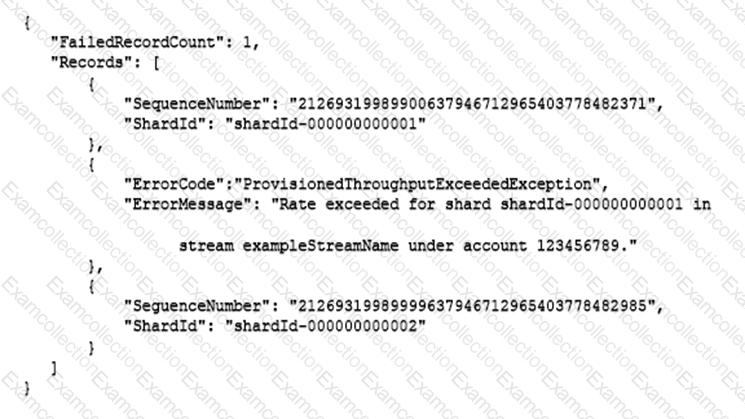
Which techniques will help mitigate this exception? (Choose two.)

A.

Implement retries with exponential backoff.

B.

Use a PutRecord API instead of PutRecords.

C.

Reduce the frequency and/or size of the requests.

D.

Use Amazon SNS instead of Kinesis.

E.

Reduce the number of KCL consumers.

A developer is creating an AWS Lambda function that searches for items from an Amazon DynamoDB table that contains customer contact information. The DynamoDB table items have the customer ' s email_address as the partition key and additional properties such as customer_type, name, and job_title.

The Lambda function runs whenever a user types a new character into the customer_type text input. The developer wants the search to return partial matches of the email_address property for a particular customer_type value. The developer does not want to recreate the DynamoDB table.

What should the developer do to meet these requirements?

A.

Add a global secondary index (GSI) to the DynamoDB table with customer_type as the partition key and email_address as the sort key. Perform a query operation on the GSI by using the begins_with key condition expression with the email_address property.

B.

Add a global secondary index (GSI) to the DynamoDB table with email_address as the partition key and customer_type as the sort key. Perform a query operation on the GSI by using the begins_with key condition expression with the email_address property.

C.

Add a local secondary index (LSI) to the DynamoDB table with customer_type as the partition key and email_address as the sort key. Perform a query operation on the LSI by using the begins_with key condition expression with the email_address property.

D.

Add a local secondary index (LSI) to the DynamoDB table with job_title as the partition key and email_address as the sort key. Perform a query operation on the LSI by using the begins_with key condition expression with the email_address property.

A developer previously deployed an AWS Lambda function as a .zip package. The developer needs to deploy the Lambda function as a container.

A.

Create an Amazon ECR repository in the same AWS Region as the Lambda function. Package the Lambda function into a container image. Build the image and upload it to the Amazon ECR repository. Update the existing Lambda function configuration to specify the repository URI and container image tag.

B.

Create an AWS SAM template that defines the Lambda function and its resources as code. Include a container image in the template, and store the container image in an Amazon S3 bucket. Deploy the AWS SAM template. Specify the S3 bucket URI.

C.

Create an AWS CloudFormation template that defines the Lambda function and its resources as code. Include a container image in the template, and store the image in an Amazon S3 bucket. Deploy the CloudFormation template. Specify the S3 bucket URI.

D.

Create an Amazon ECR repository in the same AWS Region as the Lambda function. Build the image and upload it to the Amazon ECR repository. Update the existing Lambda function to use the new image by specifying the repository URI.

A developer maintains a critical business application that uses Amazon DynamoDB as the primary data store The DynamoDB table contains millions of documents and receives 30-60 requests each minute The developer needs to perform processing in near-real time on the documents when they are added or updated in the DynamoDB table

How can the developer implement this feature with the LEAST amount of change to the existing application code?

A.

Set up a cron job on an Amazon EC2 instance Run a script every hour to query the table for changes and process the documents

B.

Enable a DynamoDB stream on the table Invoke an AWS Lambda function to process the documents.

C.

Update the application to send a PutEvents request to Amazon EventBridge. Create an EventBridge rule to invoke an AWS Lambda function to process the documents.

D.

Update the application to synchronously process the documents directly after the DynamoDB write

When using the AWS Encryption SDK how does the developer keep track of the data encryption keys used to encrypt data?

A.

The developer must manually keep Hack of the data encryption keys used for each data object.

B.

The SDK encrypts the data encryption key and stores it (encrypted) as part of the resumed ophertext.

C.

The SDK stores the data encryption keys automaticity in Amazon S3.

D.

The data encryption key is stored m the user data for the EC2 instance.

A large company has its application components distributed across multiple AWS accounts. The company needs to collect and visualize trace data across these accounts.

What should be used to meet these requirements?

A.

AWS X-Ray

B.

Amazon CloudWatch

C.

Amazon VPC flow logs

D.

Amazon OpenSearch Service

A developer is creating an AWS CloudFormation template to deploy Amazon EC2 instances across multiple AWS accounts. The developer must choose the EC2 instances from a list of approved instance types.

How can the developer incorporate the list of approved instance types in the CloudFormation template?

A.

Create a separate CloudFormation template for each EC2 instance type in the list.

B.

In the Resources section of the CloudFormation template, create resources for each EC2 instance type in the list.

C.

In the CloudFormation template, create a separate parameter for each EC2 instance type in the list.

D.

In the CloudFormation template, create a parameter with the list of EC2 instance types as AllowedValues.

An Amazon Simple Queue Service (Amazon SQS) queue serves as an event source for an AWS Lambda function In the SQS queue, each item corresponds to a video file that the Lambda function must convert to a smaller resolution The Lambda function is timing out on longer video files, but the Lambda function ' s timeout is already configured to its maximum value

What should a developer do to avoid the timeouts without additional code changes ' ?

A.

Increase the memory configuration of the Lambda function

B.

Increase the visibility timeout on the SQS queue

C.

Increase the instance size of the host that runs the Lambda function.

D.

Use multi-threading for the conversion.

A data visualization company wants to strengthen the security of its core applications The applications are deployed on AWS across its development staging, pre-production, and production environments. The company needs to encrypt all of its stored sensitive credentials The sensitive credentials need to be automatically rotated Aversion of the sensitive credentials need to be stored for each environment

Which solution will meet these requirements in the MOST operationally efficient way?

A.

Configure AWS Secrets Manager versions to store different copies of the same credentials across multiple environments

B.

Create a new parameter version in AWS Systems Manager Parameter Store for each environment Store the environment-specific credentials in the parameter version.

C.

Configure the environment variables in the application code Use different names for each environment type

D.

Configure AWS Secrets Manager to create a new secret for each environment type. Store the environment-specific credentials in the secret