


CIMA F3 - Financial Strategy
Companies A, B, C and D:
   • are based in a country that uses the K$ as its currency. Â
   • have an objective to grow operating profit year on year.
   • have the same total levels of revenue and cost.
   • trade with companies or individuals in the eurozone.  All import and export trade with companies or individuals in the eurozone is priced in EUR. Â
Typical import/export trade for each company in a year are as follows:
  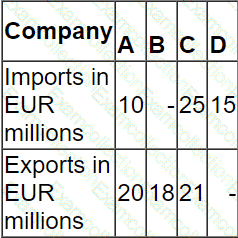
 Which company's growth objective is most sensitive to a movement in the EUR/K$ exchange rate?
A company is based in Country Y whose functional currency is Y$. It has an investment in Country Z whose functional currency is Z$.
This year the company expects to generate Z$ 10 million profit after tax.
Tax Regime:
   • Corporate income tax rate in country Y is 50%
   • Corporate income tax rate in country Z is 20%
   • Full double tax relief is available
Assume an exchange rate of Y$ 1 = Z$ 5.
Â
What is the expected profit after tax in Y$ if the Z$ profit is remitted to Country Y?
Extracts from a company's profit forecast for the next financial year as follows:
  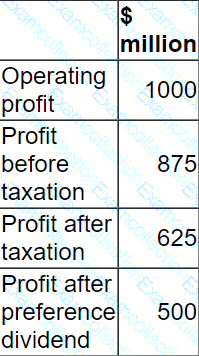
Since preparing the forecast, the company has decided to return surplus cash to shareholders by a share repurchase arrangement.
The share repurchase would result in the company purchasing 20% of the 1,250 million ordinary shares currently in issue and canceling them.
Â
Assuming the share repurchase went ahead, the impact on the company's forecast earnings per share will be an increase of:
A profitable company wishes to dispose of a loss-making division that generated negative free cashflow in the last financial year.
The division requires significant new investment to return it to profitability.
Â
Which of the following valuation approaches is likely to be the most useful to the company when negotiating the sales price?
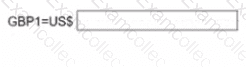
D has US$10 million to invest over 12 months in either USS or GBP Its options are to invest in USS at the present USS interest rate of 10 18%. or to convert the USS to GBP at the spot rate GBP1 =US$1 61 and invest in GBP at an interest rate of 6.4%.
According to the interest rate parity theory, what will the one year forward rate be?
Give your answer to three decimal places.
Company S is planning to acquire Company T.
The shareholders in Company T will receive new shares in Company S in an all-share consideration.
Â
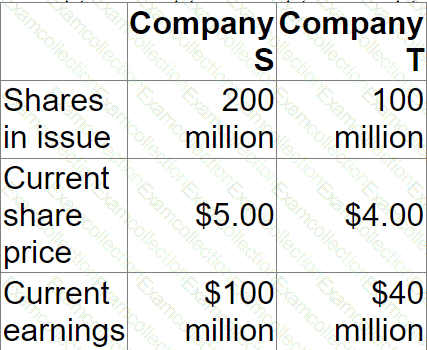
Relevant information:
Â
Â
The shareholders in Company T want sufficient shares to receive a 25% premium on the pre-acquisition value of their shares, based on the pre-acquisition share price.
Â
Which of the following share-for-share offers will achieve the desired result?
A company has a financial objective of maintaining a gearing ratio of between 30% and 40%, where gearing is defined as debt/equity at market values.Â
The company has been affected by a recent economic downturn leading to a shortage of liquidity and a fall in the share price during 20X1.
Â
On 31 December 20X1 the company was funded by:
•   Share capital of 4 million $1 shares trading at $4.0 per share.
•   Debt of $7 million floating rate borrowings.
Â
The directors plan to raise $2 million additional borrowings in order to improve liquidity. Â
They expect this to reassure investors about the company's liquidity position and result in a rise in the share price to $4.2 per share.
Â
Is the planned increase in borrowings expected to help the company meet its gearing objective?
A large multi-divisional company in the food processing and distribution business is conducting a strategic review. Â The divisions all compete in the same market.
Â
The sale of one of its underperforming food processing divisions to the divisional management team is currently being considered. The purchase by the divisional management team will require venture capital finance.
Â
Which THREE of the following are likely to influence the multi-divisional company's decision on whether or not to sell the under-performing division to the management team?
A venture capitalist invests in a company by means of buying:
   • 9 million shares for $2 a share and
   • 8% bonds with a nominal value of $2 million, repayable at par in 3 years' time.Â
The venture capitalist expects a return on the equity portion of the investment of at least 20% a year on a compound basis over the first 3 years of the investment.
Â
The company has 10 million shares in issue.
Â
What is the minimum total equity value for the company in 3 years' time required to satisify the venture capitalist's expected return?
Â
Give your answer to the nearest $ million.
Â
$Â Â million. Â Â
Â
Which of the following would be a reason for a company to adopt a low dividend pay-out policy?
