


Pre-Summer Sale Special Limited Time 70% Discount Offer - Ends in 0d 00h 00m 00s - Coupon code: xmas50

IIA IIA-CIA-Part3 - Internal Audit Function

Page: 9 / 11
Total 514 questions

An organization has an immediate need for servers, but no time to complete capital acquisitions. Which of the following cloud services would assist with this situation?

A.

Infrastructure as a Service (laaS).

B.

Platform as a Service (PaaS).

C.

Enterprise as a Service (EaaS).

D.

Software as a Service (SaaS).

Which of the following IT disaster recovery plans includes a remote site dessgnated for recovery with available space for basic services, such as internet and

telecommunications, but does not have servers or infrastructure equipment?

A.

Frozen site

B.

Cold site

C.

Warm site

D.

Hot site

Which of the following best explains why an organization would enter into a capital lease contract?

A.

To increase the ability to borrow additional funds from creditors

B.

To reduce the organization's free cash flow from operations

C.

To Improve the organization's free cash flow from operations

D.

To acquire the asset at the end of the lease period at a price lower than the fair market value

A new manager received computations of the internal rate of return regarding his project proposal. What should the manager compare the computation results to in order to determine whether the project is potentially acceptable?

A.

Compare to the annual cost of capital.

B.

Compare to the annual interest rate.

C.

Compare to the required rate of return.

D.

Compare to the net present value.

Which of the following situations best illustrates a "false positive" in the performance of a spam filter?

A.

The spam filter removed Incoming communication that included certain keywords and domains.

B.

The spam filter deleted commercial ads automatically, as they were recognized as unwanted.

C.

The spam filter routed to the "junk|r folder a newsletter that appeared to include links to fake websites.

D.

The spam filter blocked a fitness club gift card that coworkers sent to an employee for her birthday.

When auditing the account receivables for the first time, an internal auditor noted that the finance team had not—over many accounting periods—reviewed the accounts receivables for debts that could no longer be collected. How should the auditor proceed?

A.

Escalate the finding to the board, due to the significance of the risk

B.

Recommend that management review the receivables for debts that can no longer be collected and remove them from the cash flow statement

C.

Recommend that management review the receivables for debts that can no longer be collected and write them off

D.

Document the finding and conclude that no immediate action is warranted, as bad debt allowances are merely estimates

An organization requires an average of 58 days to convert raw materials into finished products to sell. An additional 42 days is required to collect receivables. If the organization takes an average of 10 days to pay for raw materials, how long is its total cash conversion cycle?

A.

26 days.

B.

90 days.

C.

100 days.

D.

110 days.

Which of the following is a distinguishing feature of managerial accounting, which is not applicable to financial accounting?

A.

Managerial accounting uses double-entry accounting and cost data.

B.

Managerial accounting uses general accepted accounting principles.

C.

Managerial accounting involves decision making based on quantifiable economic events.

D.

Managerial accounting involves decision making based on predetermined standards.

Which of the following statements is true regarding a bring-your-own-device (BYOD) environment?

A.

There is a greater need for organizations to rely on users to comply with policies and procedures.

B.

With fewer devices owned by the organization, there is reduced need to maintain documented policies and procedures.

C.

Incident response times are less critical in the BYOD environment compared to a traditional environment.

D.

There is greater sharing of operational risk in a BYOD environment.

Upon completing a follow-up audit engagement, the chief audit executive (CAE) noted that management has not implemented any mitigation measures to address the high risks that were reported in the initial audit report. What initial step must the CAE take to address this situation?

A.

Communicate the issue to senior management

B.

Discuss the issue with members of management responsible for the risk area

C.

Report the situation to the external auditors

D.

Escalate the issue to the board

An organization uses the management-by-objectives method whereby employee performance is based on defined goals. Which of the following statements is true regarding this approach?

A.

It is particularly helpful to management when the organization is facing rapid change.

B.

It is a more successful approach when adopted by mechanistic organizations.

C.

It is mere successful when goal setting is performed not only by management, but by all team members, including lower-level staff.

D.

It is particularly successful in environments that are prone to having poor employer-employee relations.

As it relates to the data analytics process, which of the following best describes the purpose of an internal auditor who cleaned and normalized data?

A.

The auditor eliminated duplicate information

B.

The auditor organized data to minimize useless information

C.

The auditor made data usable for a specific purpose by ensuring that anomalies were identified and addressed

D.

The auditor ensured data fields were consistent and that data could be used for a specific purpose

The chief audit executive (CAE) identified an unacceptable risk and believes that the risk is not being mitigated to an acceptable level. Which of the following is the CAE's next step in this situation?

A.

Escalate the concern to senior management

B.

Send a letter to responsible management and provide a deadline to accept the risk

C.

Escalate the concern to the board

D.

Discuss the issue with the members of responsible management

Management decides to accept the risk on a significant audit observation related to the organization's exposure to fraud risk. The chief audit executive considers the finding to have a high residual risk. Which of the following steps should be performed last?

A.

Gather risk appetite data

B.

Inform the internal legal counsel

C.

Inform the board

D.

Consult with the organization's regulators

An internal auditor found the following information while reviewing the monthly financial siatements for a wholesaler of safety
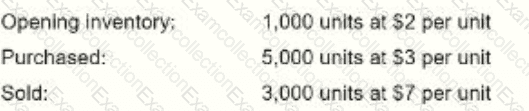
The cost of goods sold was reported at $8,500. Which of the following inventory methods was used to derive this value?

A.

Average cost method

B.

First-in, first-out (FIFO) method

C.

Specific identification method

D.

Activity-based costing method