


Nutanix NCP-CN - Nutanix Certified Professional - Cloud Native (NCP-CN-6.10)
A Platform Engineer would like to deploy an NKP Platform Application to all the clusters within an NKP workspace from the command line. What is the command set to use, and what parameters must be specified with it?
A Platform Engineer is deploying a new NKP cluster that has internet connectivity. Now, a Cloud Administrator and Security Administrator are discussing the security of communications between the NKP Kubernetes cluster and the container registry. The engineer proposes to have an on-prem private registry.
What is the most significant reason that the engineer should create a private registry instead of configuring a secure connection between the NKP cluster and Github (SaaS)?
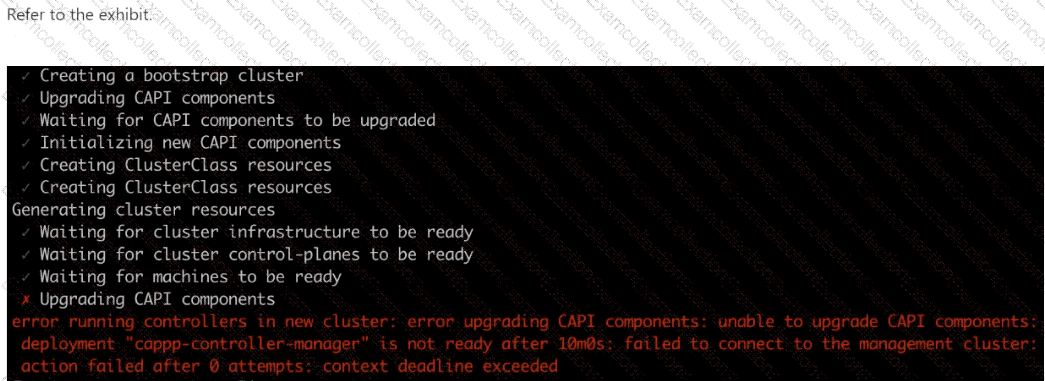
An administrator is provisioning an NKP cluster. After the VM creation task, the error shown in the exhibit is produced.
What could be the reason?
NKP cluster nodes require a disk for some of its deployed components, outside of an application’s persistent volume requirements. What are these components and where are they deployed?
A company recently deployed NKP. A Platform Engineer was asked to attach the existing Amazon EKS. A workspace and project were created accordingly, and resource requirements were met. What does the engineer need to do first to prepare the EKS clusters?
An infrastructure team has configured a Backup Storage Location on an existing AWS bucket and created a backup named testbackup. What command can the team use to view the backup?
Prior to implementing NKP, a company had created a number of Kubernetes (K8s) clusters using kubeadm. While they are deploying new managed clusters via NKP, the company does not wish to migrate workloads from these pre-existing native K8s clusters over to new NKP clusters just yet.
What are the requirements to have these clusters attached to their NKP management cluster?
A Cloud Engineer is deploying an NKP Cluster in AWS. The environment is for testing purposes only, so the AWS team has requested it be deployed to use a minimal set of system resources to reduce cloud subscription fees. Which two parameters should be specified when initializing a Kommander installation, using the nkp install kommander command set? (Choose two.)
A company has been modernizing on cloud-native platforms for the past few years and has been running some small consumer support utilities on their production NKP cluster. After a thorough testing and QA cycle with simulated workloads on a development cluster, the company is ready to bring their online retail application into the fold. While they have sufficient system resources to scale the NKP cluster properly from a performance standpoint, they also want to ensure they properly scale their monitoring stack’s resource settings to retain a sufficient amount of data to see how overall system resource utilization trends for the NKP cluster over several months’ time with the added workloads. Which NKP Platform Application component should the company be most concerned with adjusting, and how should their Platform Engineer adjust it?
After a finished project, three Kubernetes clusters within a workspace were deleted, so the workspace is empty. Now a Platform Engineer needs to delete the workspace. How should the engineer delete the workspace in NKP?