


Nutanix NCP-US - Nutanix Certified Professional – Unified Storage (NCP-US) v6 exam
What happens to an FSVM during a node failure in a 3-node cluster?
An administrator has been asked to create a new user account for an auditor during an audit event. The auditor will write data to a Files share,forconfidentiality reasons, the auditors tasks should be not analyzed by the system.
How should the administrator configure File Analytics to accomplish this task?
Refer the exhibit.
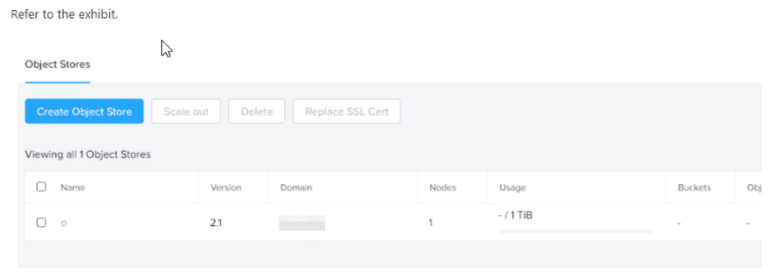
An administrator is experiencing the following Objects failure error message:
IAM Service is not healthy.
The Object Store Domain entries appear grayed out in the user Interface, as shown in the exhibit.
Which commands should the administrator execute to identify the failure source?
When deploying Nutanix unified Storage Objects. which two protocols are supported? (Choose two.)
Which action will improve the performance of a database server storage using Volumes that is experiencing persistent slow queries?
An existing Objects bucket was created for backups with these parameters:
A)WORM policy of three years
B)Versioning policy of two years
C)Lifecycle policy of two years
The customer reports that the cluster is nearly full due to backups created during a recent crypto locker attack. The customer would like to automatically delete backups older than one year to free up space in the cluster.
How should the administrator change settings within Objects?
An administratorreceivea warning message concerning a file server hosted in a 3-node cluster. On the Files Console Dashboard tab, the file server displays a warning to recommend performance optimization,
How should the administrator resolve this issue?
A company's IT security policy requires that all network traffic must be secure, and no web browser certificate error warnings should be accepted by end users.
An administrator is tasked with configuring Objects so that it uses a certificate from an internal Certificate Authority (CA),
How should the administrator configure Objects to meet the security policy?
An administrator has received multiple trouble tickets from users who are unable to access a particular Distributed share.
While troubleshooting, the administrator observes that data located on FSVM 3 can be accessed, but the data located on FSVMs 1 and 2 is inaccessible. The administrator receives this message when attempting to access data on FSVMs 1 and 2:
Network object not found
Both FSVM 1 and 2 nodes successfully reply to pings, and the administrator is able to access data via the node IP.
What must the administrator check as a next step?
An administrator is increasing the read performance for Splunk at their remote site, which uses Objects at the primary site for SmartStore capability. Read latency is extremely high due to WAN traversal for data,
What should the administrator do to remediate this problem?