


Netapp NS0-527 - NetApp Certified Implementation Engineer - Data Protection
A client has two regional offices that use SnapMirror cross-site replication to host disaster-recovery mirrors for both offices. Aco-worker at one office is requesting read/write access to one of the volume mirrors. You must accomplish this task without interrupting data access or replication.
In this scenario. how should you proceed?
A customer has deployed OnCommand Unified Manager and wants to use it to manage their data protection relationships within their NetApp storage infrastructure.
In this scenario, which additional component must be deployed to satisfy this requirement?
For DR purposes, data must be replicated between on-premises clusters and multiple public clouds. In this scenario, which solution would simplify management?
Which two types of volumes support NDMP backup? (Choose two.)
A customer has ONTAP 9.5 clusters running at two nearby locations. The customer wants a zero RPO for one mission-critical volume.
In thisscenario, which two NetApp solutions satisfy this requirement while using the existing ONTAP clusters? (Choose two.)
You have set up a SnapMirror relationshipbetween two SVMs for data protection. The data in the source volume is unavailable due to an event related to a virus infection leading to data corruption.
In this scenario, which three actions are required to activate the SnapMirror destination volume and provide data access to the users? (Choose three.)
A company just installed SnapCenter to help manage their ONTAP 9.7 environment. The database administrator wants to add new volumes withLUNs for a 10 TB Oracle database.
Which two tools would accomplish this task? (Choose two.)
You are upgrading your Data ONTAP cluster from clustered Data ONTAP 8.3 to clustered Data ONTAP 9.1. Which two actions must be performed for the SnapMirror relationships?
(Choose two.)
Click the Exhibit button.
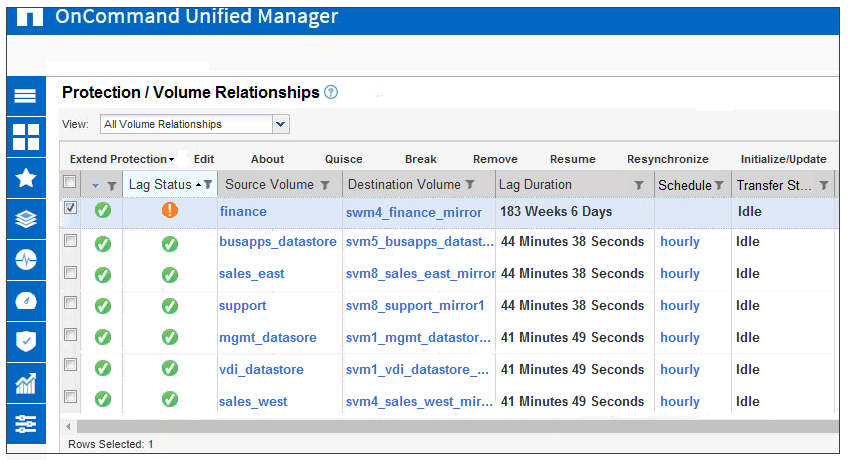
You have been receiving the lag status error notifications shown in the exhibit.
What must you do to correctthis problem?
Acompany has a 4-node FAS9000 fabric MetroCluster cluster separated by 101 km. Site A has an unmirrored HDD aggregate. An FC-VI card fails in one of the nodes in site A and a switchover occurs.
Which statement is correct in this scenario?