

Month End Sale Special Limited Time 70% Discount Offer - Ends in 0d 00h 00m 00s - Coupon code: xmas50

Fortinet NSE5_SSE_AD-7.6 - Fortinet NSE 5 - FortiSASE and SD-WAN 7.6 Core Administrator

Page: 1 / 1
Total 35 questions

Which three factors about SLA targets and SD-WAN rules should you consider when configuring SD-WAN rules? (Choose three answers)

A.

When configuring an SD-WAN rule, you can select multiple SLA targets from different performance SLAs.

B.

SLA targets are used only by SD-WAN rules that are configured with a Lowest Cost (SLA) strategy.

C.

Member metrics are measured only if a rule uses the SLA target.

D.

SD-WAN rules can use SLA targets to check whether the preferred members meet the SLA requirements.

E.

When configuring an SD-WAN rule, you can select multiple SLA targets if they are from the same performance SLA.

Which two statements correctly describe what happens when traffic matches the implicit SD-WAN rule? (Choose two answers)

A.

Traffic is load balanced using the algorithm set for the v4-ecmp-mode setting.

B.

Traffic does not match any of the entries in the policy route table.

C.

FortiGate flags the session with may_dirty and vwl_default.

D.

The traffic is distributed, regardless of weight, through all available static routes.

E.

The session information output displays no SD-WAN service id.

An existing Fortinet SD-WAN customer who has recently deployed FortiSASE wants to have a comprehensive view of, and combined reports for, both SD-WAN branches and remote users. How can the customer achieve this?

A.

Forward the logs from FortiSASE to Fortinet SOCaaS.

B.

Forward the logs from FortiGate to FortiSASE.

C.

Forward the logs from FortiSASE to the external FortiAnalyzer.

D.

Forward the logs from the external SD-WAN FortiAnalyzer to FortiSASE.

An SD-WAN member is no longer used to steer SD-WAN traffic. You want to update the SD-WAN configuration and delete the unused member.

Which action should you take first? (Choose one answer)

A.

Move the SD-WAN member to the virtual-wan-link zone.

B.

Disable the interface.

C.

Remove the member from the performance service-level agreement (SLA) definitions.

D.

Delete static route definitions for that interface.

You have a FortiGate configuration with three user-defined SD-WAN zones and one or two members in each of these zones. One SD-WAN member is no longer used in health-check and SD-WAN rules. This member is the only member of its zone. You want to delete it.

What happens if you delete the SD-WAN member from the FortiGate GUI?

A.

FortiGate displays an error message. SD-WAN zones must contain at least one member.

B.

FortiGate accepts the deletion and removes static routes as required.

C.

FortiGate accepts the deletion with no further action.

D.

FortiGate accepts the deletion and places the member in the default SD-WAN zone.

Which secure internet access (SIA) use case minimizes individual endpoint configuration? (Choose one answer)

A.

Agentless remote user internet access

B.

SIA for FortiClient agent remote users

C.

Site-based remote user internet access

D.

SIA using ZTNA

How does the FortiSASE security dashboard facilitate vulnerability management for FortiClient endpoints? (Choose one answer)

A.

It automatically patches all vulnerabilities without user intervention and does not categorize vulnerabilities by severity.

B.

It shows vulnerabilities only for applications and requires endpoint users to manually check for affected endpoints.

C.

It displays only critical vulnerabilities, requires manual patching for all endpoints, and does not allow viewing of affected endpoints.

D.

It provides a vulnerability summary, identifies affected endpoints, and supports automatic patching for eligible vulnerabilities.

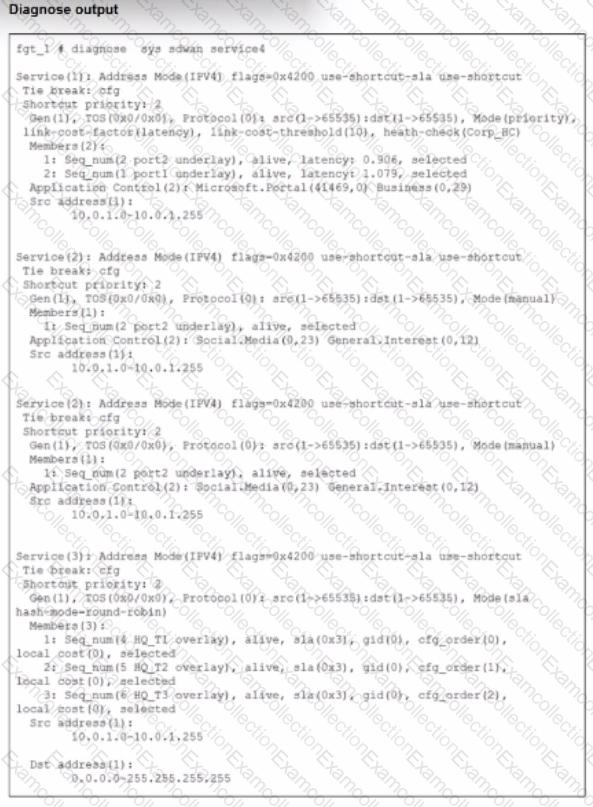
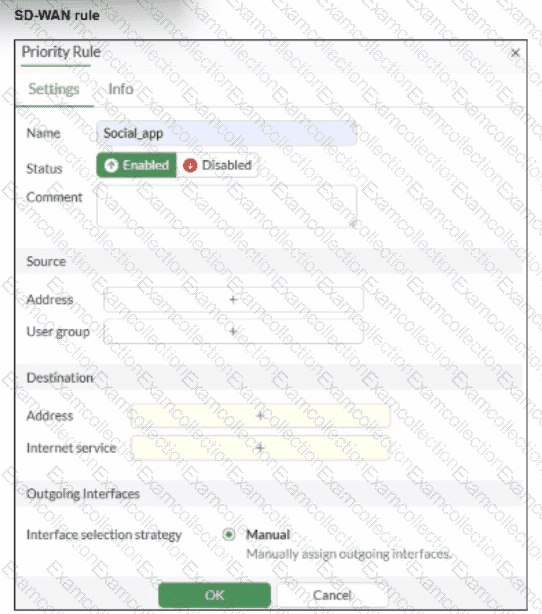
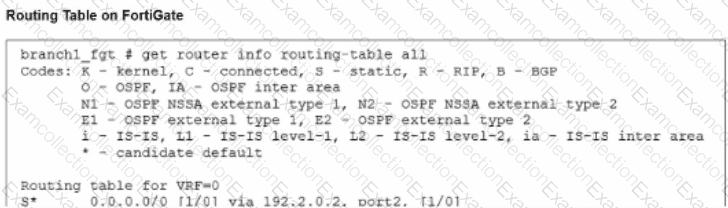
Refer to the exhibits.

The administrator increases the member priority on port2 to 20. Upon configuration changes and the receipt of new packets, which two actions does FortiGate perform on existing sessions established over port2? (Choose two.)

A.

FortiGate updates the gateway information of the sessions with SNAT so that they use port1 instead of port2.

B.

FortiGate flags the SNAT session as dirty only if the administrator has assigned an IP pool to the firewall policies with NAT.

C.

FortiGate routes only new sessions over port1.

D.

FortiGate continues routing all existing sessions over port2.

E.

FortiGate flags the sessions as dirty.

A FortiGate device is in production. To optimize WAN link use and improve redundancy, you enable and configure SD-WAN.

What must you do as part of this configuration update process? (Choose one answer)

A.

Replace references to interfaces used as SD-WAN members in the firewall policies.

B.

Replace references to interfaces used as SD-WAN members in the routing configuration.

C.

Disable the interface that you want to use as an SD-WAN member.

D.

Purchase and install the SD-WAN license, and reboot the FortiGate device.

An administrator is troubleshooting SD-WAN on FortiGate. A device behind branch1_fgt generates traffic to the 10.0.0.0/8 network. The administrator expects the traffic to match SD-WAN rule ID 1 and be routed over HUB1-VPN1. However, the traffic is routed over HUB1-VPN3.

Based on the output shown in the exhibit, which two reasons, individually or together, could explain the observed behavior? (Choose two.)

A.

HUB1-VPN1 does not have a valid route to the destination.

B.

HUB1-VPN3 has a higher member configuration priority than HUB1-VPN1.

C.

HUB1-VPN3 has a lower route priority value (higher priority) than HUB1-VPN1.

D.

The traffic matches a regular policy route configured with HUB1-VPN3 as the outgoing device.