


Cisco 300-610 - Designing Cisco Data Center Infrastructure for Traditional and AI Workloads v1.2 (DCID 300-610)
A customer needs a design for a new data center network that meets these requirements:
Logically partition the environment into separate security domains.
Cut costs related to purchasing additional equipment.
Separate routing processes, TCAM, QoS tables, and data planes.
Which technology must be used?
An engineer must connect an existing Cisco Fabric Interconnect to an IP-based storage array. The connection be a channel made directly between the fabric interconnect expansion module and the storage array. The engineer must also consider that the environment is running FCoE for storage and uses QoS to prioritize traffic. Which port type should be used to meet these requirements?
An engineer configured the OSPF protocol in the vPC topology. During the catastrophic failure of one of the vPC the member switches, the traffic was routed to a black hole. This route was caused by the long convergence time caused by the delay of the of the vPC member switch reboot. After the failure, the engineer rebooted both switches, but the secondary switch powered on before the primary one. It caused all the vPCs to be shut down due to consistency-check violations. Which two features must be used to prevent these situations from happening in the future? (Choose two.)

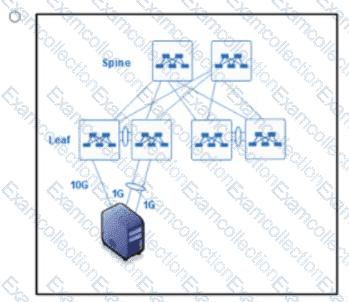
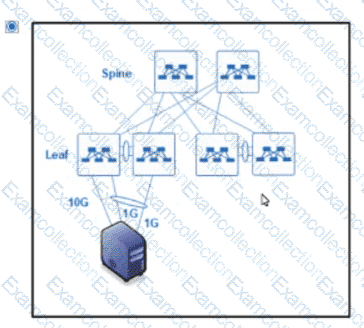
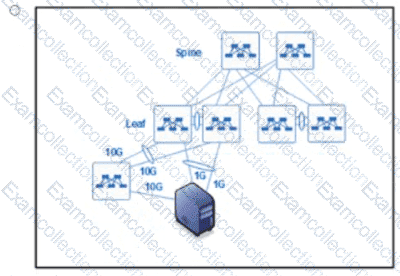
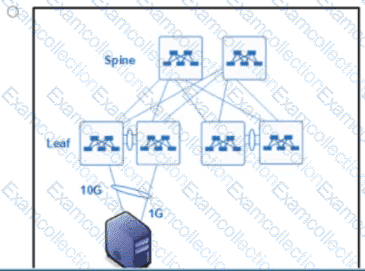
A network engineer is connecting a backup server to the network shown. The server has three available physical Ethernet interfaces: two 1-Gbps interfaces and one 10-Gbps interface. All devices support virtual port channels (vPCs). The engineer must minimize backup time, eliminate any single point of failure in the server’s data-center connectivity, and configure the interfaces in an active/passive arrangement. Which deployment model must the engineer use?
Which programming model is vendor-agnostic and combines operational and configuration data in the same container?
An engineer is experiencing performance issues on a cisco UCS blade server. The B-series blade server contains four CPUs, most of which are idle. The engineer notices that the CPU is suffering from too many requests sent by the NIC. Additionally, the number of queues appears to be insufficient and only a single CPU is processing the network traffic. Which policy must be used to alleviate these issues?
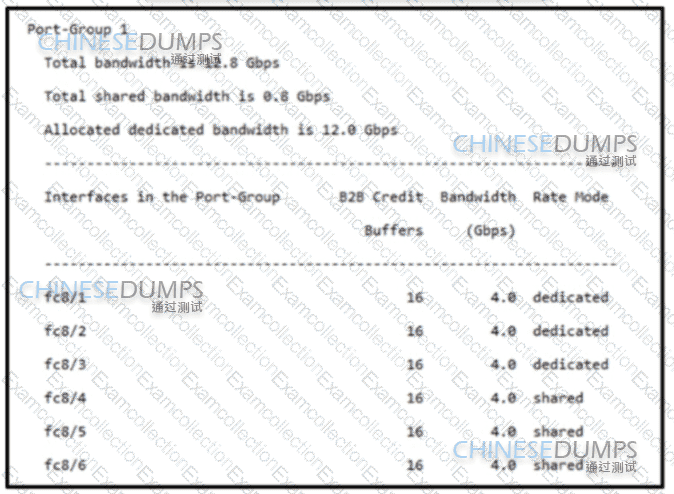
Refer to the exhibit. A Cisco engineer is configuring a customer scenario with 2 x MDS 9000 switches 24 x UCS B200M6 blade servers. UCS 64S4 Fabric Interconnect in end-host mode and 3 x UCS 5108 server chassis with 2408 Fabric Extenders The engineer installs 6 x SQL Server 2019 on all blades and then notices that there are read and write latencies What is the best way to balance the utilization across the shared ports?
Refer to the exhibit.
The security team created a new security policy that requires certain types of traffic to be subject to deep packet inspection The traffic types are
•internet traffic to application servers
•internet traffic to corporate users
•partner network traffic to application servers
•partner network traffic to corporate users
Where must the next-generation firewalls be inserted to implement the new policy?
A Cisco engineer is analyzing a customer environment where dozens of VMs are running on a physical server and UCS chassis are cascaded The setup uses two ISLs in a port channel to the SAN switch (per fabric) The oversubscription from VM to physical SAN port is often 20 (VMs/host) x 72 (9 UCS chassis cascaded = 72 hosts): 2 (ISLs from fabric interconnect to SAN switch port on the NPV core (NPIV enabled switch) This results to 20 x 72 2 per single ISL = 720 VMs per ISL
20 (VMs per host) x 8 (hosts per chassis) x 9 (chassis per port channel to SAN switch) / 2 (ISLs per port channel) = 20 x 8 x 9 / 2 = 720 VMs per SAN F-port What is the best way to resolve possible IOPS bottleneck?
Refer to the exhibit.
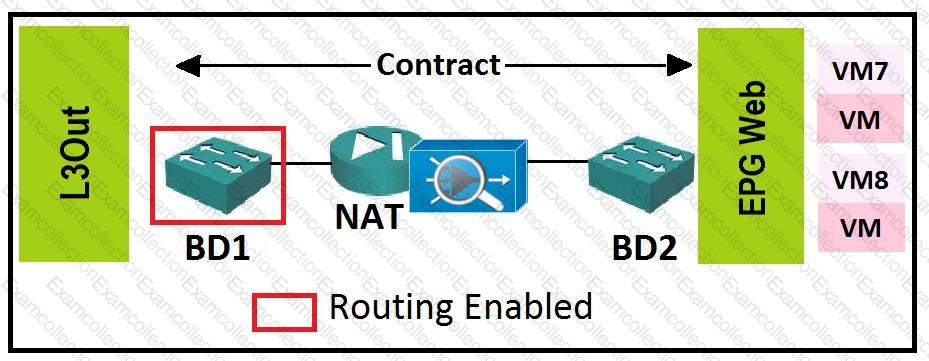
What must be the default gateway of the servers in EPG Web?