

VMware 3V0-23.25 - Advanced VMware Cloud Foundation 9.0 Storage
A financial organization successfully deployed a new Workload Domain in VMware Cloud Foundation (VCF) using NFS storage. All ESX hosts are commissioned and connected to the same storage network. The system administrator is tasked to configure a new NFS datastore in the existing cluster.
Which two steps are correct? (Choose two.)
An agency is designing its secure private cloud on VMware Cloud Foundation with the following requirements:
• Strict data segregation between the management and workload domains.
• Company policy prevents using vSAN as a storage solution.
• Data encryption at rest is mandatory for both the management and workload domains.
• Data encryption in transit is mandatory for the workload domains.
• Data-at-rest encryption must be performed by the storage array and not rely on VMware native or vSAN-specific mechanisms.
• Allow for automated VM placement, operational integrity with VCF Operations, and assurance that file-based workloads scale efficiently.
Which storage architecture fulfills these technical and regulatory requirements?
A VMware Cloud Foundation (VCF) environment runs mixed workloads (Online Transaction Processing (OLTP) + analytics), with the following vSAN configuration:
• 8 hosts (all-flash), ESA enabled.
• Each host: 2 x 3.2 TB NVMe devices.
• Compression is Enabled.
• Checksum is Enabled.
• Storage Policy: FTT=1 (RAID-5/6), Failures to Tolerate = 1 and Object Space Reservation = 0%.
During peak OLTP load, vSAN resync I/O and backend congestion increase latency despite having sufficient network bandwidth.
What is the direct action the administrator can perform to improve write performance while maintaining data protection compliance?
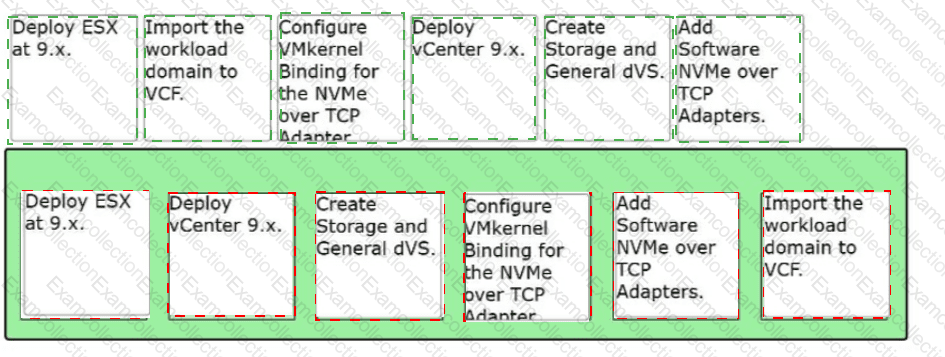
A VMware Cloud Foundation (VCF) Workload Domain is requested to be deployed with the following information:
. 6 blade style hosts with no local storage beyond the operating system.
. 4 25 Gb networking cards installed in each host.
. A 30 TB external array configured to support NVMe/TCP only.
. 2 dVS switches, one configured for storage isolation and one for all other traffic.
. NVMe/TCP multi-path configuration required.
. Existing Management Domain is deployed with VCF.
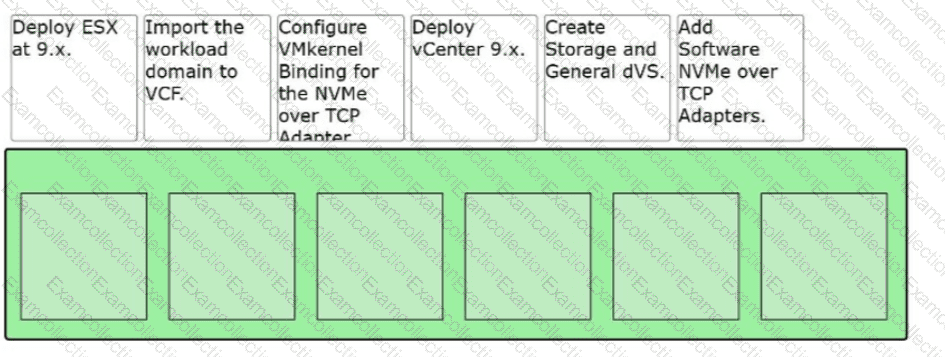
Place the steps for importing VCF on to this configuration.
An administrator is tasked designing a vSAN storage solution while respecting the following requirements:
• Must use vSAN ESA
• Must be stretched between two data centers
• Must configure Failures to tolerate = 1
• Must configure Erasure Coding
How many components per Virtual Machine (VM) will be created?
An administrator has been tasked with modifying an existing vSAN File Services deployment which uses Active Directory for Kerberos authentication.
Select three settings which can be modified after initially configuring the vSAN File Services. (Choose three.)
A multinational corporation is deploying a VMware Cloud Foundation (VCF) Workload Domain cluster to host tier-1 business applications with the following requirements:
• Deliver high performance to all workloads.
• Integration with automated VM placement.
• Reuse of existing infrastructure including multiple Fibre Channel (FC) arrays partitioned by business unit.
• The storage architecture must avoid vSAN.
• Meet organizational separation requirements.
Which two deployment approaches meet these requirements? (Choose two.)
An administrator has been tasked with making changes to a VMware Cloud Foundation (VCF) Workload Domain cluster that is configured with NFS for both Principal storage and Supplemental storage.
The cluster has the following configuration:
• There are 3 x ESX host servers.
• There are 3 x NFS Datastores allocated to host Virtual Machines workloads.
• There is a single NFS Datastore allocated for hosting ISO files.
The administrator has the following concerns with the existing configuration:
• Every time a new Virtual Machine is deployed to the Workload Domain, the administrator must choose which datastore should be used.
• When reviewing the Datastores in VCF Operations:
One of the datastores has no Virtual Machines running in it.
The other two datastores have an imbalance of Virtual Machines and this is causing resource contention. The administrator has the following requirements: • Virtual Machines must be placed automatically on the most appropriate datastore based on utilization. • Migration recommendations on Virtual Machine placement should be made when one datastore reaches 50% utilization. • Virtual Machines must only be migrated to another datastore after being approved by an administrator. What four actions must the administrator take to meet all of the requirements? (Choose four.)
A customer attaches an external Fibre Channel (FC) VMFS datastore to a VMware Cloud Foundation (VCF) workload domain for backup staging. The administrator must confirm that the datastore is visible to all hosts, and that path and device health alarms will trigger should a fabric link or path fail.
Which action should the administrator take to verify this?
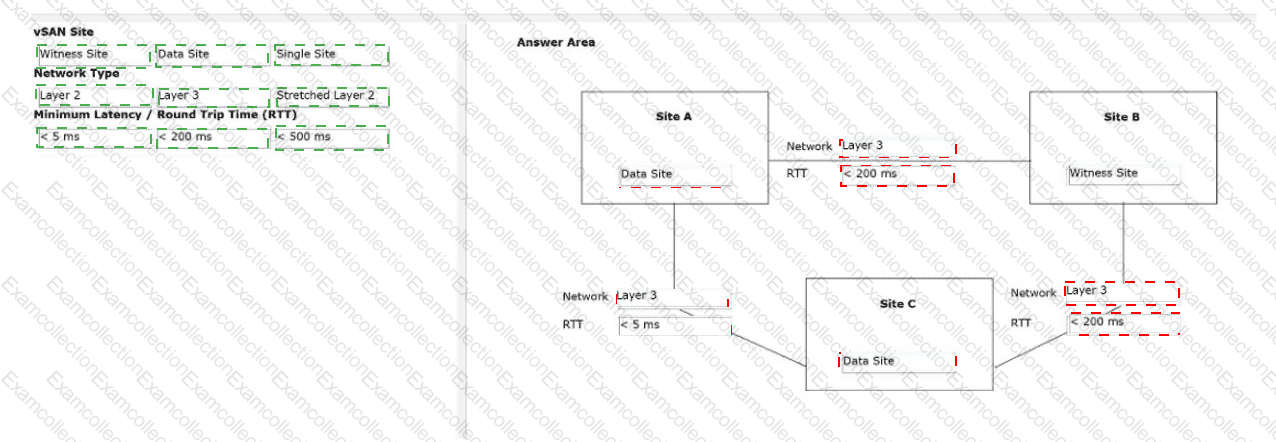
An administrator is responsible for managing a VMware Cloud Foundation (VCF) Private Cloud.
The following information has been provided about the environment:
• There are 3 customer datacenters, Site A, Site B and Site C.
• The datacenter at Site A runs all Production Services.
• The datacenter at Site B has reached capacity and there is no space for additional physical hardware.
• The datacenter at Site C has been commissioned to replace Site B, because there is more rack space and power capacity to cater for future demand.
The administrator has been tasked with identifying the networking requirements for a new VMware vSAN Stretched Cluster with the following requirements:
• The solution will deploy a total of 10 new ESX host servers to create a VMware vSAN Stretched Cluster.
• The solution must deploy appropriate networking to ensure minimal disruption from issues with Spanning Tree Protocol (STP).
Drag and drop the correct vSAN Site Type, Networking Type and Round Trip Latency (RTT) within the boxes provided to complete the high-level diagram.