


VMware 3V0-23.25 - Advanced VMware Cloud Foundation 9.0 Storage
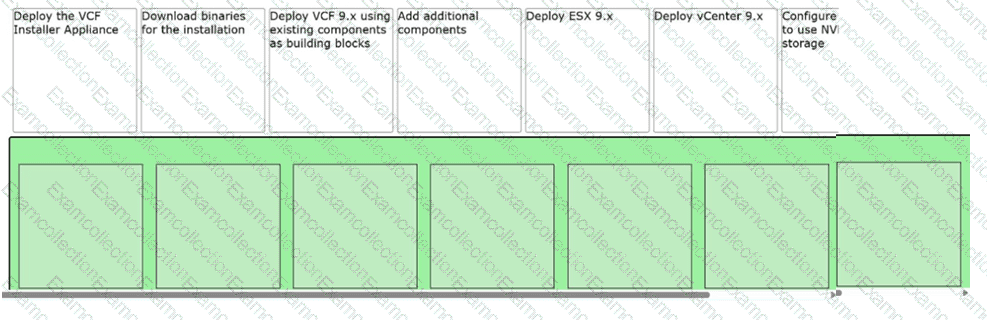
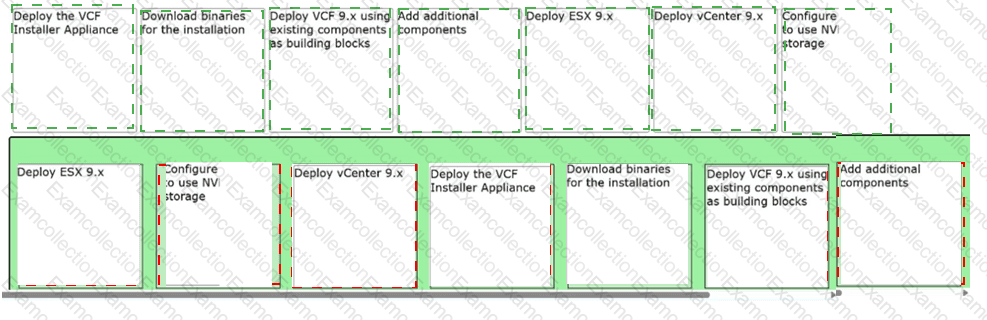
A VMware Cloud Foundation (VCF) Management Domain is requested to be deployed with the following information:
. 6 blade style hosts with no local storage beyond the operating system.
. 4 25 Gb networking cards installed in each host.
. A 30 TB external array configured to support NVMe/TCP only.
. 2 dVS switches, one configured for storage isolation and one for all other traffic.
. Aria Operations is not currently deployed in the environment.
Place the general steps in sequence for converging VCF on to this configuration.
An architect has been tasked with designing a vSAN OSA storage solution for a VMware Cloud Foundation (VCF) Private Cloud. The following requirements and constraints have been gathered from the client:
• 2 x 4 TB NVMe disks per host
• 6 hosts
• FTT=1/RAID-5 for all deployed Virtual Machines
• Expected Dedupe/Compression Ratio = 2 (100%)
• Reserve enough capacity to rebuild a host completely in case of a failure (Host Rebuild Reservation)
• Operational Reserve of 10%
• Expected Overhead for Filesystem, Object, etc. of 25%
What is the approximate expected usable capacity of the resulting array?
An administrator is using an external Key Management Server (KMS) with a vSAN Data-at-Rest Encryption cluster.
The KMS becomes temporarily unavailable.
What happens if a host without a Trusted Platform Module in the cluster is rebooted during this outage?
An enterprise is planning to deploy a new vSAN ESA enabled cluster to their existing VMware Cloud Foundation (VCF) Private Cloud Workload Domain. The following requirements have been given:
• 2 x 4 TB NVMe disks per host
• FTT=1/RAID-5 for all deployed Virtual Machines
• Expected dedupe/compression ratio = 1.5 (50%)
• Reserve enough capacity to rebuild a host completely in case of a failure (Host Rebuild Reservation)
• Operational Reserve of 10%
• Expected overhead for filesystem, object, etc. of 25%
How many hosts are required to meet a minimum usable capacity of 12 TB?
A storage architect has been called into a meeting with the accounting team who is trying to determine why 20% of their raw capacity is not available for consumption. Their vSAN cluster was created with the following characteristics:
• 2 x 2 TB NVMe disks in 6 hosts in their vSAN cluster.
• FTT=1, RAID-1 for the default policy.
• Host Rebuild Reserve not activated for this cluster.
Which two items should the Architect say accounts for most of the unusable capacity? (Choose two.)
A storage architect is designing a VMware Cloud Foundation (VCF) Workload Domain with the following requirements:
• vSAN File Services hosting multiple file shares.
• Each department requires distinct protection levels and placement rules.
Which option satisfies the requirements?
The security team has notified the VMware Cloud Foundation (VCF) Storage Administrator of a new security vulnerability that must be patched immediately. The vSAN Cluster uses vSphere Lifecycle Manager images.
After updating the image with the patch, what method should the administrator use to apply this patch with the least amount of disruption to the cluster?
An administrator is tasked with setting up immutable snapshots for recovery in case of a cyber-attack.
Which two limitations apply when configuring immutable snapshots? (Choose two.)
An administrator is tasked with designing a highly available vSAN ESA two-node cluster for a remote VMware Cloud Foundation (VCF) workload domain. The solution should be able to survive the failure of any disk group in addition to a host failure without data loss.
What is the minimum total number of nested fault domains required for the design?
An administrator notices alerts triggering IOPS and Disk Throughput storage performance problems in the Fibre Channel datastore in a VMware Cloud Foundation (VCF) Workload Domain.
What can the administrator review to identify which Virtual Machines (VMs) may be experiencing storage IOPS and disk throughput performance issues?
