


Spring Sale Special Limited Time 70% Discount Offer - Ends in 0d 00h 00m 00s - Coupon code: xmas50

Appian ACD201 - Appian Senior Developer

Page: 1 / 4
Total 106 questions

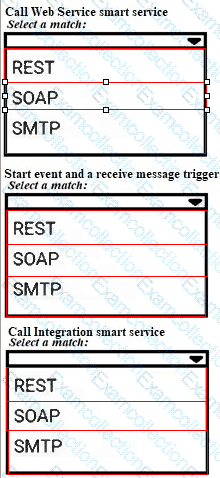
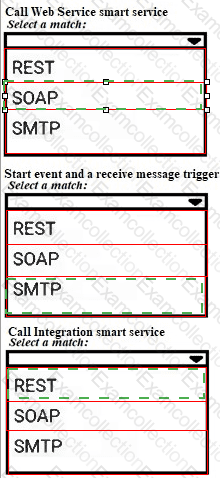
You're creating an application which has integrations with multiple systems using different protocols.

Match each process model component or node to the appropriate protocol.

Note: Each protocol will be used once. To change your responses, you may deselect your response by clicking the blank space at the top of the selection list.
You're refining a story regarding a highly regulated form, where information needs to be sent to a regulatory body at the end of each month to ensure that the business complies with laws and legislation. The story only concerns the creation of the form.

You need to create a form that captures information to comply with the regulatory requirements.

Which two questions should you ask the business? (Choose two.)

A.

What information does the regulatory body require?

B.

How often is the information sent to the regulatory body?

C.

Is the information sent to the regulatory body via an integration?

D.

What is the maximum length of each field?

What are three ways to optimize the memory usage of a process model? (Choose three.)

A.

Pass data directly to activity nodes and smart services.

B.

Minimize the use of subprocesses in the model.

C.

Decrease the number of process variables.

D.

Configure process variables as parameters.

E.

Divide large nodes into multiple smaller nodes.

F.

Avoid storing large blocks of text in process variables.

You need to connect to an external system using OAuth 2.0: SAML Bearer Assertion Flow authentication type, which requests access to an API on behalf of a signed in user.

This standard has the several steps involved with the SAML Bearer Assertion Flow.

Which two steps should you perform? (Choose two.)

A.

Add required users and groups to OAuth 2.0 SAML Bearer Assertion Users system group.

B.

Enable the checkbox labeled OAuth 2.0: SAML Bearer Assertion Flow in the Admin Console.

C.

Create a Bearer Assertion process flow to authenticate the user.

D.

Upload Client Certificate to Connected System.

You receive a warning about approaching the 2,000,000 row limit with synced records in your Production environment.

What are two ways to efficiently address this warning to prevent reaching the limit? (Choose two.)

A.

Design the process to write data in batches of 1,000.

B.

Disable data sync immediately to prevent user facing-front end issues.

C.

Keep only necessary data and plan to move the archived data to an audit table in a longer run.

D.

Apply one or more source filters to limit the number of rows synced in Agpian.

You run a report on different employee transactions by using a View.

You encounter the following error: "a!queryEntity: An error occurred while retrieving the data."

What is the most likely root cause of this error?

A.

The view doesn't have a column mapped as a primary key in its corresponding CDT.

B.

The view contains a large number of rows, requiring more time to fetch the data.

C.

The rule contains a missing syntax.

What are two advantages of database normalization? (Choose two.)

A.

Enforcing data integrity.

B.

Simplifying query statements to read data.

C.

Minimizing the number of tables that need to be created.

D.

Minimizing data redundancy.

After reviewing the latest Expression performance logs, you notice you have several expressions contributing to slow interface or process performance.

Which two conditions will lead to a higher risk associated with slow-performing expressions? (Choose two.)

A.

When the expression is used in a local variable.

B.

When the expression is used frequently or by many concurrent users.

C.

When the expression is evaluated on a mobile device.

D.

When the expression is a custom function plug-in.

The synced record type Customer has a one-to-many relationship with the Case record type.

You need to calculate the number of open cases for each customer.

What are two valid methods to accomplish this? (Choose two.)

A.

Within the Case record type, edit the relationship to the Customer record and select the "Open” status as the grouping filter.

B.

Within the Customer record type, create a custom field that evaluates in real-time to aggregate related record fields and count the open cases.

C.

Create a query expression for the Customer record type. Utilize the a!measure() function within the aggregation fields to count the related cases in the “Open” status.

D.

Create a sync-time custom record field within the Customer record. Utilize the a!relatedRecordData() function to filter open cases and count the number of entries.

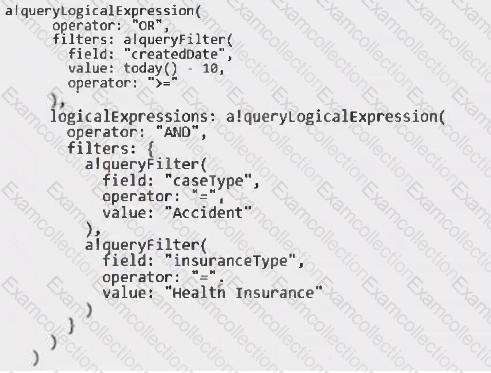
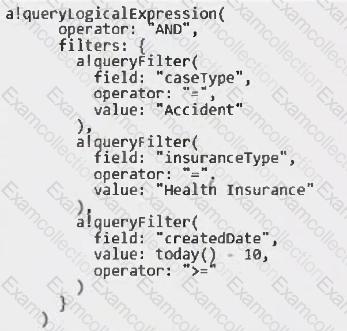
An insurance application has a dashboard in which all the cases with "Accident" case type and "Health Insurance" insurance type are displayed to the user, using the following query:
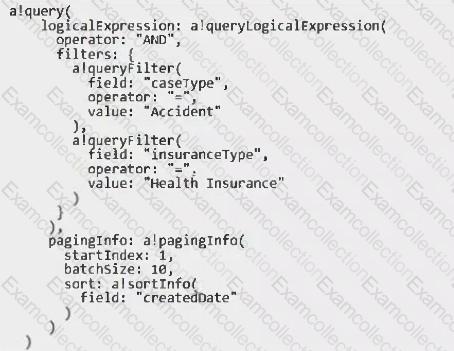
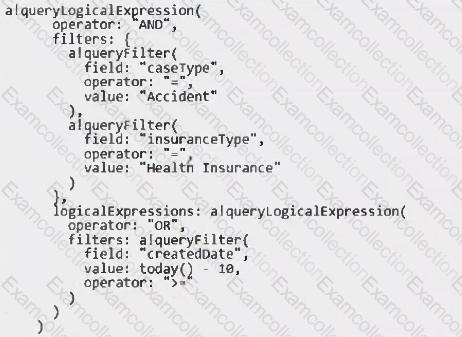
You need to update the query entity to display all the cases that are "Accident" case type and "Health Insurance" insurance type, or created in the last ten days.

What is the right configuration for the logical expression?

A)
B)
C)
A.

Option A

B.

Option B

C.

Option C
