

Black Friday Sale Special Limited Time 70% Discount Offer - Ends in 0d 00h 00m 00s - Coupon code: xmas50

Adobe AD0-E117 - Adobe Experience Manager Architect Master

Page: 3 / 3
Total 87 questions

An AEM Architect is moving existing content from an on-premise AEM to an AEM Cloud Service instance using the Content Transfer Tool. As part of the initial source preparation, the Architect is going to run the offline compaction on the on-premise AEM.

What other two actions should the Architect do to the on-premise AEM before proceeding with the extraction phase? (Choose two.)

A.

Validate that all replication agents are disabled

B.

Verify that wipe mode is enabled

C.

Stop all bundles using the AEM Web Console

D.

Verify that free disk space is at least 1.5x the JCR size

E.

Run datastore consistency check via oak-run

A customer is using AEM on AMS as the central content provider for its omnichannel presence with more than 100+ authors working around the clock and 30+ concurrent authors. The customer is happy with the performance of the author server, but they have a critical requirement to guarantee no data loss and quick failover in the event of any author failure. Which deployment strategy would the AEM architect use for the author environment?

A.

Use single Oak instance with regular AMS backups

B.

Use multiple Oak instances with TarMk Farms

C.

Use multiple Oak instances with MongoMK

D.

Use single Oak instance with a cold standby

A news agency editor wants to publish news articles to an intermediate Publish (preview) instance for internal review before publishing the article to production Publish instance.

Which two steps should the Architect recommend? (Choose two.)

A.

Create a closed user group (CUG) for editors

B.

Create a reverse replication agent on preview server

C.

Create a separate live copy to preview content

D.

Set up a new replication agent for preview server

E.

Create a custom publish workflow

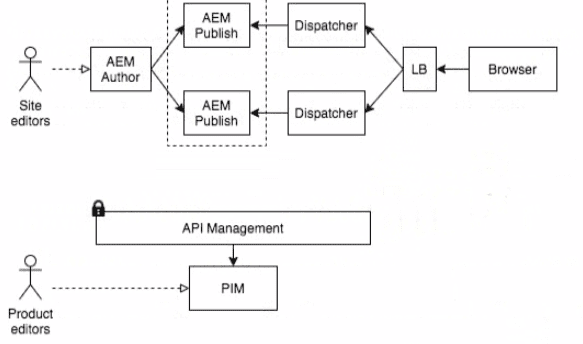
Refer to the exhibit.

A customer with an existing AEM implementation wants to enrich product pages with technical data coming from their PIM system. The PIM system sits behind an API Management solution that publicly exposes the PIM API's as RESTful web services with basic authentication as the security mechanism. Data consistency with the PIM and secure access to the APIs are key elements of the integration.

How should the Architect set up the integration between AEM and the PIM?

A.

Integrate the AEM Publishers directly with the API Management solution

B.

Use a client-side integration with AJAX from the browser to the API Management

C.

Import the technical data into the AEM Author and replicate to Publishers

D.

Convert the technical data to Content Fragments and expose using Content Services

A client requires the ability to create multiple microsites with the same set of components but with different visual variations. The client needs to make sure that an author of a specific microsite is following a specific microsite Style Guide. What approach would the architect take?

A.

Create a set of core components with the required functionalities

Extend these components and create different versions of them for each one of the microsites

Configure the static templates for each microsite to use the specific set of extended components based on the required design

B.

Create a set of core components with the required functionalities

Create a set of CSS classes that correspond to each visual variation as well as the corresponding CSS code

Configure the Clientlibs policies in the editable templates that render the required styles based on each microsite

C.

Create a set of core components with the required functionalities

Extend these components and create different versions of them for each one of the microsites

Configure the authors' permissions to only be able to access the proper set of components based on which microsite they are authoring

D.

Create a set of core components with the required functionalities

Create a set of CSS classes that correspond to each visual variation as well as the corresponding CSS code

Configure the Style System policies in the editable templates that render the required styles based on each microsite

A fashion retail company is planning to enhance the online shopping experience by integrating Adobe Experience Manager (AEM) with a third-party commerce platform using the Commerce Integration Framework (CIF). What are the purpose and benefits of using CIF in this integration?

A.

CIF facilitates the exchange of commerce data, such as products, prices, and inventory, between AEM and the third-party commerce platform, enabling a unified shopping experience.

B.

CIF enables AEM to host the entire checkout process, reducing the dependency on the third-party commerce platform and improving security.

C.

CIF allows for direct data synchronization between AEM and the third-party commerce platform, eliminating the need for APIs and simplifying integration.

D.

CIF provides a set of pre-built UI components for AEM that can be easily embedded into the third-party commerce platform, ensuring consistent branding.