Microsoft AI-300 - Operationalizing Machine Learning and Generative AI Solutions
You create an Azure Machine Learning workspace
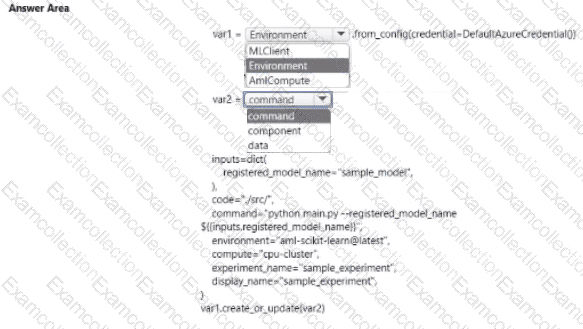
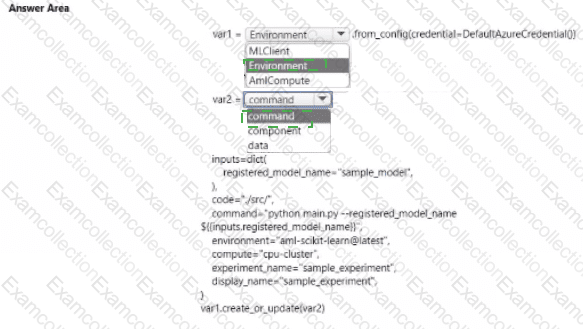
You are developing a Python SDK v2 notebook to perform custom model training in the workspace. The notebook code imports all required packages.
You need to complete the Python SDK v2 code to include a training script. environment, and compute information.
How should you complete ten code? To answer, select the appropriate options in the answer area.
NOTE: Each correct selection is worth one point
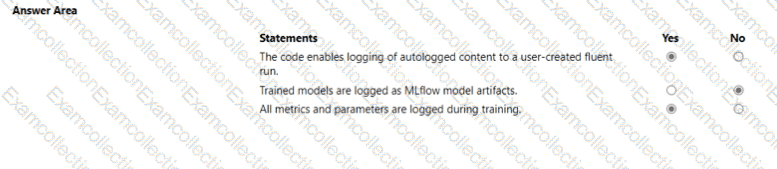
You manage an Azure Machine Learning workspace. You submit a training job with the Azure Machine Learning Python SDK v2. You must use MLflow to log metrics, model parameters, and model artifacts automatically when training a model.
You start by writing the following code segment:

For each of the following statements, select Yes If the statement is true. Otherwise, select No.
You create an Azure Machine Learning workspace.
You plan to write an Azure Machine Learning SDK for Python v2 script that logs an image for an experiment. The logged image must be available from the images tab in Azure Machine Learning Studio.
You need to complete the script.
Which code segments should you use? To answer, select the appropriate options in the answer area.
NOTE: Each correct selection is worth one point.


You are planning to register a trained model in an Azure Machine Learning workspace.
You must store additional metadata about the model in a key-value format. You must be able to add new metadata and modify or delete metadata after creation.
You need to register the model.
Which parameter should you use?
You have an Azure Machine Learning (ML) model deployed to an online endpoint.
You need to review container logs from the endpoint by using Azure Ml Python SDK v2. The logs must include the console log from the inference server with print/log statements from the models scoring script.
What should you do first?
A team plans to deploy a large foundation model in Microsoft Foundry as part of a new enterprise AI capability.
Different business units across the team ' s organization will access the model from various internal applications.
You need to deploy a foundation model by minimizing latency.
Which deployment type should you use?
A team manages an Azure Machine Learning workspace where they deploy models to online endpoints.
The team needs to introduce a new version of a model to production without disrupting existing users.
The team must validate the new version before full rollout.
You need to reduce risk during deployment.
What should you do?
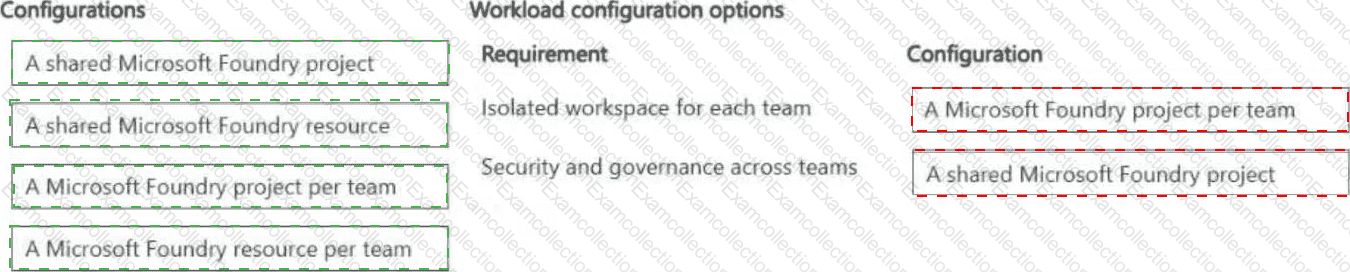
A company is standardizing generative AI development across multiple teams.
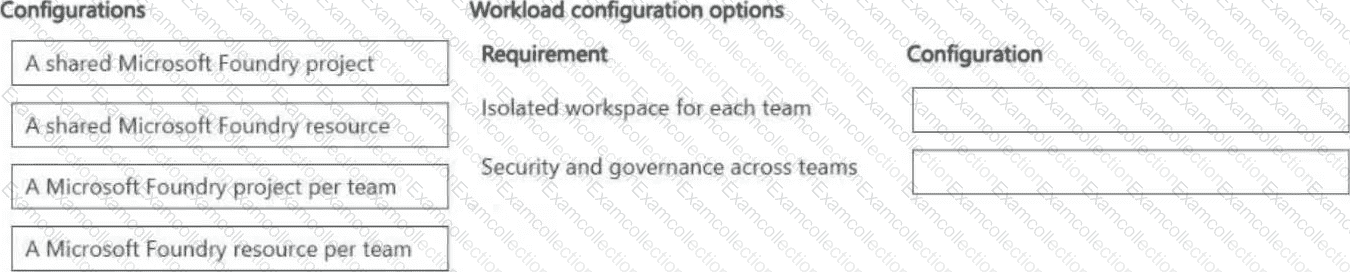
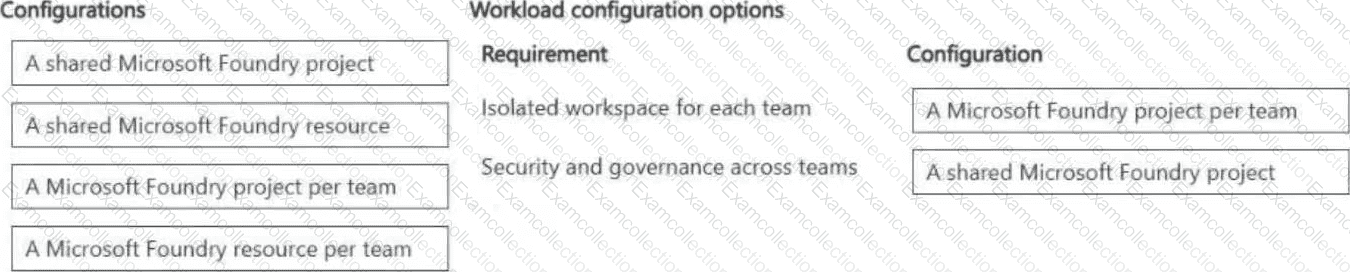
Each team requires an isolated workspace. Governance and shared connections must be centrally managed.
You need to implement a Microsoft Foundry environment structure that supports centralized governance and team isolation.
Which type of configuration should you use for each requirement? To answer, move the appropriate configurations to the correct requirements. You may use each configuration once, more than once, or not at all. You may need to move the split bar between panes or scroll to view content. NOTE: Each correct selection is worth one point.
-
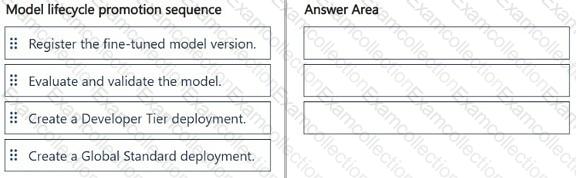
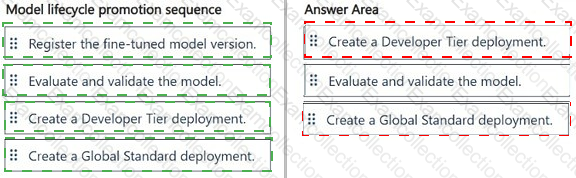
You complete the fine-tuning of a generative model in Microsoft Foundry. The fine-tuned model now appears as a new model variant in your development environment.
The deployment process must ensure that proper validation and control is maintained.
You need to promote the fine-tuned model from development to production.
Which three actions should you perform in sequence? To answer, move the appropriate actions from the list of actions to the answer area and arrange them in the correct order.
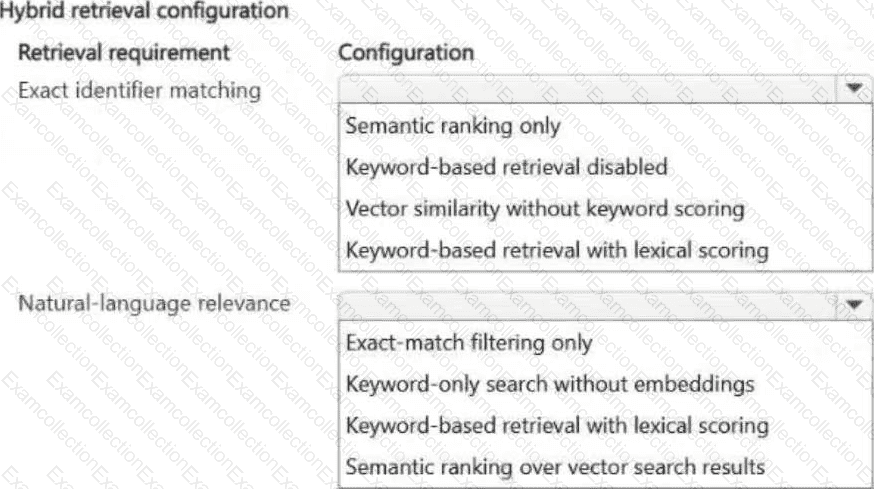
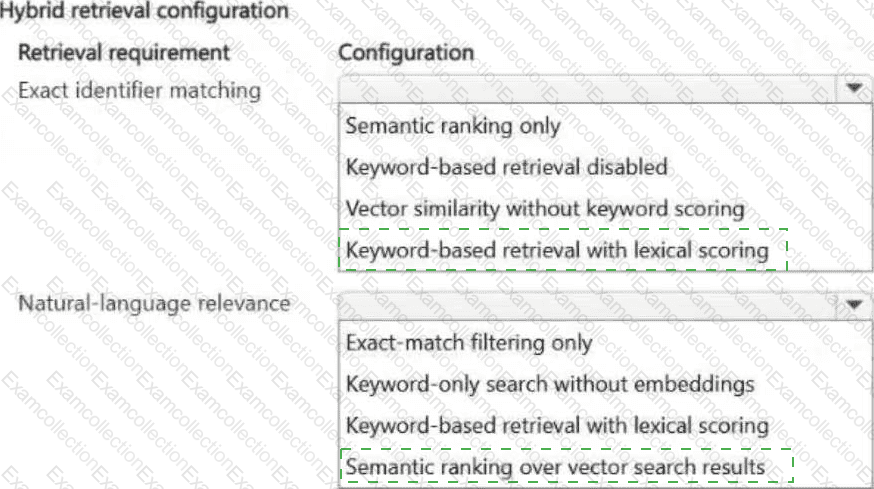
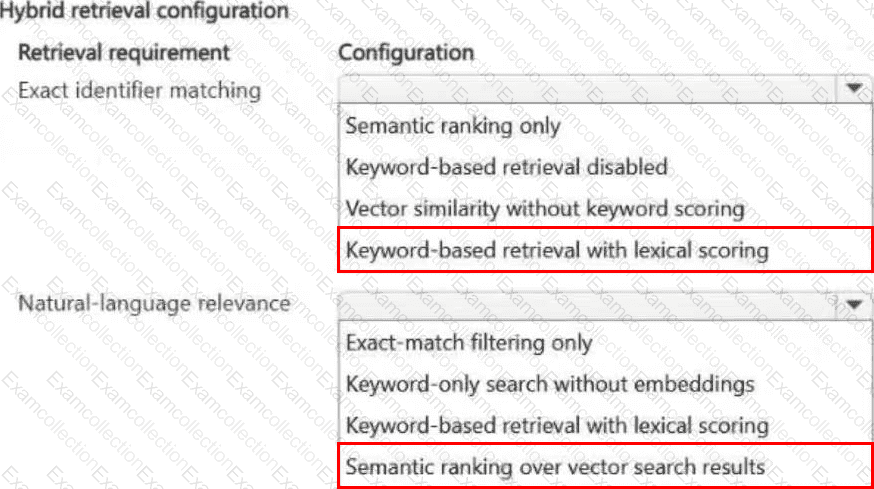
You manage a Retrieval-Augmented Generation (RAG) system that uses Azure AI Search to retrieve documents from an indexed knowledge base.
The system must support the following retrieval requirements:
Queries that include exact policy identifiers must return matching documents even when semantic similarity is low.
Natural-language questions must prioritize semantically relevant documents even when keywords are not an exact match.
You need to configure the retrieval approach to meet the requirements.
How should you configure the retrieval behavior for each requirement? To answer, select the appropriate options in the answer area. NOTE: Each correct selection is worth one point.