


Microsoft AI-300 - Operationalizing Machine Learning and Generative AI Solutions
You are fine-tuning a base language model to analyze customer feedback.
You label examples of support tickets. You must improve classification accuracy by configuring and fine-tuning the base model in Microsoft Foundry.
You need to configure and run fine-tuning.
What should you do first?
You plan to filter your traces to identify issues while observing how the application is responding. The solution must not use an external knowledge base.
You need to select an evaluation metric.
Which built-in evaluator should you use?
You have an Azure Machine Learning workspace named Workspace 1 Workspace! has a registered Mlflow model named model 1 with PyFunc flavor
You plan to deploy model1 to an online endpoint named endpoint1 without egress connectivity by using Azure Machine learning Python SDK vl
You have the following code:
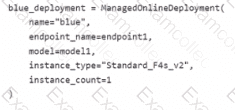
You need to add a parameter to the ManagedOnlineDeployment object to ensure the model deploys successfully
Solution: Add the environment parameter.
Does the solution meet the goal?
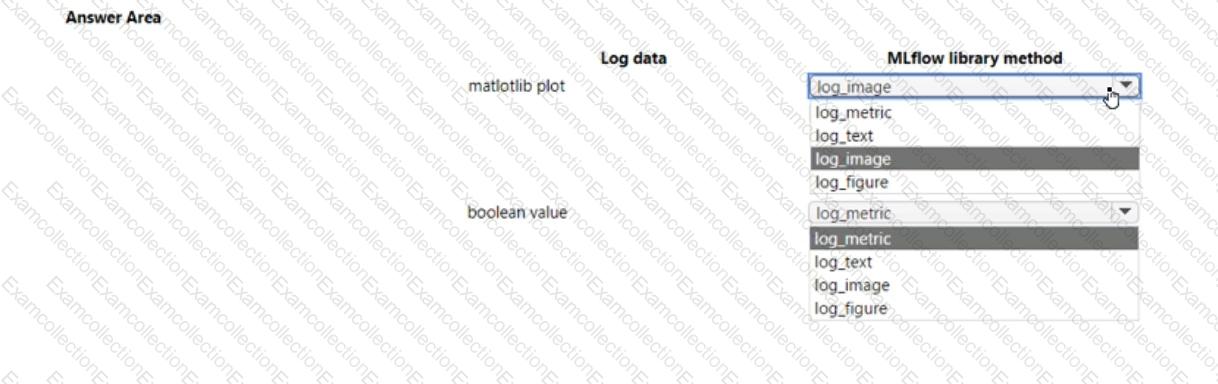
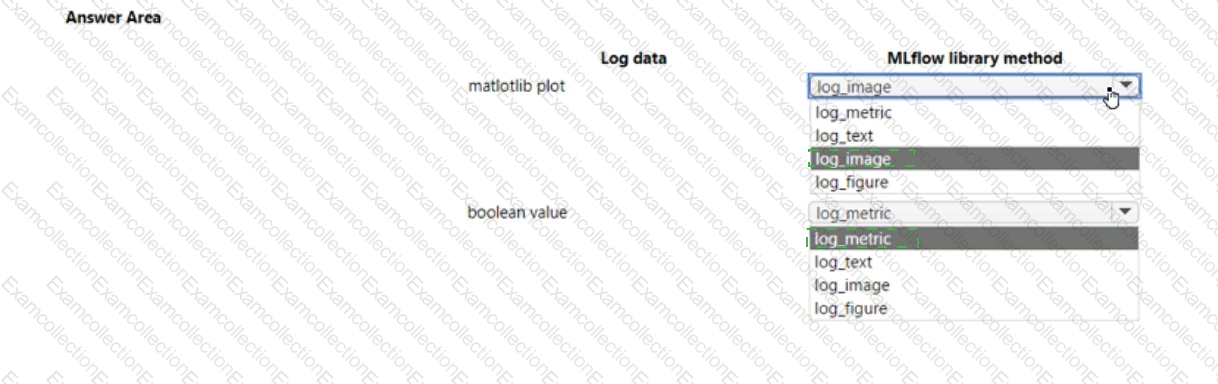
You create an Azure Machine Learning workspace and install the MLflow library.
You need to tog different types of data by using the MLflow library.
Which method should you use? To answer, select the appropriate options in the answer area.
NOTE: Each correct selection is worth one point.
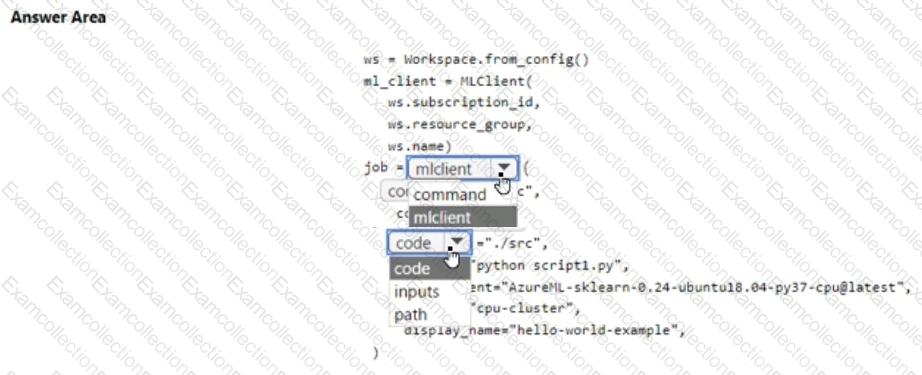
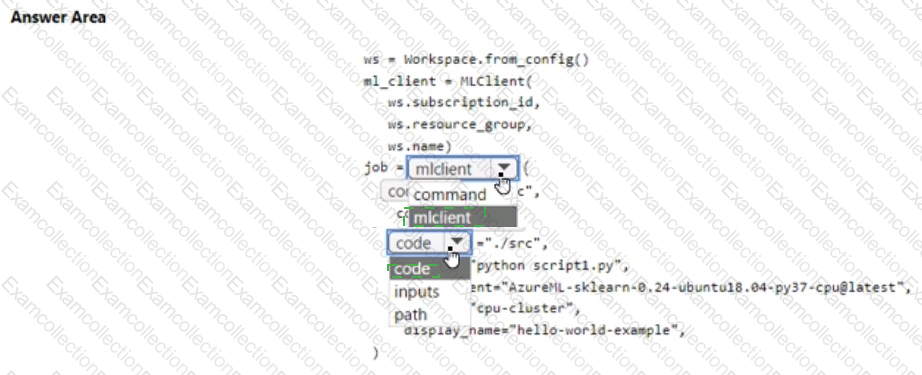
You create an Azure Machine learning workspace. The workspace contains a folder named src. The folder contains a Python script named script 1 .py.
You use the Azure Machine Learning Python SDK v2 to create a control script. You must use the control script to run script l.py as part of a training job.
You need to complete the section of script that defines the job parameters.
How should you complete the script? To answer, select the appropriate options in the answer area.
NOTE: Each correct selection is worth one point.
You manage an Azure Machine Learning workspace named Workspace1.
You plan to create a pipeline in the Azure Machine Learning Studio designer. The pipeline must include a custom component You need to ensure the custom component can be used in the pipeline. What should you do first.
You manage an Azure Machine Learning workspace. You design a training job that is configured with a serverless compute. The serverless compute must have a specific instance type and count
You need to configure the serverless compute by using Azure Machine Learning Python SDK v2. What should you do?
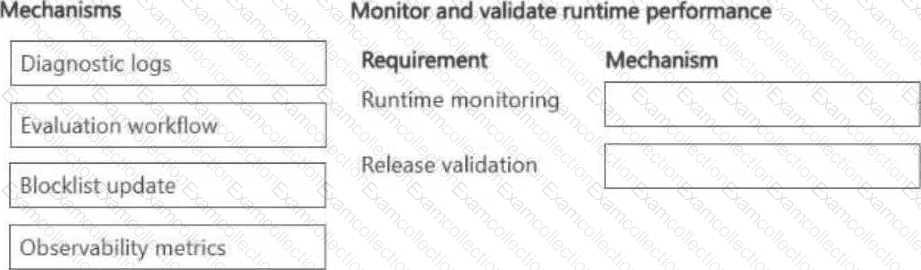
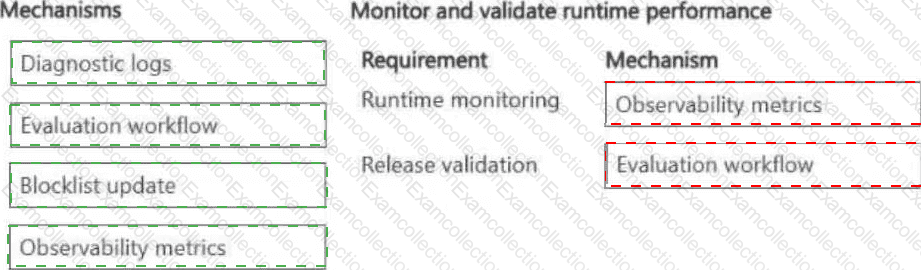
An organization operates a generative AI application in production by using Microsoft Foundry. The application serves live user traffic and is updated by a data scientist team regularly as prompts and models evolve.
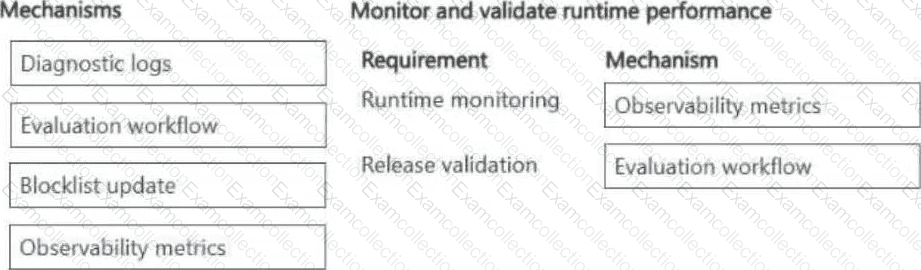
The application intermittently times out during production use, which requires ongoing visibility into runtime behavior.
The team must also validate model quality and safety before releasing new updates to avoid introducing regressions.
You need to apply the correct mechanisms for continuous runtime monitoring and for release time validation.
Which mechanisms should you use for each requirement? To answer, move the appropriate mechanisms to the correct requirements. You may use each mechanism once, more than once, or not at all. You may need to move the split bar between panes or scroll to view content. NOTE: Each correct selection is worth one point.
You have an Azure Machine Learning workspace. You are running an experiment on your local computer.
You need to use MLflow Tracking to store metrics and artifacts from your local experiment runs in the workspace.
In which order should you perform the actions? To answer, move all actions from the list of actions to the answer area and arrange them in the correct order.


Note: This question is part of a series of questions that present the same scenario. Each question in the series contains a unique solution that might meet the stated goals. Some question sets might have more than one correct solution, while others might not have a correct solution.
After you answer a question in this section, you will NOT be able to return to it. As a result, these questions will not appear on the review screen.
You work in Microsoft Foundry with a prompt flow.
You must manually evaluate prompts and compare results across prompt variants.
You need to capture the inputs, outputs, token usage, and latencies for each flow run for the evaluation.
Solution: Use the prompt flow SDK to enable tracing for the flow before executing runs. Then run the flow to generate traceable results.
Does the solution meet the goal?