


ASCP ASCP-MLT - MEDICAL LABORATORY TECHNICIAN - MLT(ASCP)
Transmission-based precautions isolation categories include all of the following except:
Which of the following is most likely to interact with arterial walls, leading to deposition of cholesterol, and initiating or worsening atherosclerosis?
In combined fiscal years 2005 through 2009, transfusion-related acute lung injury (TRALI) caused the higest number of reported fatalities (48%), followed by hemolytic transfusion reactions (26%) due to non-ABO (16%) and ABO (10%) incompatibilities. Complications of microbial infection, transfusion-associated circulatory overload (TACO), and anaphylactic reactions each accounted for a smaller number of reported fatalities.
Serum amylase and lipase levels may be slightly elevated in chronic pancreatitis, but not diagnostic enough to predict chronic pancreatitis; wheras high levels are found only during acute pancreatitis episodes. In the later stages of chronic pancreatitis, normal to decreased levels of amylase and lipase are caused by the gradual inability of the pancreas to secrete the enzyme
All of the statements below regarding amylase and lipase in pancreatitis are TRUE EXCEPT:
As maturation continues in the granulocytic series the nucleus of the metamyelocyte becomes kidney or bean shaped.
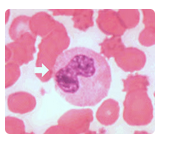
Identify the cell in this illustration indicated by the arrow:
The correct set of patient data would be: Hgb A = 60%, Hgb S = 38%, Hgb A2 = 2%, Hgb F = 0%
Patients with sickle cell trait commonly have Hgb A values between 40 and 60%, Hgb S values between 20 and 40% and Hgb A2 values between 2 and 3%.
A known sickle cell trait patient has a hemoglobin electrophoresis test performed. Which of the following hemoglobin percentage sets would most closely match this patient's diagnostic state?
All of the following tubes contain separation gel except:
Question options:
Anything that can cause significant turbidity in a blood sample, such as high leukocyte count or lipemia can potentially interfere with the accuracy of a spectrophotometric hemoglobin assay.
Hematology
Which of the following may interfere with the accurate measurement of hemoglobin:
The ratio of blood to anticoagulant in a light blue stopper tube is:
The Fc portion of immunoglobulin can activate the classical complement pathway, where the heavy chains, light chains, hinge regions and Fab portions cannot.
Which part of the immunoglobulin molecule is responsible for activating complement?
Isotonic or normal saline is a 0.85 % solution of sodium chloride in water.
The concentration of sodium chloride in an isotonic solution is :
A combination of (nonselective) 5% sheep blood and (selective) MacConkey agars is sufficient for the recovery of the pathogenic microorganisms that are most commonly encountered in urinary tract infections (UTIs). MacConkey is the selective culture medium that is most commonly used to inhibit growth of gram-positive organisms (most UTIs are caused by gram-negative organisms).
Eosin methylene blue (EMB) is a selective agar that also inhibits the growth of gram-positive organisms. Therefore, using only a combination of MacConkey and EMB would prevent the detection of a gram-positive organism, if this were the cause of the infection.
Chocolate agar or other enriched media may be needed in addition to blood and MacConkey if a more fastidious organism is suspected.
Thayer-Martin would be used specifically for recovery of Neisseria gonorrhoeae. Thayer-Martin (or Modified Thayer-Martin) inhibits other microorganisms and allows the selective recovery of both N. gonorrhoeae and N. meningitidis.
Microbiology
Which culture agar combinations below will usually be sufficient for MOST routine urine culture investigations?
What is the best description of the purpose of the Commission on Office Laboratory Accreditation (COLA) pertaining to the clinical laboratory?
Limited to blood and body fluids visibly contaminated with blood
What are the certification requirements for clinical laboratory professionals?