


ASCP ASCP-MLT - MEDICAL LABORATORY TECHNICIAN - MLT(ASCP)
Only non-self antigens can be immunogenic. Self antigens are normally recognized by the immune system as part of the host, so an immune response does not normally occur. Non-self antigens are immunogenic since they have the potential to cause an immune response.
For a substance to be immunogenic it must be:
The combination of complement C4, C2 and C3 that binds to the antigen-antibody complex in the initial reaction step in the classical pathway of complement activation is called the activation unit.
Which of the following is the "activation unit" in the classical complement pathway?
Which of the following could reduce the risk of a patient becoming infected with a hospital acquired infection?
The risk of HbS polymerization is enhanced by a low (acid) pH, a state of dehydration, and increased levels of 2,3-DPG. Increased temperature (above 37°C) also adds to the risk.
Hematology
Which group of conditions INCREASES the risk of HbS polymerization?
Hemolytic transfusion reactions seldom occur because the incidence of unexpected antibodies in random patients is relatively low, e.g., 3-5% is sometimes cited.
Being transfused with O Rh negative RBC is irrelvant if you have an unexpected antibody like anti-K or anti-c.
Incompatible red cells may "bleed out" but only if bleeding is brisk. Even then, a hemolytic reaction may occur later once the patient's antibody rebounds and destroys remaining antigen-positive donor red cells.
It's true that some patients have only cold-reactive antibodies that will not react at body temperature. But this does not explain why warm-reactive red cell antibodies cause few reactions
Why do so few patients transfused with un-crossmatched red cells in an emergency experience a hemolytic transfusion reaction? Select the one best reason.
An international, nonprofit organization that establishes standards of best current practice for clinical laboratories is
Mrs. Jones, a diabetic, is admitted to the hospital on November 25th. It appears that she has had an AMI but did not feel the severe chest pain because of diabetic neuropathy. She has not felt well since November 20th and her physician believes she possibly had an AMI on November 20th.
Assuming that the infarct was uncomplicated, which of the following cardiac biomarkers would most likely still be elevated and would assist in an AMI diagnosis?
These are tyrosine crystals

Urinalysis & Other Body Fluids
True or false? Cystine crystals are present on this slide.
The lecithin-sphingomyelin ratio is a test for assessing fetal lung maturity that is useful in determining risk of an infant born with respiratory distress syndrome.
The Lecithin/Sphingomyelin ratio determination of amniotic fluid is useful in assessing the probability of:
Drawing a lavendar stopper tube before an SST tube can cause a falsely:
Question options:
1+ reaction has numerous small clumps and cloudy red supernatant
2+ has many medium-sized clumps and clear supernatant.
3+ has several large clumps and clear supernatant
4+ has one solid clump, no free cells, and clear supernatant
BB
Tube-based agglutination reactions in blood bank are graded from negative (0) to 4+. A reaction that has numerous small clumps in a cloudy, red background is:
The dematiaceous molds can be broadly separated into two major groups: the agents of chromomycosis that grow more slowly, maturing only after 7 days or more of incubation, and the more rapidly growing species that most commonly are clinically insignificant commensals or contaminants when recovered from clinical specimens, but in rare situations may cause opportunistic infections called phaeohyphomycosis.
Dematiaceous molds can be broadly separated into two major groups; the agents of chromomycosis and clinically insignificant commensals or contaminants. The agents of chromomycosis grow: more slowly than; more rapidly than; or generally at the same rate as the clinically insignificant commensals or contaminants?
In this case, the pH may become more alkaline, perhaps above 8.0, if the bacteria in the sample are proliferating during the extended room-temperature wait time.
A urine specimen was collected at 6:00 a.m. and remained at room temperature until it was received in the laboratory at 3:30 p.m. How may the pH of the specimen be affected by the extended time at room temperature if bacteria are present in the specimen?
Which of the following cardiac biomarkers rises within 30 minutes - 4 hours after chest pain, peaks in 2 - 12 hours, and is usually normal within 24 - 36 hours.
Although any one of the answers might be considered correct, a report of gram-positive cocci in chains provides sufficient information without going beyond what the observation might allow. In off-the record conversation with the physician, a technologist might divulge that the picture is consistent with Streptococcus; however, enterococci may have a similar Gram stain appearance, potentially leading to the wrong choice of empiric antibiotic agents.
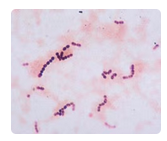
The image shows the Gram stain prepared from the positive blood culture. What is the MOST appropriate report?