


CIMA BA2 - Fundamentals of management accounting
Which THREE of the following are characteristics of job costing?
The variable overhead expenditure variance is:
Refer to the Exhibit.
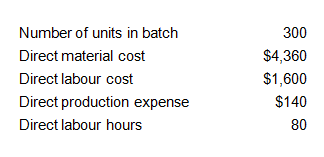
A company operates a batch costing system.
Production overhead costs are absorbed into the cost of batches using a direct labour hour rate. Other overhead costs are absorbed at a rate of 20% of total production cost. The company adds a mark-up of 10% to total cost in order to derive its selling prices.
Budgeted production overheads for the period are $44,000 and the budgeted level of activity is 8,800 direct labour hours.
The following data are available for batch number 309:
The required selling price per unit (to two decimal places) is:
A company uses an integrated accounting system.
The accounting entries for the sale of goods on credit would bE.
The variable overhead efficiency variance is:
Refer to the Exhibit.
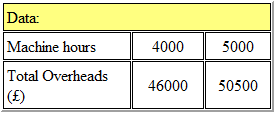
PJ Ltd has forecast that the relationship between total overheads and machine hours will be as follows:
If the budget is to be based on 4,000 machine hours, the variable overhead absorption rate will be:
*per machine hour.
Give your answer to 2 decimal places.
In order to provide information that is suitable for control purposes, the budget must be:
Refer to the exhibit.
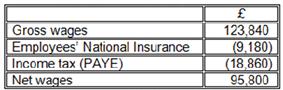
DS is manufacturing company that uses an integrated accounting system. The following payroll data is available for the month of August:
The Employers' National Insurance for the period was $13,790. An analysis of the wages is as follows:
Which of the following factors affect the budgeted cash flow:
(a) Funds from the issue of share capital
(b) Bank Interest on a long term loan
(c) Depreciation on fixed assets
(d) Bad debt write off
The management accountant has completed the appraisal of an investment in new office equipment.
It has now been discovered that the cost of capital used in the appraisal should have been higher.
What will be the effect on the calculated net present value (NPV) and the payback period?
PQR Manufacturing Ltd. has £3,000,000 of fixed costs for the forthcoming period. The company produces a single product 'X', which has a selling price of £75 per unit and total cost of £50.
75% of the total cost represents variable costs.
What are the break-even units?
