


CIMA BA2 - Fundamentals of management accounting
GB Limited operates a standard costing system. During the month 18,500 labour hours were worked at a standard cost of $6 per hour. The labour efficiency variance was $8,700 favourable.
How many standard hours were produced?
Refer to the exhibit.
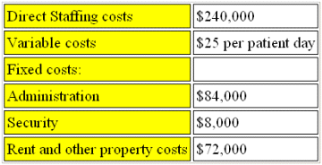
X Enterprises runs a private nursing home for the elderly. The company are concerned that bed occupancy rates have been falling over the past 2 years with a consequential effect on profit. They have drawn up a budget for next year as follows:
The nursing home currently charges $90 per patient day.
The nursing home operates at 7,500 patient days per year. In an effort to increase occupancy rates the company are proposing to reduce the current price by 10% and increase spending on advertising by $10,000 each year. What effect will this have on the margin of safety?
Eton Ltd. operates a manufacturing process that produces product A. Information for this process last month is as follows:
(a) Opening work in progress - 2,500 kg valued at £2,000 for direct material and £1,500 for labour and overheads.
(b) Materials input - 25,000 kg at £2.10 per kg.
(c) Labour - £10,000
(d) Overheads - £5,000
(e) Output during the month - 20,000 kg.
(f) There were 7,500 units of closing work in progress which was complete as to materials and 30% complete as to conversion.
(g) Normal loss for the month was 3% of input and all losses have a scrap value of £1 per kg.
What was the average cost per kg of finished output during the month?
A company’s management accountant wishes to calculate the present value of the cost of renting a delivery vehicle. There will be five annual rental payments of $5,000, the first of which is due immediately. The company’s discount rate is 12%.
Which TWO of the following are valid ways to calculate the present value of the rental payments? (Choose two.)
Which of the following statements regarding variances is valid?
An organisation produces and sells a single product. The organisation’s management accountant has reported the following information for the most recent period.
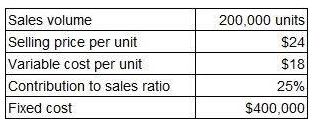
Which TWO of the following statements are valid? (Choose two.)
A company has three production departments X, Y and Z, and one service department.
The service department’s overhead has been apportioned to the production departments in the ratio 3:2:5. As a result of this apportionment, $2,070 was given to Department Y.
What is the amount of service department overhead that would have been apportioned to Department Z? Give your answer to the nearest dollar.
In a company that manufactures many different products on the same production line, which TWO of the following would NOT be classified as indirect production costs? (Choose two.)
Which of the following is a valid definition of a cash budget?
A company makes and sells a range of products. The standard details per unit for one of these products, product X, are as follows.
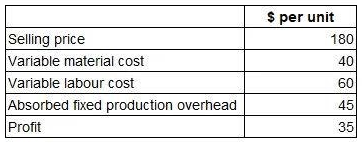
To meet sales demand, the company must obtain 2,000 units of product X next month. There is sufficient labour capacity to produce 1,500 of these units in-house during normal time. However, any production above this level would require overtime working which would be paid at a premium of 50%.
The company can buy as many units of product X as it wishes next month from an external supplier at a price of $120 per unit.
What is the total financial benefit to the company of purchasing the appropriate number of units from the external supplier rather than producing them in-house?
