


Spring Sale Special Limited Time 70% Discount Offer - Ends in 0d 00h 00m 00s - Coupon code: xmas50

CIMA BA2 - Fundamentals of management accounting

Page: 5 / 12
Total 392 questions

A company operates a full cost system of pricing. Production overheads are absorbed using a pre-determined absorption rate of £3.50 per machine hour. The direct production cost of product A is £15 per unit and it utilises 6 machine hours per unit. The mark-up for non-production costs is 10% of total production cost. The company wants to make a 25% return on sales revenue for all products.

The required selling price for Product A, to two decimal places, is:

Refer to the exhibit.
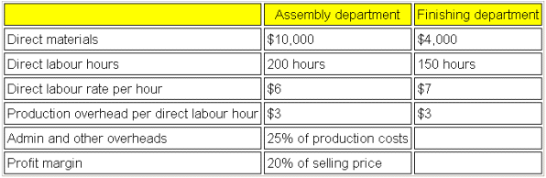
The following information relates to Job 123:

The selling price to the customer for Job 123 is:

Which one of the following is a characteristic of strategic financial information?

A.

Detailed and accurate

B.

Provided mainly to junior managers

C.

Provided daily to keep managers informed

D.

Provides information for long term decision making

The accounting treatment for overheads over absorbed is to:

A.

Debit the income statement for the period

B.

Increase the cost per unit for the period

C.

Credit the income statement for the period

D.

Decrease the cost per unit for the period

An overtime premium may be defined as:

A.

The rate of pay at which overtime hours are paid

B.

A premium paid to workers with special skills

C.

The additional payment made during overtime hours

D.

The total number of overtime hours worked

The following costs are incurred by a company which owns a five star hotel. Which THREE of the items would normally be classified as variable costs?

A.

Advertising

B.

Food

C.

Depreciation on gym equipment

D.

Restaurant Manager's salary

E.

Beverages

F.

Outside laundry service

The principal budget factor can be defined as:

A.

The factor which has the highest value in the budget

B.

The factor which limits the activities of the organisation

C.

The factor which is most likely to result in an adverse variance

D.

The factor which is least likely to change in the future

The standard labour cost for 1 component is $15.00 (5 hours at $3 per hour). Last month, 6,000 hours were worked at a cost of $17,000 to produce 1,100 components. The labour efficiency variance was:

A.

$1,500 Adverse

B.

$1,000 Adverse

C.

$1,000 Favourable

D.

$1,500 Favourable

A company’s cash budgetary plans show that there will be surplus cash for three months of the forthcoming year.

Which THREE of the following would be appropriate management actions in this situation?

A.

Offer a longer credit period to new customers to boost sales

B.

Purchase new non-current assets to increase efficiency

C.

Reduce the finished goods inventory to save storage costs

D.

Pay suppliers early to obtain prompt payment discounts

E.

Repay a long-term loan to reduce interest costs

F.

Invest in a short-term deposit account

The wages of a machine operator who is paid a guaranteed minimum wage plus a bonus for each unit produced would be described as A.

A.

Fixed cost

B.

Semi-variable cost

C.

Variable cost

D.

Stepped fixed cost