


IAPP CIPT - Certified Information Privacy Technologist
SCENARIO
Clean-Q is a company that offers house-hold and office cleaning services. The company receives requests from consumers via their website and telephone, to book cleaning services. Based on the type and size of service, Clean-Q then contracts individuals that are registered on its resource database - currently managed in-house by Clean-Q IT Support. Because of Clean-Q's business model, resources are contracted as needed instead of permanently employed.
The table below indicates some of the personal information Clean-Q requires as part of its business operations:
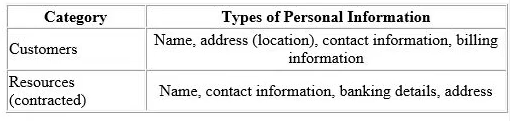
Clean-Q has an internal employee base of about 30 people. A recent privacy compliance exercise has been conducted to align employee data management and human resource functions with applicable data protection regulation. Therefore, the Clean-Q permanent employee base is not included as part of this scenario.
With an increase in construction work and housing developments, Clean-Q has had an influx of requests for cleaning services. The demand has overwhelmed Clean-Q's traditional supply and demand system that has caused some overlapping bookings.
Ina business strategy session held by senior management recently, Clear-Q invited vendors to present potential solutions to their current operational issues. These vendors included Application developers and Cloud-Q’s solution providers, presenting their proposed solutions and platforms.
The Managing Director opted to initiate the process to integrate Clean-Q's operations with a cloud solution (LeadOps) that will provide the following solution one single online platform: A web interface that Clean-Q accesses for the purposes of resource and customer management. This would entail uploading resource and customer information.
A customer facing web interface that enables customers to register, manage and submit cleaning service requests online.
A resource facing web interface that enables resources to apply and manage their assigned jobs.
An online payment facility for customers to pay for services.
If Clean-Q were to utilize LeadOps' services, what is a contract clause that may be included in the agreement entered into with LeadOps?
When writing security policies, the most important consideration is to?
A company configures their information system to have the following capabilities:
Allow for selective disclosure of attributes to certain parties, but not to others.
Permit the sharing of attribute references instead of attribute values - such as “I am over 21†instead of birthday date.
Allow for information to be altered or deleted as needed.
These capabilities help to achieve which privacy engineering objective?
SCENARIO
You have just been hired by Ancillary.com, a seller of accessories for everything under the sun, including waterproof stickers for pool floats and decorative bands and cases for sunglasses. The company sells cell phone cases, e-cigarette cases, wine spouts, hanging air fresheners for homes and automobiles, book ends, kitchen implements, visors and shields for computer screens, passport holders, gardening tools and lawn ornaments, and catalogs full of health and beauty products. The list seems endless. As the CEO likes to say, Ancillary offers, without doubt, the widest assortment of low-price consumer products from a single company anywhere.
Ancillary's operations are similarly diverse. The company originated with a team of sales consultants selling home and beauty products at small parties in the homes of customers, and this base business is still thriving. However, the company now sells online through retail sites designated for industries and demographics, sites such as “My Cool Ride" for automobile-related products or “Zoomer†for gear aimed toward young adults. The company organization includes a plethora of divisions, units and outrigger operations, as Ancillary has been built along a decentered model rewarding individual initiative and flexibility, while also acquiring key assets. The retail sites seem to all function differently, and you wonder about their compliance with regulations and industry standards. Providing tech support to these sites is also a challenge, partly due to a variety of logins and authentication protocols.
You have been asked to lead three important new projects at Ancillary:
The first is the personal data management and security component of a multi-faceted initiative to unify the company’s culture. For this project, you are considering using a series of third- party servers to provide company data and approved applications to employees.
The second project involves providing point of sales technology for the home sales force, allowing them to move beyond paper checks and manual credit card imprinting.
Finally, you are charged with developing privacy protections for a single web store housing all the company’s product lines as well as products from affiliates. This new omnibus site will be known, aptly, as “Under the Sun.†The Director of Marketing wants the site not only to sell Ancillary’s products, but to link to additional products from other retailers through paid advertisements. You need to brief the executive team of security concerns posed by this approach.
If you are asked to advise on privacy concerns regarding paid advertisements, which is the most important aspect to cover?
Aadhaar is a unique-identity number of 12 digits issued to all Indian residents based on their biometric and demographic data. The data is collected by the Unique Identification Authority of India. The Aadhaar database contains the Aadhaar number, name, date of birth, gender and address of over 1 billion individuals.
Which of the following datasets derived from that data would be considered the most de-identified?
Which of the following are the mandatory pieces of information to be included in the documentation of records of processing activities for an organization that processes personal data on behalf of another organization?
A developer is designing a new system that allows an organization's helpdesk to remotely connect into the device of the individual to provide support Which of the following will be a privacy technologist's primary concern"?
How does k-anonymity help to protect privacy in micro data sets?
SCENARIO
Tom looked forward to starting his new position with a U.S —based automobile leasing company (New Company), now operating in 32 states. New Company was recently formed through the merger of two prominent players, one from the eastern region (East Company) and one from the western region (West Company). Tom, a Certified Information Privacy Technologist (CIPT), is New Company's first Information Privacy and Security Officer. He met today with Dick from East Company, and Harry, from West Company. Dick and Harry are veteran senior information privacy and security professionals at their respective companies, and continue to lead the east and west divisions of New Company. The purpose of the meeting was to conduct a SWOT (strengths/weaknesses/opportunities/threats) analysis for New Company. Their SWOT analysis conclusions are summarized below.
Dick was enthusiastic about an opportunity for the New Company to reduce costs and increase computing power and flexibility through cloud services. East Company had been contemplating moving to the cloud, but West Company already had a vendor that was providing it with software-as-a-service (SaaS). Dick was looking forward to extending this service to the eastern region. Harry noted that this was a threat as well, because West Company had to rely on the third party to protect its data.
Tom mentioned that neither of the legacy companies had sufficient data storage space to meet the projected growth of New Company, which he saw as a weakness. Tom stated that one of the team's first projects would be to construct a consolidated New Company data warehouse. Tom would personally lead this project and would be held accountable if information was modified during transmission to or during storage in the new data warehouse.
Tom, Dick and Harry agreed that employee network access could be considered both a strength and a weakness. East Company and West Company had strong performance records in this regard; both had robust network access controls that were working as designed. However, during a projected year-long transition period, New Company employees would need to be able to connect to a New Company network while retaining access to the East Company and West Company networks.
When employees are working remotely, they usually connect to a Wi-Fi network. What should Harry advise for maintaining company security in this situation?
An organization is deciding between building a solution in-house versus purchasing a solution for a new customer facing application. When security threat are taken into consideration, a key advantage of purchasing a solution would be the availability of?