


ISTQB CT-STE - Certified Tester Security Test Engineer
ElectricCars is a multinational automotive manufacturer that specializes in the design and production of electric vehicles. The company must comply with three manufacturing-process standards: ISO/SAE 21434 for automotive cybersecurity engineering, GDPR (General Data Protection Regulation), and UN Regulation No. 155 (Uniform provisions concerning the approval of vehicles regarding cyber security and cyber security management system).
Compliance with these regulations requires:
Secure storage and communication of data within vehicles and between vehicles and backend systems.
Emergency procedures for cybersecurity breaches affecting production, vehicles in operation, or customer data.
Transparent incident-reporting mechanisms for regulators and customers.
Which of the following is a security test resulting from the compliance requirement?
You test a system that sends documents containing sensitive data between users. One risk is that an attacker who obtains access to such a document could read its contents.
What type of testing verifies a mechanism that prevents unauthorized persons from reading documents?
You assess the following functional security-control risk: “A financial application may not detect unauthorized access attempts when input-validation controls for user authentication are improperly implemented, enabling attackers to bypass login mechanisms.â€
Which test case addresses this risk?
Auto Tech, a prominent automotive manufacturer, was recently targeted by a group of unidentified hackers. They conducted a phishing campaign aimed at employees in the finance and IT departments. A finance employee received an email posing as an invoice from a known supplier that contained a malicious link. The employee did not select the link and instead emailed the security team.
The team discovered that selecting the link downloads and runs a program that encrypts data on the disk. To prevent the program from being installed on company employees’ computers, the team immediately blocked access to the IP address from which the malicious program originated. The team also emailed all employees about the attempted attack and reminded them not to select suspicious links in emails.
What is the MOST likely motivation for the attackers to carry out this attack?
As a security tester, you established the following test prioritization:
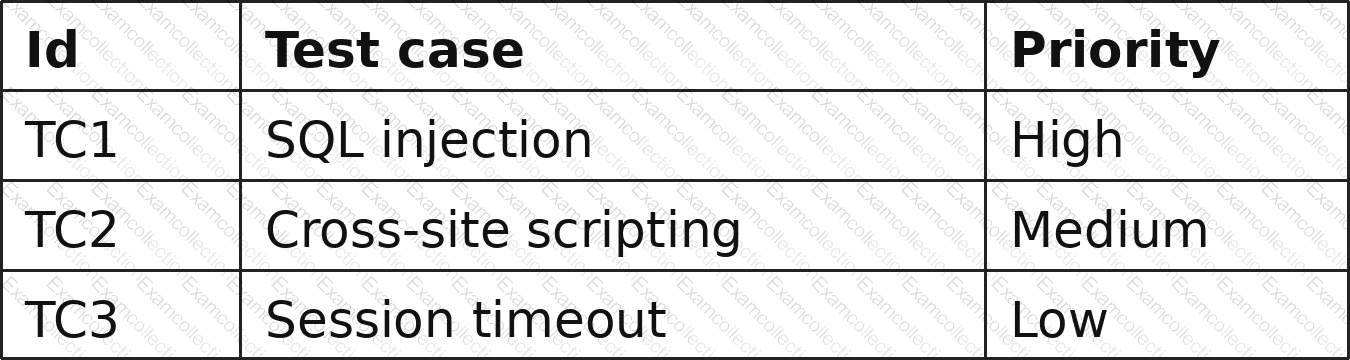
During which activity of the security test process was this action carried out?
Why do test oracles derived from standards and best practices benefit security testers?
An e-commerce website includes an integrated product inventory management system that communicates with an internal server to verify product availability. The system is complex, has a complicated architecture, and contains many interconnected components.
Because of a flaw in processing user-provided URLs, an attacker can manipulate a URL input to cause unauthorized internal requests to the server. This is an example of a Server-Side Request Forgery (SSRF) vulnerability.
You have only just discovered this vulnerability and have little time to improve this version of the software before delivering it to the customer.
What is the BEST technique for handling this vulnerability in the scenario described above?
Which of the following tools is used for dynamic security testing?
Which of the following accurately describes the role of security testing in the context of security audits?
Your company is launching a new web-based e-commerce platform that lets customers create accounts, browse products, and make purchases. Because the platform will integrate with payment gateways and process sensitive customer information, such as personal data and credit card details, the security team is concerned about vulnerabilities that attackers could exploit. To provide strong security, you want to conduct security testing that evaluates and mitigates the most common and critical web application security risks.
Which of the following would be MOST BENEFICIAL for the team to achieve this goal?