


ISTQB CTAL-TM - Certified Tester Advanced Level Test Management (CTAL-TM) v3.0
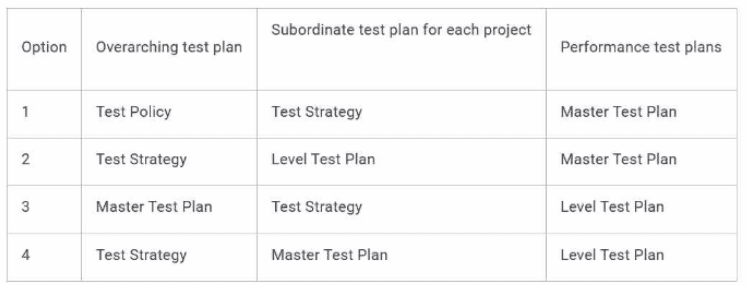
Refer to SCENARIO 2 It has been agreed that the following test planning documents will be produced;
• A single overarching document outlining the general testing methodology for the whole programme of work
• A subordinate test plan for each of the three projects
• A separate test plan for performance testing within each project
Which one of the following options BEST describes the type of test management document that will meet the programme requirements?
What is the primary use for the traceability information regarding the relationship between test results and test conditions during test execution? [2]
You are writing a system test level plan and are defining the test activities that must take place during test implementation. There is an established project risk register in place, with product risks addressing all new features to be developed. Three time-boxed cycles of system test execution are planned, and all the new features will be delivered in the first cycle.
The project test strategy states that the stakeholders require an overall view of the product quality for these features. This should be achieved by planning to test each product risk, to some degree, during the first cycle of test execution.
Which risk-based mitigation approach should be adopted during test implementation, to BEST meet the stakeholders' requirement?
Following identification of a number of costly system performance failures late in the development lifecycle, your organisation has introduced a more rigorous review process for system design documents and source code to enhance phase containment. There will be subsequent checks to see if the improved review process detects/prevents these types of performance defects which are likely to have the highest impact on the technical behavior of the system. You have been tasked with evaluating the current defect management tool that will be used to support the reviews and dynamic testing, to ensure that the correct defect data attributes will be captured to enable these checks to be done.
Which three of the following attributes would be MOST effective?
a) Phase of introduction
b) Severity
c) Steps to reproduce the failure
d) Resolution details
e) Phase of detection
SELECT ONE OPTION
You are the Test Manager on a project to replace an old sales and merchandising system with one that will be based on modern platforms.
The main requirements for the system are:
Loading sales data, sent electronically from the stores each evening, into a central database.
Producing sales reports for the merchandisers.
Producing forecast reports, used to predict demand.Loading sales data and producing reports with the current system has frequently taken longer than the overnight processing window allows. The Data Centre Manager requires that all batch processing takes at least 10% less time than currently.The Sales and Merchandising Manager is more concerned about usability because the parameter entry will be complex.Which option contains two key considerations that would need to be added to your test approach?
You have been asked to implement formal reviews at your company. From the list below, what are the correct characteristics of a formal review?
a. Entry and exit criteria have been defined.
b. Checklists created to be used by all reviewers.
c. Consistency with current project plan is checked.
d. Metrics on effectiveness will be gathered.
e. The review will be moderated by a lead auditor.
Test results are reported as "Requirements tested, passed, and failed".
What test strategy are you using? [1]
Which TWO of the following statements are TRUE about a model-based improvement approach?
You are Test Manager for a project which is in the Test Implementation stage for the first planned iteration, creation of the initial Test Cases and required test data is progressing well.
The Test Strategy documents the Stakeholders view that small teams should collaborate together to create and test functionality which is to be released in iterations, with each release building on the success of the last.
Stakeholders are willing to accept the risks of a partly working system in the early stages. Delivery of working functionality (particularly around interfaces to third party systems and performance of back end databases) is the priority for the early releases.
Which of the following test types would you select for this first planned iteration, in order to meet Stakeholders expectations?
a) Usability testing
b) Structural testing
c) Functional testing of process flows
d) Performance testing
e) Business process testing
f) Component integration testing
You are Test Manager for a project which is in the Test Implementation stage for the first planned iteration, creation of the initial Test Cases and required test data is progressing well.
The Test Strategy documents the Stakeholders view that small teams should collaborate together to create and test functionality which is to be released in iterations, with each release building on the success of the last.
Stakeholders are willing to accept the risks of a partly working system in the early stages. Delivery of working functionality (particularly around interfaces to third party systems and performance of back end databases) is the priority for the early releases.
Which of the following test types would you select for this first planned iteration, in order to meet Stakeholders expectations?
a) Usability testing
b) Structural testing
c) Functional testing of process flows
d) Performance testing
e) Business process testing
f) Component integration testing
As the Test Manager for an agile project how would you BEST plan and guide the testing activities during development? SELECT ONE OPTION
