


AAFM CWM_LEVEL_2 - Chartered Wealth Manager (CWM) Certification Level II Examination
Section A (1 Mark)
Which factor can trigger the stagnation or decline in value of a property?
Section C (4 Mark)
As a CWM you are required to calculate the tax liability of an individual whose Taxable income is:
• $ 85650 in US dollars and he is a US citizen (single individual)
• $ 159000 in SGD and he is a citizen of Singapore
Section C (4 Mark)
Read the senario and answer to the question.
As a CWM® which option would you recommend from the following to Neeraj and Kapil so that their tax liability is minimum if they invest in the debt based scheme
Section A (1 Mark)
Which of the following is NOT a major consideration in the asset allocation process?
Section B (2 Mark)
Manish is thinking of acquiring some shares of ABC. Ltd. The rate of returns is as follows:
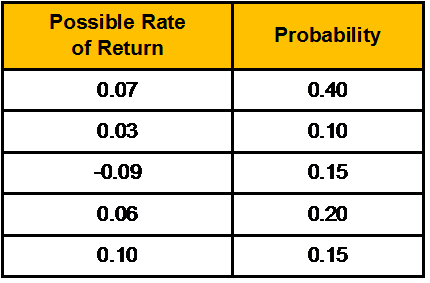
Calculate the variance and the standard deviation
Section A (1 Mark)
Select the CORRECT statement regarding basis risk associated with futures.
Section A (1 Mark)
The life-cycle theory of asset allocation proposes that as investors progress through life, their
Section B (2 Mark)
As a result of a lawsuit, Catherine was awarded $300,000 for compensatory damages and $400,000 for punitive damages. What is the taxable income resulting from this suit?
Section C (4 Mark)
As a CWM you are required to calculate the tax liability of an individual whose Taxable income is:
• $125000 in US dollars and he is a US citizen (single individual)
• $109000 in SGD and he is a citizen of Singapore
Section C (4 Mark)
The returns of 2 shares are as follows
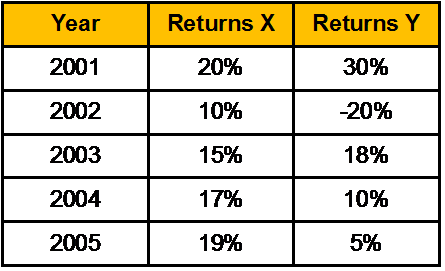
Calculate the covariance of returns.
Section C (4 Mark)
Read the senario and answer to the question.
Sajan and Jennifer want to arrange for the funds to meet marriage expenses of their children. They plan the wedding of Mark after 23 years from now and that of Stephanie after 25 years from now. To accumulate the funds for marriage, you advise to start a monthly Systematic investment Plan (SIP) immediately in Equity scheme of a mutual fund. Such SIP will continue for the next 15 years. You further advise to hold the investment in equity shares till Stephanie’s marriage to meet the wedding expenses. After meeting the expenses of Marks’ marriage, the balance fund in the quity scheme are allowed to appreciate to meet the differential expenses of Stephanie’s marriage. The amount of SIP comes to __________.
Section A (1 Mark)
The________________ deals with the double-edged enigma of why individuals like dividends (in developed country where dividends are taxable) and why this method of income distribution persists in light of quite burdensome double taxation.
Section A (1 Mark)
______________ is based on a particular (theoretical) lottery game that leads to a random variable with infinite expected value, i.e., infinite expected payoff, but would nevertheless be considered to be worth only a very small amount of money.
Section B (2 Mark)
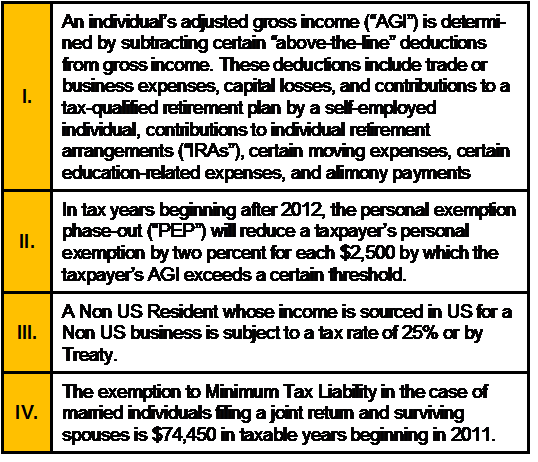
Which of the following statements with respect to US Taxation Structure is/are correct?
Section C (4 Mark)
Vinod has a investment portfolio of Rs. 100000, a floor of Rs. 75000, and a multiplier of 2. So the initial portfolio mix is 50000 in stocks and 50000 in bonds. If stock market falls by 20%, what should Vinod do assuming he is following a CPPI policy?
Section A (1 Mark)
A European put option can be exercised
Section A (1 Mark)
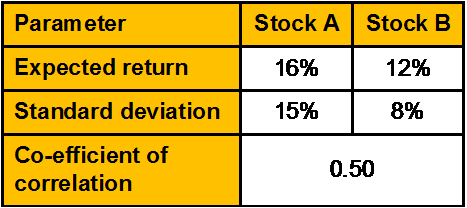
From the following data calculate the expected rate of return of a portfolio in which A and B has weights equally:
Section A (1 Mark)
A ____________________ tax system places a relatively large tax burden on upper-income people and a relatively small tax burden on lower-income people.
Section A (1 Mark)
A market timing approach that increases the proportion of funds in stocks when the stock market is expected to be rising, and increases cash when the stock market is expected to be falling is a:
Section C (4 Mark)
The following parameters are available for four mutual funds:
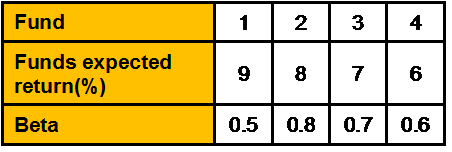
Calculate Treynor’s performance index for each of the funds on the assumption that r=6% where r stands for the risk – free interest rate.
Section A (1 Mark)
Which of the following options is not true about CODICIL?
Section B (2 Mark)
Consider the multifactor model APT with two factors. Portfolio A has a beta of 0.75 on factor 1 and a beta of 1.25 on factor 2. The risk premiums on the factor 1 and factor 2 portfolios are 1% and 7%, respectively. The risk-free rate of return is 7%. The expected return on portfolio A is __________ if no arbitrage opportunities exist.
Section B (2 Mark)
Which of the following statements is/are true?

Section A (1 Mark)
A(n) _____________ is an assurance that investors will be repaid in the event of the default of the underlying loans in a securitization. These can be internal or external to the securitization process and lower the risk of the securities.
Section B (2 Mark)
Matrix Ltd has a current ratio of 1.6, and a quick ratio equal to 1.2. The company has Rs 20,00,000 in sales and its current liabilities are Rs 10, 00,000. What is the company’s inventory turnover ratio?
Section A (1 Mark)
If your credit application is denied, you:
Section B (2 Mark)
A taxpayer has taxable income for 2011-12 (after deducting the personal allowance) of £75,200. None of the income is derived from savings or dividends. The income tax liability for the year is:
Section A (1 Mark)
The __________ is NOT a market anomaly.
Section C (4 Mark)
Navin Corporation, a manufacturer of do-it-yourself hardware and housewares, reported earnings per share of Rs2.10 in 1993, on which it paid dividends per share of Rs0.69. Earnings are expected to grow 15% a year from 1994 to 1998, during which period the dividend payout ratio is expected to remain unchanged. After 1998, the earnings growth rate is expected to drop to a stable 6%, and the payout ratio is expected to increase to 65% of earnings. The firm has a beta of 1.40 currently, and it is expected to have a beta of 1.10 after 1998. The Risk Free rate is 6.25%.
What is the value of the stock, using the two-stage dividend discount model?
Section B (2 Mark)
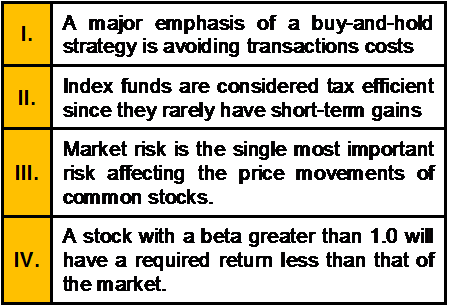
Which of the following Statements are correct?
Section B (2 Mark)
Actual Loss ratio is
Section A (1 Mark)
In The CAMPARI model of Credit evaluation ‘C’ stands for:
Section A (1 Mark)
The most common type of interest rate swap is
Section B (2 Mark)
Mr. Manish purchased a residential house for Rs.3 lakh on 1-4-1972. Its market value on 1-4-1981 was, however, Rs.12 lakh. He sells the house during the financial year 2011-12 for Rs.98 lakh. Calculate the taxable long term capital gain.[CII-12-13: 852,11-12: 785,10-11:711]
Section A (1 Mark)
Which of the following income is not exempt under section 10-
Section A (1 Mark)
The way to reduce tax liability by taking full advantage provided by the Act is
Section A (1 Mark)
_______________ reveals that people often focus on short-term financial events to the detriment of their long-term needs.
Section A (1 Mark)
_______________ consists of the constatation that people buy both insurances and lottery tickets .
Section A (1 Mark)
The covariance of the market returns with the stocks returns is 0.007. The standard deviation of the market is 7% and standard deviation of stock’s return is 10%. What is the correlation coefficient between stocks and market returns?
Section B (2 Mark)
A financial institution plans to issue a group of bonds backed by a pool of automobile loans. However, they fear that the default rate on the automobile loans will rise well above 4 percent of the portfolio – the projected default rate. The financial institution wants to lower the interest payments if the loan default rate rises too high. Which type of credit derivative contract would you most recommend for this situation?
Section B (2 Mark)
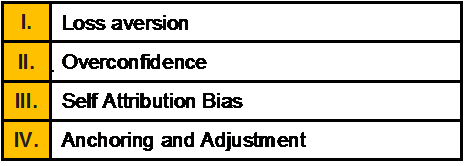
Mr. Jatin is a single forty nine year-old pharmaceutical executive earningRs25,00,000 per year. He lives extravagantly, occasionally spending more than his income, but has saved approximately Rs. 15,00,000. His primary investment goal is to donate Rs30,00,000 to his alma mater, but cannot obtain life insurance. Mr. Jatin exhibits the following biases:
Section A (1 Mark)
Mr. Naresh is working in a reputed company and earning Rs. 5,00,000/- p.a. and is now 50 years old. He has invested Rs. 2,50,000/- in an annuity which will pay him after 5 years a certain amount p.a. at the end of every year for 10 years. Rate of interest is 8% p.a. Calculate how much he will receive at the end of every year after 5 years?
Section A (1 Mark)
Hedge funds often seek to take advantage of market inefficiencies such as:
Section A (1 Mark)
A(n) _____________ is related to the credit option and is usually aimed at lenders able to handle comparatively limited declines in value but wants insurance against serious losses.
Section A (1 Mark)
Deduction under section 80C shall be allowed:
Section A (1 Mark)
The concept of designing marketing communication programs that coordinate all promotional activities to provide a consistent message across all audiences is called
Section C (4 Mark)
The probability distribution of the rate of return on ABC stock is given below:
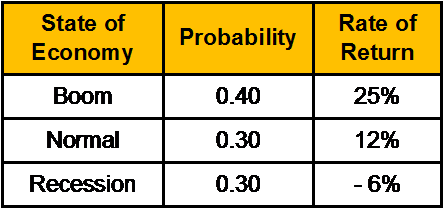
What is the standard deviation of return?
Section B (2 Mark)
You are estimating the value of a small office building. Suppose the estimated NOI for the first year of operations is Rs100,000. a. If you expect that NOI will remain constant at Rs100,000 over the next 50 years and that the office building will have no value at the end of 50 years, what is the present value of the building assuming a 12.2% discount rate?
Section C (4 Mark)
Read the senario and answer to the question.
If the interest on a sum of amount is compounded annually at the rate of 14% per annum for 3 years, what is the effective continuously compounding rate of interest?
Section A (1 Mark)
When deciding under uncertainty, which of the following generally accepted guidelines that a decision maker should follow: