

AAFM CWM_LEVEL_2 - Chartered Wealth Manager (CWM) Certification Level II Examination
Section B (2 Mark)
Rajiv's company was just surprised by a new competitor in their field. Rajiv wants to plan a way for his business to retake the lead. For this purpose, Rajiv offered a plan to compete in the market. Which one of the following parts of the strategic landscape has been described?
Section C (4 Mark)
As a CWM you are required to calculate the tax liability of an individual whose taxable income is:
• $321500 in SGD and he is a Singapore citizen
• £ 35214p.a (only dividends) and he is a UK citizen
Section B (2 Mark)
You are given the following set of data on security ABC:
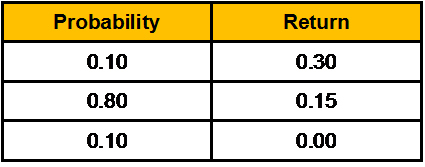
Calculate the expected return on security ABC?
Section A (1 Mark)
Mr. Sharma is aged 50 years at present. He has invested some amount in an annuity which will pay him after 10 years Rs. 25,000/- p.a. at the beginning of every year for 10 years. Rate of interest is 6% p.a. Calculate how much amount he has invested now?
Section C (4 Mark)
J&M had a return on equity of 31.5% in 1993, and paid out 37% of its earnings as dividends. The stock had a beta of 1.25. (The treasury bill rate is 6%.) The extraordinary growth is expected to last for ten years, after which the growth rate is expected to drop to 6% and the return on equity to 15% (the beta will move to 1).
Assuming the return on equity and dividend payout ratio continue at current levels for the high growth period, estimate the P/BV ratio for J&M.
Section B (2 Mark)
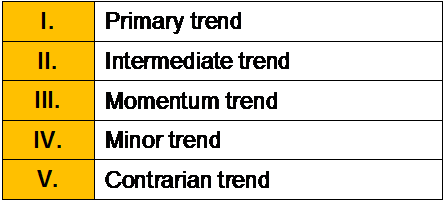
The Dow theory illustrates that the three forces that simultaneously affect stock prices are ____________.
Section A (1 Mark)
If a testator makes a will ‘to induce another person to make him comply with his (testators) wish’ but does not have any testamentary operation or intention, then this will is called as
Section C (4 Mark)
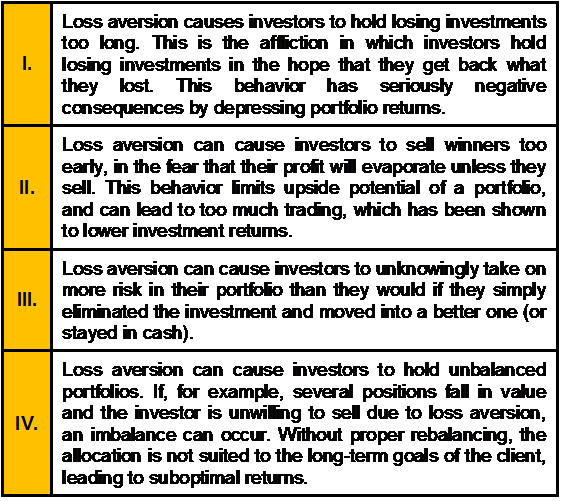
Which of the following statements is/are correct?
Section B (2 Mark)
Manav wishes to have a retirement corpus of Rs. 2,50,000/- in 30 years’ time. Assuming that he can earn a ROI of 12 % per annum, what amount he should invest yearly into a fund to reach his goal?
Section C (4 Mark)
Consider the following information for three mutual funds:

Market Return 10%
Risk free return is 7%.
Calculate Jensen measure (%).
Section C (4 Mark)
Read the senario and answer to the question.
Calculate the tax liability of Mr. Neeraj for the A.Y.08–09 assuming that he has avail full deduction under section 80C
Section A (1 Mark)
A document which is used to hand over the legal powers to sign on legal documents pertaining to the property to someone other than the owner is called_____________
Section C (4 Mark)
Nifty is presently at 2694. Mr. XYZ expects Nifty to fall. He buys one Nifty ITM Put with a strike price Rs. 2800 at a premium of Rs. 132 and sells one Nifty OTM Put with strike price Rs. 2600 at a premium Rs. 52.
What would be the Net Payoff of the Strategy?
• If Nifty closes at 2359
• If Nifty closes at 3561
Section B (2 Mark)
In a collateralized mortgage obligation (CMO) a tranche:
Section A (1 Mark)
Which of the following is a challenge of making a consumer loan?
Section A (1 Mark)
The goal of the Dow theory is to
Section B (2 Mark)
Which of the following statements is TRUE concerning zero coupon bonds?
Section B (2 Mark)
Which of the following statements is / are correct?
Section B (2 Mark)
What is the outstanding balance at the 23rd payment interval of a 16-year loan for Rs11 234 with semi-annual payments and an interest rate of 7.95% compounded quarterly?
Section C (4 Mark)
Suppose you have decided to sell your house and downsize by acquiring a townhouse that you have been eyeing for several years. You do not feel extreme urgency in selling your house; but the associated taxes are eating into your monthly cash flow, and you want to unload the property as soon as possible. Your real estate agent, whom you have known for many years, prices your home at Rs 90,00,000—you are shocked.
You paid Rs 250,000 for the home only 15 years ago, and the Rs 900,000 figure is almost too thrilling to believe. You place the house on the market and wait a few months, but you don’t receive any nibbles. One day, your real estate agent calls, suggesting that the two of you meet right away. When he arrives, he tells you that Pharma Growth, a company that moved into town eight years ago in conjunction with its much-publicized initial public offering (IPO), has just declared bankruptcy.
Now, 7,500 people are out of work. Your agent has been in meetings all week with his colleagues, and together they estimate that local real estate prices have taken a hit of about 10 percent across the board. Your agent tells you that you must decide the price at which you want to list your home, based on this new information. You tell him that you will think it over and get back to him shortly.
Assume your house is at the mean in terms of quality and salability.
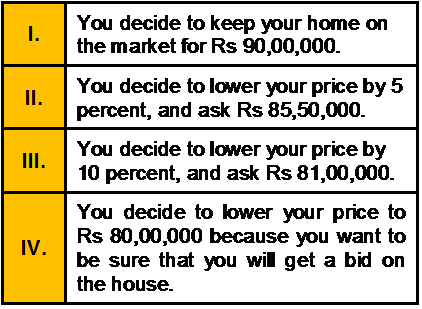
What is your likeliest course of action if you exhibit Anchoring and Adjustment bias?
Section C (4 Mark)
Read the senario and answer to the question.
If Mahesh has the option of 3 funds whose details are as below, find Jensen’s index for fund A, Treynor index for fund B and Sharpe index for the market
Section A (1 Mark)
The legal heir of the deceased who receives family pension is allowed a standard deduction from such family pension received to the extent of:
Section C (4 Mark)
Roger deposits Rs. 10,00,000 in a bank account on 1st March 2005 and another Rs. 5,00,000 on 1st March 2011. He wants to withdraw all of this money with interest on 1st March 2015. If the account pays ROI of 11% p.a. compounded quarterly what amount can he withdraw from this account?
Section A (1 Mark)
You buy a investment plan by investing Rs. 6000/- per month for first 12years and Rs. 11000/- per month for next 12 years. If the rate of interest is 15% per annum compounded monthly . How much amount would you have after 24 years?
Section A (1 Mark)
A bank is considering making a loan to Ram Kapoor. Ram has a gross salary per month of Rs40500 but has take-home pay of Rs27500 per month. What aspect of evaluating a consumer loan application is this fact most concerned with?
Section C (4 Mark)
You as a Chartered Wealth Manager are approached by a client who is depositing some amount in an account that pays a ROI of 12% p.a compounded monthly. She also has an option of investing in another account that pays ROI 12.76% p.a. compounded annually. She wants to know which of these is a better choice.
Section A (1 Mark)
NSSO stands for ____________
Section A (1 Mark)
Riskier stocks have
Section A (1 Mark)
Fiscal policy is difficult to implement quickly because
Section A (1 Mark)
The __________the suggested deviation from the rational portfolio asset allocation, the _________ the need to mitigate the investor’s behavioral biases
Section B (2 Mark)
A typical personal accident policy would normally have provisions to pay
Section B (2 Mark)
You are required to calculate standard deviation of the following portfolio
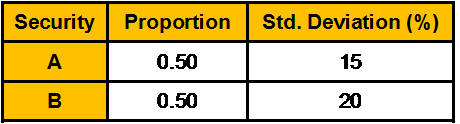
CovAB = 220.
Section B (2 Mark)
Mr. L Singh used machinery in his business. This is the only asset in the block. 20% of the usage is for personal purposes. The WDV of the block as on 31.3.2011 is —
Section B (2 Mark)
Akash has only compulsory third party policy for his car. He jumped a red light and collided with another car and then with the boundary wall of a nearby house. Damage to his car was of Rs. 17,000/-, damage to other car was of Rs. 15,000/- and damage to the boundary wall of house was of Rs. 15,000. The insurance policy of Akash will pay:
Section B (2 Mark)
Expenses are 10% of the gross (office) premium. Pure premium is Rs. 200. Calculate office premium.
Section B (2 Mark)
In regard to moving averages, it is considered to be a ____________ signal when market price breaks through the moving average from ____________.
Section B (2 Mark)
The expected market return 16 percent. The risk-free rate of return is 7 percent, and AB Co. has a beta of 1.1. The risk premium is
Section A (1 Mark)
Following is not a head of income
Section B (2 Mark)
In the year to 31 March 2012, a UK resident company made a UK trading profit of £800,000 and received net overseas income of £26,000 (net of 20% withholding tax). These were the company's only sources of income. The company also paid a qualifying charitable donation of £5,000.
For double tax relief purposes, the charitable donation will be allocated as a deduction from the company's overseas income. True or False?
Section B (2 Mark)
In the year to 31 March 2012, A Ltd (which is UK resident) made a UK trading profit of £100,000. The company's only other income consisted of rents received of £52,500 (net) from an investment property in Germany. These rents were received net of withholding tax of 25%. A Ltd has no associated companies.
The credit for double tax relief that will be given in the corporation tax computation for the year will be:
Section B (2 Mark)
In case of a defined benefit plan where the benefit payable is based on the terminal salary, an increase in of 10% of the wages of the employees would increase the contribution to be made by the employer for the benefit by
Section A (1 Mark)
Customer service facilitation includes EXCEPT:
Section B (2 Mark)
X Ltd. has given a dividend of Rs. 3 per share last year. The company is growing at a constant rate of 5 % every year and the investor’s required rate at this share is 12 % per annum. Find out the Intrinsic value of this share.
Section A (1 Mark)
Deduction under section 80QQB is allowed to an author of a book of literary or artistic or scientific nature who is resident in India to the extent of:
Section A (1 Mark)
Short-term capital gain arising for the transfer of equity shares and units of equity oriented fund shall be taxable
Section A (1 Mark)
Liquid assets comprise
Section A (1 Mark)
Short-term to medium-term loans repayable in two or more consecutive payments are known as:
Section A (1 Mark)
A testamentary trust is affected after the
Section C (4 Mark)
Read the senario and answer to the question.
Sajan sold 350 shares of a company at Rs. 300 each on 1st March 2010. He purchased 50 shares on 1st May 1979 for Rs. 20 each. The fair market value was Rs. 40 each as on 1st April 1981. Again on 7 August 1998, he was allotted 50 bonus shares. The fair market value was Rs. 115 each as on 7th August 1998. He purchased additional 250 shares on 1st April 2009 for Rs. 150 each. Calculate the capital gains on shares sold.
(CII – 1981-82 : 100; 1998-99 : 351; 2008-2009 ; 582; 2009-10; 632)
Section A (1 Mark)
When two banks simply agree to exchange a portion of their customers' loan repayments, they are using: