


Black Friday Rush: 75% Off All Exam Bundles! Apply the coupon code below before the offer expires! - Ends in 0d 00h 00m 00s - Coupon code: newyear

Linux Foundation Cilium-Associate - Cilium Certified AssociateCCA

Please review the output of cilium status below and answer the question that follows. Please note, the output has been modified for accessibility purposes.
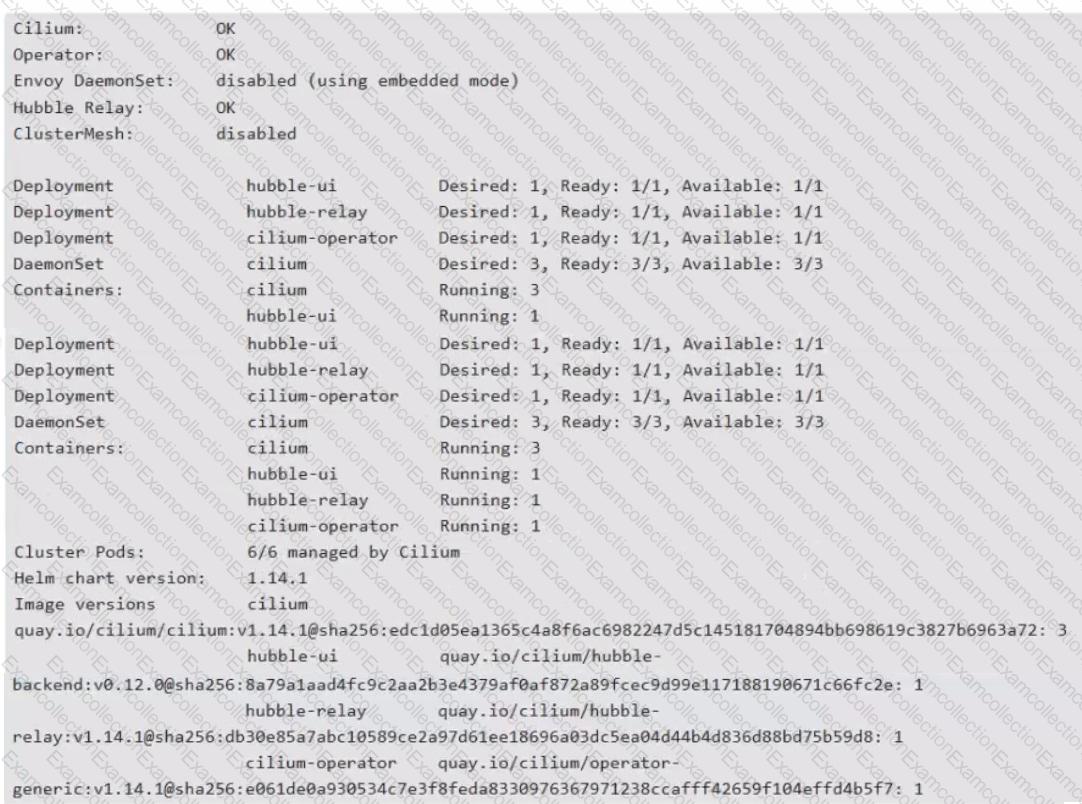
Question 2 cilium status exhibit

Assume the cluster is healthy. What is correct about the ci 1 ium status command output above?

A.

The Kubernetes cluster where Cilium has been deployed should consist of four nodes.

B.

When specific Cilium features require Layer 7 processing, the Cilium agent starts an Envoy proxy as a separate process within the Cilium agent pod.

C.

The component that allows you to query multiple Hubble instances simultaneously and aggregate the results is unhealthy.

D.

Cilium has been installed and configured in a multi-cluster deployment model to provide load balancing and service discovery.

What is correct about the Kubernetes Host Scope IP Address Management (IPAM) mode?

A.

It supports multiple CIDRs (Classless Inter-Domain Routing) per cluster

B.

It supports multiple CIDRs (Classless Inter-Domain Routing) per node.

C.

It can beset by using the ipam: crd configuration flag.

D.

It supports both tunnel and direct routing modes.

What are the differences between Ingress and Gateway API?

A.

Ingress and Gateway API serve the same purpose, but they are Just different names for the same Kubernetes resource. Ingress is used in older Kubernetes versions, while Gateway API is the updated version for modern clusters, but the underlying functionality is identical.

B.

Ingress primarily targets exposing HTTP applications with a simple, declarative syntax. Gateway API exposes a more general API for proxying that can be used for more protocols than just HTTP, and models more infrastructure components to provide better deployment and management options for cluster operators.

C.

Cilium offers seamless integration with the Gateway API, enhancing Kubernetes networking and security through advanced features powered by eBPF. This integration provides a robust solution for network management. In contrast, Ingress relies on IPtables for its functionality.

D.

Gateway API is primarily used for internal cluster routing, while Ingress is exclusively for external traffic management. Gateway API does not support routing for internet-exposed services, whereas Ingress is specifically designed for that purpose.

What is the correct statement about the masquerading feature?

A.

The iptables-based masquerading is the most efficient Implementation.

B.

It replaces the source IP of traffic leaving the cluster to the node's IP address.

C.

It is comparable to Destination Network Address Translation (DNAT).

D.

The eBPF-based masquerading is supported on all kernel versions.

This an Ingress configuration. What is the equivalent Gateway API configuration?
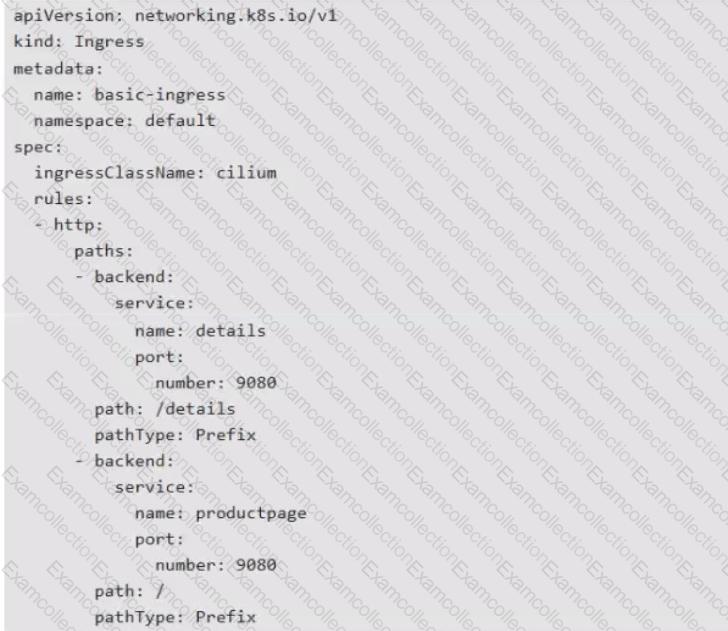
Question 19 source Ingress

A)
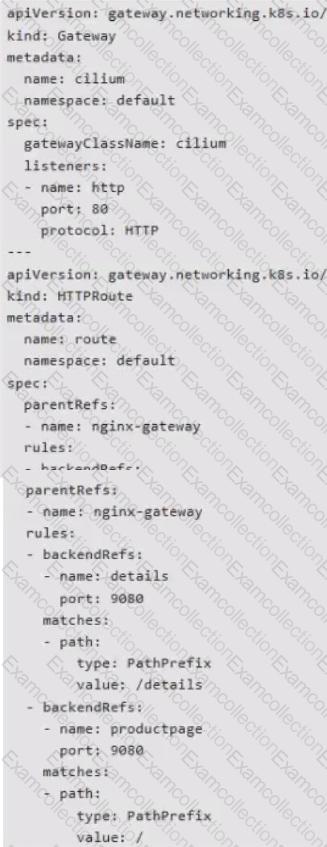
Question 19 option A

B)
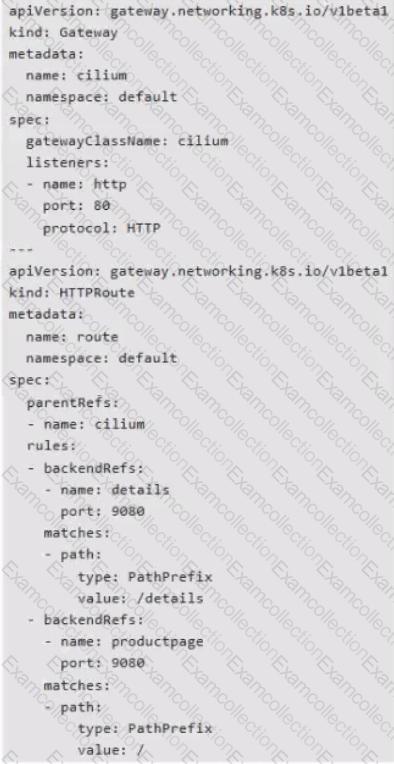
Question 19 option B

C)
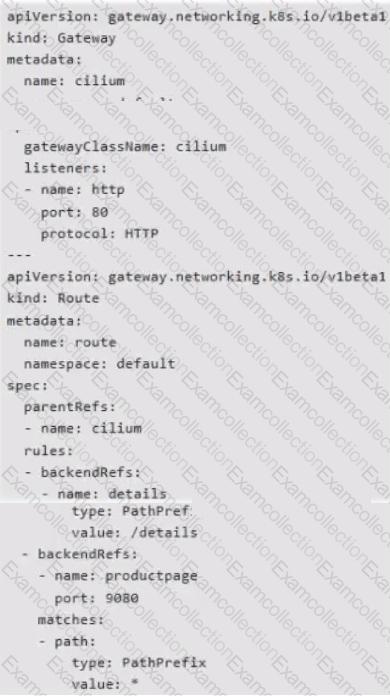
Question 19 option C

D)
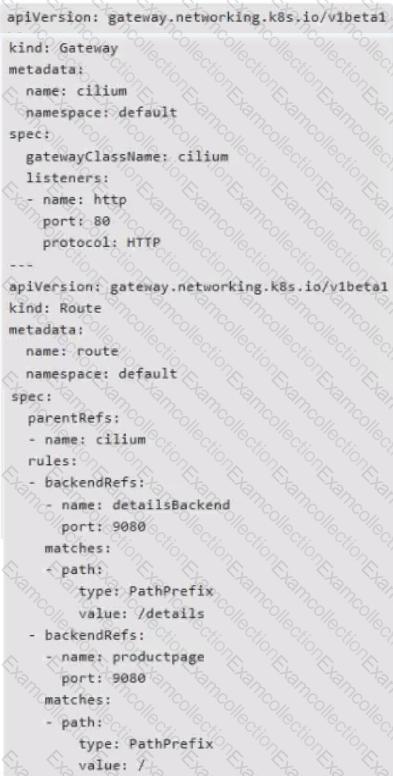
Question 19 option D

A.

Option A

B.

Option B

C.

Option C

D.

Option D

Which component manages the allocation of per-node PodCIDRs in the cluster-scope IPAM (IP address management) mode?

A.

Kubernetes through the host-scope IPAM.

B.

The Cllium Agents on the nodes.

C.

Cilium Operator via CiliumNode resource.

D.

Kubernetes through the Node resource.

The Cilium Agent is deployed as part of the Cilium installation. What of the following is true about the Cilium Agent?

A.

Cilium Agent registers the Custom Resource Definitions that Cilium uses.

B.

Cilium Agent creates the CiliumEndpoint objects for each pod in the cluster.

C.

Cilium Agent manages IP addresses for LoadBalancer type services (if LB IPAM is used).

D.

Cilium Agent synchronizes Kubernetes nodes information to the shared KVStore.

The application team would like to observe egress traffic with application level information for workloads running in a Cilium based Kubernetes Cluster Which features would offer this without the need for additional tooling?

A.

Cilium Load Balancing

B.

Fluentd and Grafana

C.

Kubernetes Network Policies

D.

Hubble Ul and CLI