
New Year Sale Special Limited Time 70% Discount Offer - Ends in 0d 00h 00m 00s - Coupon code: xmas50

Paloalto Networks CloudSec-Pro - Palo Alto Networks Cloud Security Professional

Page: 2 / 8
Total 258 questions

A customer has a requirement to restrict any container from resolving the name www.evil-url.com.

How should the administrator configure Prisma Cloud Compute to satisfy this requirement?

A.

Choose “copy into rule” for any Container, set www.evil-url.com as a blocklisted DNS name in the Container policy and set the policy effect to alert.

B.

Set www.evil-url.com as a blocklisted DNS name in the default Container runtime policy, and set the effect to block.

C.

Choose “copy into rule” for any Container, set www.evil-url.com as a blocklisted DNS name, and set the effect to prevent.

D.

Set www.evil-url.com as a blocklisted DNS name in the default Container policy and set the effect to prevent.

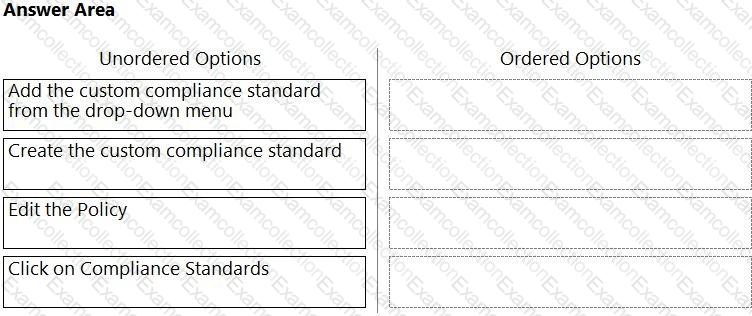
Which order of steps map a policy to a custom compliance standard?

(Drag the steps into the correct order of occurrence, from the first step to the last.)
What is the most reliable and extensive source for documentation on Prisma Cloud APIs?

A.

prisma.pan.dev

B.

docs.paloaltonetworks.com

C.

Prisma Cloud Administrator’s Guide

D.

Live Community

Which two attributes are required for a custom config RQL? (Choose two.)

A.

json.rule

B.

cloud.account

C.

api.name

D.

tag

Which two services require external notifications to be enabled for policy violations in the Prisma Cloud environment? (Choose two.)

A.

Splunk

B.

QROC

C.

SQS

D.

Email

Which three elements are part of SSH Events in Host Observations? (Choose three.)

A.

Startup process

B.

User

C.

System calls

D.

Process path

E.

Command

Web-Application and API Security (WAAS) provides protection for which two protocols? (Choose two.)

A.

HTTP

B.

SSH

C.

Tomcat Web Connector via AJP

D.

TLS

Which “kind” of Kubernetes object is configured to ensure that Defender is acting as the admission controller?

A.

MutatingWebhookConfiguration

B.

DestinationRules

C.

ValidatingWebhookConfiguration

D.

PodSecurityPolicies

Which step should a SecOps engineer implement in order to create a network exposure policy that identifies instances accessible from any untrusted internet sources?

A.

In Policy Section-> Add Policy-> Config type -> Define Policy details Like Name,Severity-> Configure RQL query "config from network where source.network = UNTRUSTJNTERNET and dest.resource.type = 'Instance' and dest.cloud.type = 'AWS*" -> define compliance standard -> Define recommendation for remediation & save.

B.

In Policy Section-> Add Policy-> Network type -> Define Policy details Like Name.Severity-> Configure RQL query "network from vpc.flow_record where source.publicnetwork IN ('Suspicious IPs', 'Internet IPs') and dest.resource IN (resource where role IN ('Instance ))" -> define compliance standard -> Define recommendation for remediation & save.

C.

In Policy Section-> Add Policy-> Network type -> Define Policy details Like Name.Severity-> Configure RQL query "network from vpc.flow_record where source.publicnetwork IN ('Suspicious IPs', 'Internet IPs') and dest.resource IN (resource where role IN ( Instance ))" -> define compliance standard -> Define recommendation for remediation & save.

D.

In Policy Section-> Add Policy-> Network type -> Define Policy details Like Name.Severity-> Configure RQL query "config from network where source.network = UNTRUSTJNTERNET and dest.resource.type = 'Instance' and dest.cloud.type = 'AWS'" -> Define recommendation for remediation & save.

Which two actions are required in order to use the automated method within Amazon Web Services (AWS) Cloud to streamline the process of using remediation in the identity and access management (IAM) module? (Choose two.)
A.

Install boto3 & requests library.

B.

Configure IAM Azure remediation script.

C.

Integrate with Azure Service Bus.

D.

Configure IAM AWS remediation script.