

Microsoft DP-750 - Implementing Data Engineering Solutions Using Azure Databricks
You have an Azure Databricks workspace named Workspace1 that contains a cluster named Cluster1.
You need to enable a user named User1 to install a Maven package on all the nodes of Cluster1. The solution must follow the principle of least privilege.
What should you do?
You have an Azure Databricks workspace that contains a Delta table named Table 1. Table 1 has accumulated obsolete files.
You need to reduce storage costs. The solution must preserve 30 days of time travel history. Which two actions should you perform? Each correct answer presents part of the solution.
NOTE: Each correct selection is worth one point.
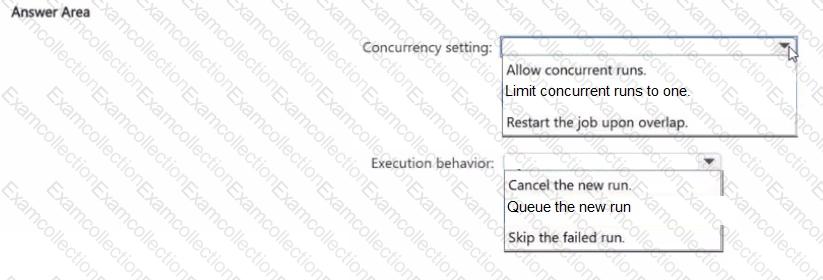
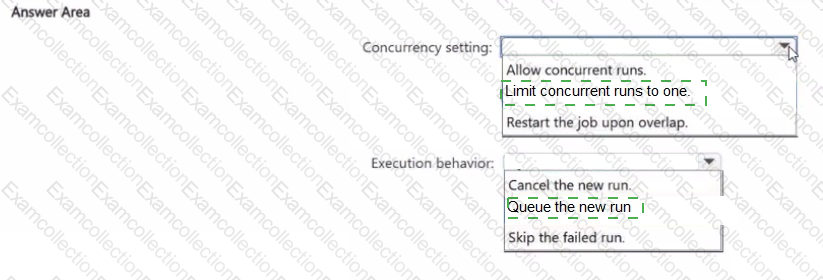
You have an Azure Databricks workspace that contains a job in Lakeflow Jobs named Job1.
Job! runs every hour.
Occasionally, the job run takes longer than one hour to complete. Overlapping runs must be prevented to avoid data corruption.
You need to configure the job scheduling behavior.
What should you configure? To answer, select the appropriate options in the answer area.
NOTE: Each correct selection is worth one point.
You have an Azure Databricks workspace that contains a job in Lakeflow Jobs named Job1.
Job1 processes raw data files stored in Azure Storage.
New files arrive at unpredictable intervals.
You need to ensure that Job1 starts automatically when new files arrive and does NOT consume compute resources when no data is available.
Which type of job trigger should you use?
You have an Azure Databricks workspace that is enabled for Unity Catalog.
You need to profile a table to meet the following requirements:
The count of null values per column must be evaluated repeatedly as new records are added to the table.
Changes in the count of null values must be observable over the progression of the dataset.
Which type of profile should you create?
You have an Azure Databricks workspace that contains a job in Lakeflow Jobs named Job1.
Job! processes raw data files stored in Azure Storage.
New files arrive at unpredictable intervals.
You need to ensure that Job1 starts automatically when new files arrive and does NOT consume compute resources when no data is available.
Which type of job trigger should you use?
You have an Azure Databricks workspace that is enabled for Unity Catalog.
You need to implement a daily batch data process that requires complex and highly customized Python transformations. The solution must minimize additional complexity.
What should you include in the solution?
You have an Azure Databricks workspace that contains a Git folder and uses Azure Repos as the Git provider. From the main branch, you create a branch named Branch1. You commit changes to Branch1.
You need to incorporate the changes from Branch1 into main The solution must preserve the commit history in the repository. Which command should you run?
You need to configure compute for the ingestion of telemetry data. The solution must meet the data ingestion and processing requirements.
What should you do?
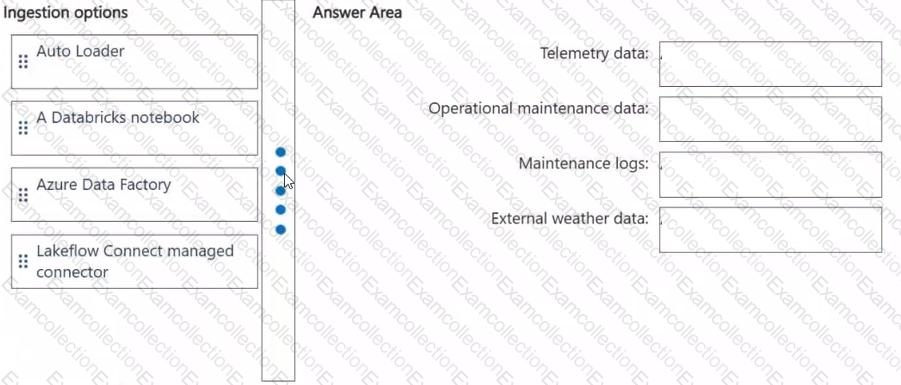
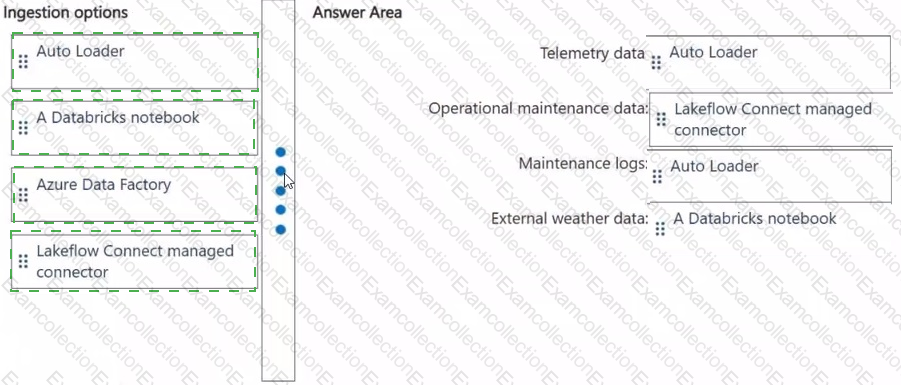
Which ingestion option should you recommend for each data source? To answer, drag the appropriate options to the correct data sources. Each option may be used once, more than once, or not at all. You may need to drag the split bar between panes or scroll to view content.
NOTE: Each correct selection is worth one point.