


Microsoft DP-800 - Developing AI-Enabled Database Solutions
You have a SQL database in Microsoft Fabric that contains a column named Payload. pay load stores customer data in JSON documents that have the following format.
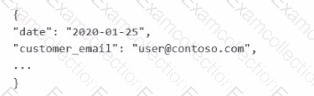
Data analysis shows that some customers have subaddressing in their email address, for example, user1+promo@contoso.com.
You need to return a normalized email value that removes the subaddressing, for example, user! + promo@contoso.com must be normalized to userl@contoso.com.
Which Transact SQL expression should you use?
You have an Azure SQL database that contains a table named dbo.ManualChunks. dbo.HonualChunks contains product manuals
A retrieval query already returns the top five matching chunks as nvarchar(max) text.
You need to call an Azure OpenAI REST endpomt for chat completions. The request body must include both the user question and theretiieved chunks.
You write the following Transact-SQL code.
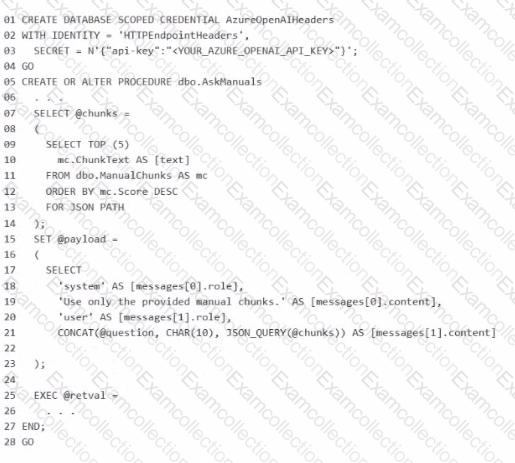
What should you insert at line 22?
You have a SQL database in Microsoft Fabric that contains a table named dbo.Orders, dbo.Orders has a clustered index, contains three years of data, and is partitioned by a column named OrderDate by month.
You need to remove all the rows for the oldest month. The solution must minimize the impact on other queries that access the data in dbo.orders.
Solution: Run the following Transact-SQL statement.
DELETE FROM dbo.Orders
WHERE OrderDate < DATEADD(nonth, -36, SYSUTCDATETIME());
Does this meet the goal?
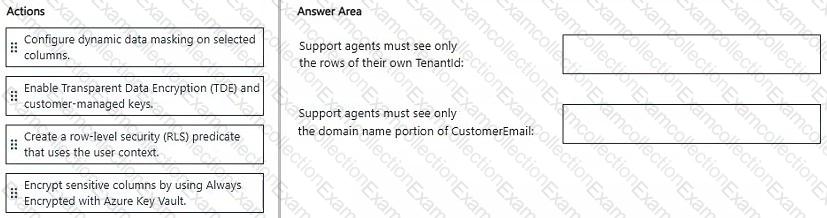
You have an Azure SQL database named sqldb-ai-prod that stores customer support tickets for a multitenant software as a service (SaaS) application. sqldb-ai-prod contains a table named Tickets. Tickets contains columns named TenantId, TicketId, CustomerEmail, CustomerPhone, and Notes.
You plan to harden data access, since a new support team will use ad hoc reporting tools that connect directly to sqldb-ai-prod.
You need to configure security to meet the following requirements:
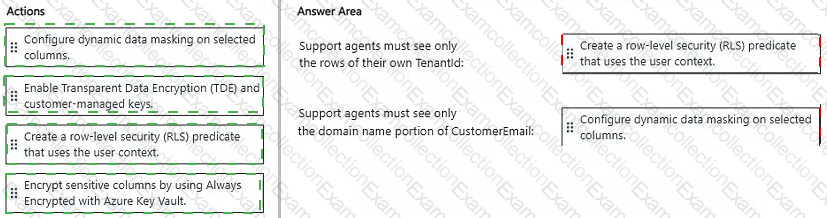
• Support agents must see only the rows of their own TenantId column.
• Support agents must see only the domain name portion of the CustomerEmail column.
What should you do for each requirement? To answer, drag the appropriate actions to the correct requirements. Each action may be used once, more than once, or not at all. You may need to drag the split bar between panes or scroll to view content.
NOTE: Each correct selection is worth one point.
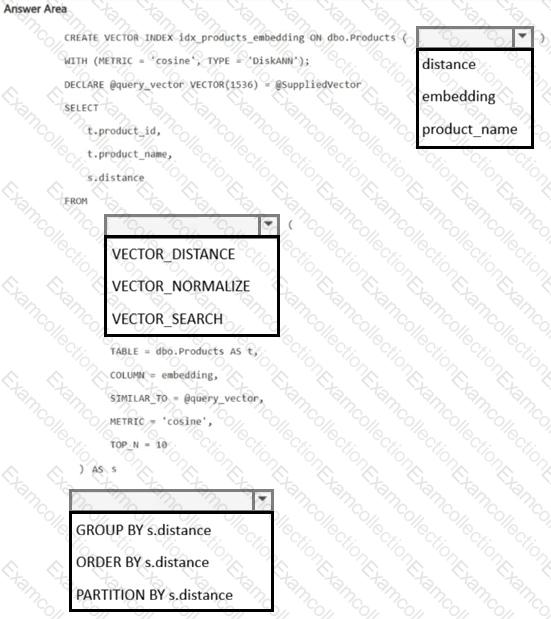
You have a SQL database in Microsoft Fabric named SalesDB that contains a table named dbo.Products.
You need to modify SalesDB to meet the following requirements:
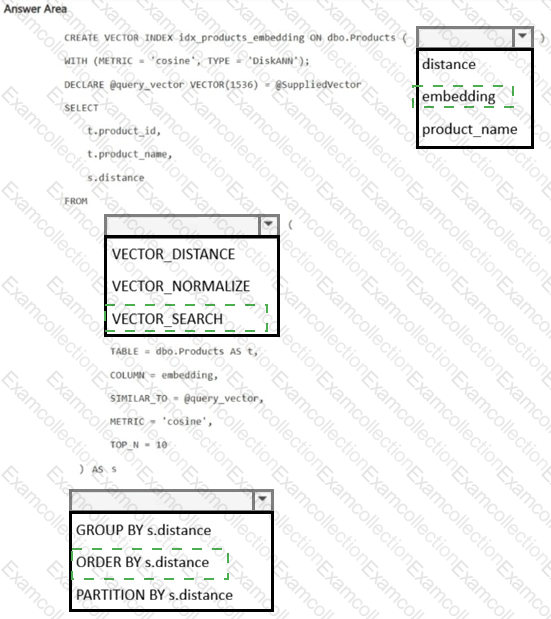
Create a vector index on the appropriate column.
Use a supplied natural language query vector.
How should you complete the Transact-SQL code? To answer, select the appropriate options in the answer area.
NOTE: Each correct selection is worth one point.
You have an Azure SQL database that contains the following SQL graph tables:
• A NODE table named dbo.Person
• An EDGE table named dbo.Knows
Each row in dbo.Person contains the following columns:
• Personid (int)
• DisplayName (nvarchar(100))
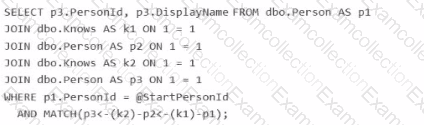
You need to use a HATCH operator and exactly two directed Knows relationships to return the Personid and DisplayName of people that are reachable from the person identified by an input parameter named @startPersonid.
Which Transact-SQL query should you use?
A)

B)
C)

D)

You have an Azure SQL database that contains tables named dbo.ProduetDocs and dbo.ProductuocsEnbeddings. dbo.ProductOocs contains product documentation and the following columns:
• Docld (int)
• Title (nvdrchdr(200))
• Body (nvarthar(max))
• LastHodified (datetime2)
The documentation is edited throughout the day. dbo.ProductDocsEabeddings contains the following columns:
• Dotid (int)
• ChunkOrder (int)
• ChunkText (nvarchar(aax))
• Embedding (vector(1536))
The current embedding pipeline runs once per night
Vou need to ensure that embeddings are updated every time the underlying documentation content changes The solution must NOT ' equire a nightly batch process.
What should you include in the solution?
You have a SQL database in Microsoft Fabric that contains a column named Payload. Payload stores customer data in JSON documents that have the following format:
JSON
{
" date " : " 2026-01-25 " ,
" customer_email " : " user@contoso.com " ,
...
}
Data analysis shows that some customers have subaddressing in their email address; for example, user1+promo@contoso.com.
You need to return a normalized email value that removes the subaddressing, for example, user1+promo@contoso.com must be normalized to user1@contoso.com.
Which Transact-SQL expression should you use?
