

New Year Sale Special Limited Time 70% Discount Offer - Ends in 0d 00h 00m 00s - Coupon code: xmas50

Databricks Databricks-Certified-Associate-Developer-for-Apache-Spark-3.5 - Databricks Certified Associate Developer for Apache Spark 3.5 – Python

A developer is running Spark SQL queries and notices underutilization of resources. Executors are idle, and the number of tasks per stage is low.

What should the developer do to improve cluster utilization?

A.

Increase the value of spark.sql.shuffle.partitions

B.

Reduce the value of spark.sql.shuffle.partitions

C.

Increase the size of the dataset to create more partitions

D.

Enable dynamic resource allocation to scale resources as needed

A data engineer needs to persist a file-based data source to a specific location. However, by default, Spark writes to the warehouse directory (e.g., /user/hive/warehouse). To override this, the engineer must explicitly define the file path.

Which line of code ensures the data is saved to a specific location?

Options:

A.

users.write(path="/some/path").saveAsTable("default_table")

B.

users.write.saveAsTable("default_table").option("path", "/some/path")

C.

users.write.option("path", "/some/path").saveAsTable("default_table")

D.

users.write.saveAsTable("default_table", path="/some/path")

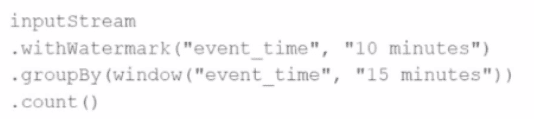
Given this code:

.withWatermark("event_time", "10 minutes")

.groupBy(window("event_time", "15 minutes"))

.count()

What happens to data that arrives after the watermark threshold?

Options:

A.

Records that arrive later than the watermark threshold (10 minutes) will automatically be included in the aggregation if they fall within the 15-minute window.

B.

Any data arriving more than 10 minutes after the watermark threshold will be ignored and not included in the aggregation.

C.

Data arriving more than 10 minutes after the latest watermark will still be included in the aggregation but will be placed into the next window.

D.

The watermark ensures that late data arriving within 10 minutes of the latest event_time will be processed and included in the windowed aggregation.

A data engineer needs to write a DataFrame df to a Parquet file, partitioned by the column country, and overwrite any existing data at the destination path.

Which code should the data engineer use to accomplish this task in Apache Spark?

A.

df.write.mode("overwrite").partitionBy("country").parquet("/data/output")

B.

df.write.mode("append").partitionBy("country").parquet("/data/output")

C.

df.write.mode("overwrite").parquet("/data/output")

D.

df.write.partitionBy("country").parquet("/data/output")

Given this view definition:

df.createOrReplaceTempView("users_vw")

Which approach can be used to query the users_vw view after the session is terminated?

Options:

A.

Query the users_vw using Spark

B.

Persist the users_vw data as a table

C.

Recreate the users_vw and query the data using Spark

D.

Save the users_vw definition and query using Spark

1 of 55. A data scientist wants to ingest a directory full of plain text files so that each record in the output DataFrame contains the entire contents of a single file and the full path of the file the text was read from.

The first attempt does read the text files, but each record contains a single line. This code is shown below:

txt_path = "/datasets/raw_txt/*"

df = spark.read.text(txt_path) # one row per line by default

df = df.withColumn("file_path", input_file_name()) # add full path

Which code change can be implemented in a DataFrame that meets the data scientist's requirements?

A.

Add the option wholetext to the text() function.

B.

Add the option lineSep to the text() function.

C.

Add the option wholetext=False to the text() function.

D.

Add the option lineSep=", " to the text() function.

A Spark DataFrame df is cached using the MEMORY_AND_DISK storage level, but the DataFrame is too large to fit entirely in memory.

What is the likely behavior when Spark runs out of memory to store the DataFrame?

A.

Spark duplicates the DataFrame in both memory and disk. If it doesn't fit in memory, the DataFrame is stored and retrieved from the disk entirely.

B.

Spark splits the DataFrame evenly between memory and disk, ensuring balanced storage utilization.

C.

Spark will store as much data as possible in memory and spill the rest to disk when memory is full, continuing processing with performance overhead.

D.

Spark stores the frequently accessed rows in memory and less frequently accessed rows on disk, utilizing both resources to offer balanced performance.

Which Spark configuration controls the number of tasks that can run in parallel on the executor?

Options:

A.

spark.executor.cores

B.

spark.task.maxFailures

C.

spark.driver.cores

D.

spark.executor.memory

A data scientist is analyzing a large dataset and has written a PySpark script that includes several transformations and actions on a DataFrame. The script ends with a collect() action to retrieve the results.

How does Apache Sparkâ„¢'s execution hierarchy process the operations when the data scientist runs this script?

A.

The script is first divided into multiple applications, then each application is split into jobs, stages, and finally tasks.

B.

The entire script is treated as a single job, which is then divided into multiple stages, and each stage is further divided into tasks based on data partitions.

C.

The collect() action triggers a job, which is divided into stages at shuffle boundaries, and each stage is split into tasks that operate on individual data partitions.

D.

Spark creates a single task for each transformation and action in the script, and these tasks are grouped into stages and jobs based on their dependencies.

A developer wants to refactor some older Spark code to leverage built-in functions introduced in Spark 3.5.0. The existing code performs array manipulations manually. Which of the following code snippets utilizes new built-in functions in Spark 3.5.0 for array operations?
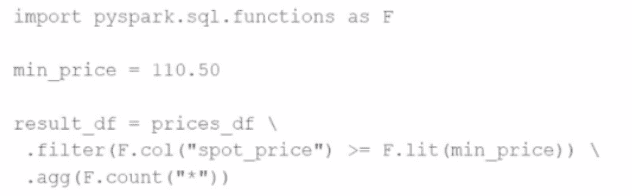
A)

B)

C)

D)


A.

result_df = prices_df \

.withColumn("valid_price", F.when(F.col("spot_price") > F.lit(min_price), 1).otherwise(0))

B.

result_df = prices_df \

.agg(F.count_if(F.col("spot_price") >= F.lit(min_price)))

C.

result_df = prices_df \

.agg(F.min("spot_price"), F.max("spot_price"))

D.

result_df = prices_df \

.agg(F.count("spot_price").alias("spot_price")) \

.filter(F.col("spot_price") > F.lit("min_price"))