

CIMA F3 - Financial Strategy
A company needs to raise $20 million to finance a project.
It has decided on a rights issue at a discount of 20% to its current market share price.
There are currently 20 million shares in issue with a nominal value of $1 and a market price of $5 per share.
 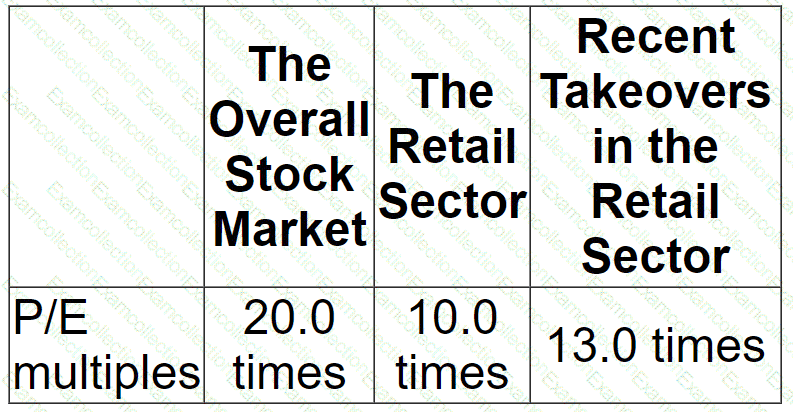
Calculate the terms of the rights issue.
Holding cash in excess of business requirements rather than returning the cash to shareholders is most likely to result in lower:
Company A has a cash surplus.
The discount rate used for a typical project is the company's weighted average cost of capital of 10%.
No investment projects will be available for at least 2 years.
Â
Which of the following is currently most likely to increase shareholder wealth in respect of the surplus cash?
A company is located in a single country. The company manufactures electrical goods for export and for sale in its home country. When exporting, it invoices in its customers' currency. What currency risks is the company exposed to?
An unlisted company which is owned and managed by its original founders has accumulated excess cash following many years of profitable trading.
The Board of Directors is comprised of the four original founders who each hold 25% of the equity share capital.
Â
Which THREE of the following will be significant considerations when deciding on the company's dividend policy?Â
A company enters into a floating rate borrowing with interest due every 12Â months over the five year life of the borrowing.Â
At the same time, the company arranges an interest rate swap to swap the interest profile on the borrowing from floating to fixed rate.Â
These transactions are designated as a hedge for hedge accounting purposes under IAS 39 Financial Instruments: Recognition and Measurement.
Â
Assuming the hedge is considered to be effective, how would the swap be accounted for 12 months later?Â
A listed company is planning a share repurchase.
The following data applies
• There are 20 million shares in issue
• The share repurchase will involve buying back 10% of the shares at a price of $1.20
• The company is holding $4.8 million cash
• Earnings for the current year ended are $3.6 million
The Directors are concerned about the impact that this repurchase programme will have on the company's cash balance and current year earnings per share (EPS) ratio.
Advise the directors which of the following statements is correct?
A company is currently all-equity financed with a cost of equity of 8%.Â
It plans to raise debt with a pre-tax cost of 4% in order to buy back equity shares.
After the buy-back, the debt-to-equity ratio at market values will be 1 to 2.
The corporate income tax rate is 30%.
Â
Which of the following represents the company's cost of equity after the buy-back according to Modigliani and Miller's Theory of Capital Structure with taxes?
Company BBB has prepared a valuation of a competitor company, Company BBD. Company BBB is intending to acquire a controlling interest in the equity of Company BBD and therefore wants to value only the equity of Company BBD.

The directors of Company BBB have prepared the following valuation of Company BBD:
Value of Equity = 4.63 + 5.14 + 5.56 = S15.33 million
Additional information on Company BBD:

Which THREE of the following are weaknesses of the above valuation?
Company AAB is located in country A whose currency is the AS It has a subsidiary, BBA, located m country B that has the BS as its currency AAB has asked BBA to pay BS40 million surplus funds to AAB to assist with a planned new capital investment in country A The exchange rate today is AS1 = BS3
Tax regimes
• Company BBA pays withholding tax of 25% on all cash remitted to the parent company
• Company AAB pays tax of 10% on at cash received from its subsidiary
How much will company AAB have available for investment after receiving the surplus funds from BBA?