


F5 F5CAB2 - BIG-IP Administration Data Plane Concepts (F5CAB2) exam
What is the result when a BIG-IP Administrator manually disables a pool member ? (Choose one answer)
An application is configured so that the same pool member must be used for an entire session , and this behavior must persist across HTTP and FTP traffic . A user reports that a session terminates and must be restarted after the active BIG-IP device fails over to the standby device.
Which configuration settings should the BIG-IP Administrator verify to ensure proper behavior when BIG-IP failover occurs? (Choose one answer)
The BIG-IP Administrator disables all pool members in a pool. Users are still able to reach the pool members.
What is allowing users to continue to reach the disabled pool members?
A BIG-IP Administrator assigns the default HTTP health monitor to a pool that has three members listening on port 80. When the administrator connects to each pool member using the curl utility, two of the members respond with a status of 404 Not Found , while the third responds with 200 OK . What will the pool show for member availability? (Choose one answer)
A development team needs to apply a software fix and troubleshoot one of its servers. The BIG-IP Administrator needs to immediately remove all connections from the BIG-IP system to the back-end server. The BIG-IP Administrator checks the Virtual Server configuration and finds that a persistence profile is assigned to it. What should the BIG-IP Administrator do to meet this requirement?
To emulate stateless IP routing with BIG-IP, what would be the appropriate virtual server type?
Refer to the exhibit.
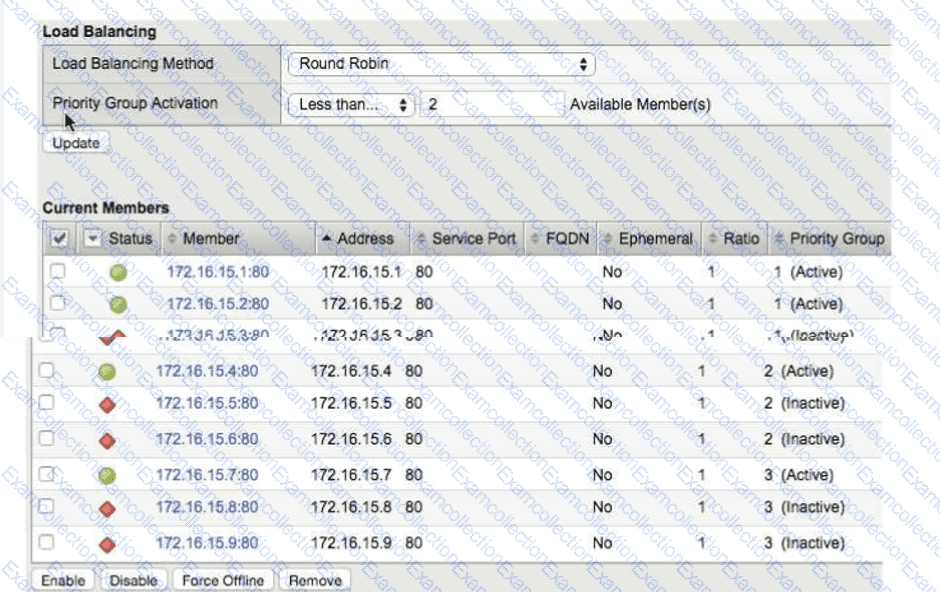
Load Balancing Method: Round Robin
Priority Group Activation: Less than 2 Available Members
Which two pool members should be chosen for a new connection? (Choose two.)
To increase available bandwidth of an existing Trunk, the BIG-IP Administrator is adding additional interfaces. Which command should the BIG-IP Administrator run from within bash shell?
A virtual server is listening at 10.10.1.100:any and has the following iRule associated with it:
when CLIENT_ACCEPTED { if {[TCP::local_port] equals 21 } { pool
ftppool } elseif {[TCP::local_port] equals 23 } { pool telnetpool }
If a user connects to 10.10.1.100 and port 22, which pool will receive the request?
When is an interface considered Available for use in a trunk?