


F5 F5CAB4 - BIG-IP Administration Control Plane Administration (F5CAB4) exam
As an organization grows, more people have to log into the BIG-IP. Instead of adding more local users, the BIG-IP Administrator is asked to configure remote authentication against a central authentication server.
Which two types of remote server can be used here? (Choose two answers)
What is the tmsh command to list the IP ranges that can access the management interface via SSH ? (Choose one answer)
A BIG-IP Administrator needs to restore a UCS file to an F5 device using the Configuration Utility .
Which section of the Configuration Utility should the BIG-IP Administrator access to perform this task? (Choose one answer)
An LTM device has a virtual server mapped to www.f5.com. Users report that when they connect to /resources/201.1.2h.l_l.com they are unable to receive content. What is the likely cause of the issue?
A BIG-IP Administrator receives an RMA replacement for a failed F5 device. The Administrator tries to restore a UCS taken from the previous device, but the restore fails. The following error appears in the /var/log/ltm:
insufficient pool members. 01070608:3: License is not operational
(expired, digital signature does not match contents)
What should the BIG-IP Administrator do to avoid this error ? (Choose one answer)
Users are unable to reach an application. The BIG-IP Administrator checks the Configuration Utility and observes that the Virtual Server has a red diamond in front of the status.
What is causing this issue? (Choose one answer)
Refer to the exhibit.
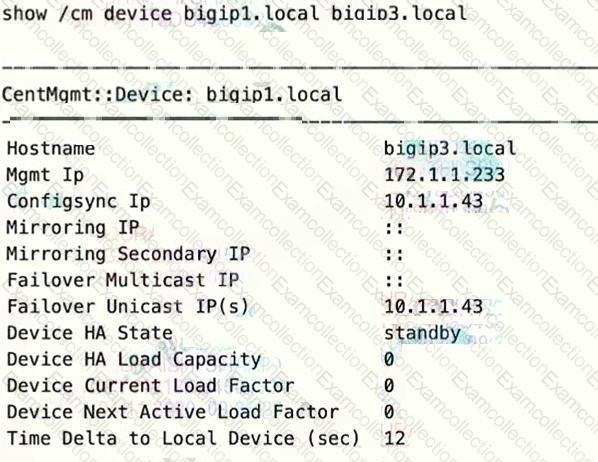
The BIG-IP Administrator runs the command shown and observes a device trust issue between BIG-IP devices in a device group. The issue prevents config sync on device bigip3.local. What is preventing the config sync?
New Syslog servers have been deployed in an organization. The BIG-IP Administrator must reconfigure the BIG-IP system to send log messages to these servers.
In which location in the Configuration Utility can the BIG-IP Administrator make the needed configuration changes to accomplish this? (Choose one answer)
A BIG-IP Administrator wants to allow management access only from a specific subnet. Where should this be configured?
Refer to the exhibit.
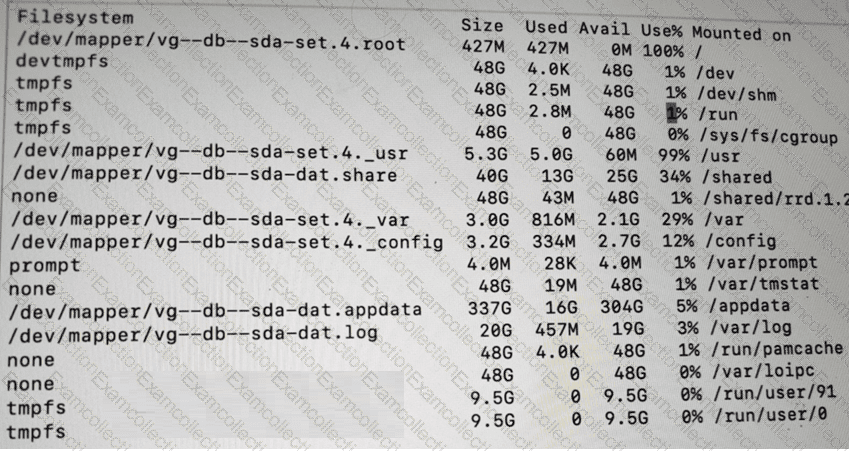
The BIG-IP Administrator is investigating disk utilization on the BIG-IP device. What should the BIG-IP Administrator check next? (Choose one answer)
