Summer Sale Special Limited Time 70% Discount Offer - Ends in 0d 00h 00m 00s - Coupon code: xmas50

Fortinet FCSS_NST_SE-7.6 - Fortinet NSE 6 - Network Security 7.6 Support Engineer

Page: 4 / 4
Total 134 questions

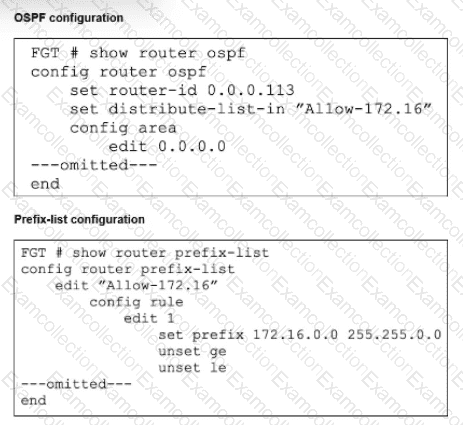
Refer to the exhibits.

An OSPF peer is advertising route 172.16.52.0/24. The local FortiGate is configured with an inbound distribution list that allows the 172.16.0.0/16 network to be injected into its routing table. However, the 1 ' 2.16.52.0/24 subnet cannot be seen in the FIB.

Which two stops can the administrator of the local FortiGate take to ensure that the advertised 172.16. 52.0/24 subnet will be injected into the routing table? (Choose two.)

A.

Add another entry to the prefix list to specifically allow the 172.16.52.0/24 network.

B.

Change the ge value to 17.

C.

Change the R- value lo 16.

D.

Modify the default prefix-list behavior from implicit deny to implicit allow.

A FortiGate administrator is troubleshooting a VPN that is failing to establish.

As a first step, the administrator is attempting to sniff the traffic using the command:

# diagnose sniffer packet any ‘’udp port 500 or udp port 4500 or esp’’ 4

After several minutes there is still no output. What is the most Likely reason for this?

A.

The VPN is configured to use IKE over TCP

B.

esp is not a valid sniffer argument.

C.

The ISP is blocking all VPN traffic.

D.

Mismatched IKE versions are detected on the VPN peers

Which two protocol states indicate that traffic is bidirectional? (Choose two.)

A.

proto_state=01 for a TCP session.

B.

proto_state=01 for a UDP session.

C.

proto_state=05 for a TCP session.

D.

proto_state=00 for an ICMP session.

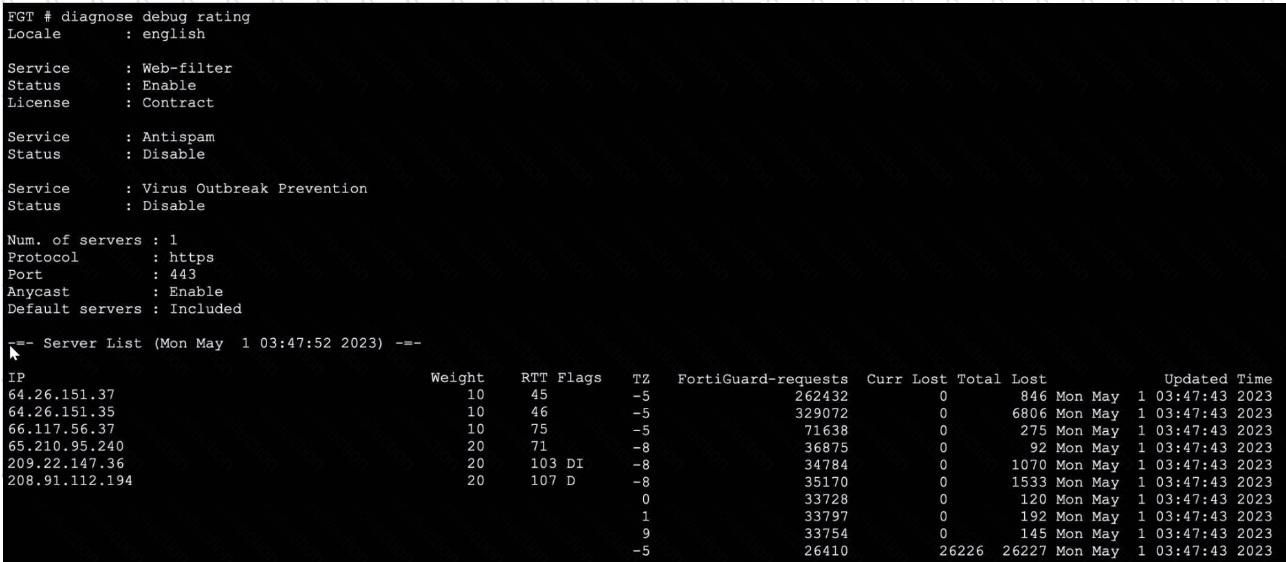
Exhibit.

Refer to the exhibit, which shows the output of a diagnose command.

What can you conclude about the debug output in this scenario?

A.

The first server provided to FortiGate when it performed a DNS query looking for a list of rating servers, was 121.111.236.179.

B.

There is a natural correlation between the value in the FortiGuard-requests field and the value in the Weight field.

C.

FortiGate used 64.26.151.37 as the initial server to validate its contract.

D.

Servers with a negative TZ value are less preferred for rating requests.

Refer to the exhibit.

Partial output of command diagnose debug rating is shown. Which FDS server will the FortiGate algorithm choose?

A.

96.45.33.65

B.

208.91.112.194

C.

64.26.151.37

D.

209.22.147.36

Refer to the exhibit, which shows the output of a debug command.
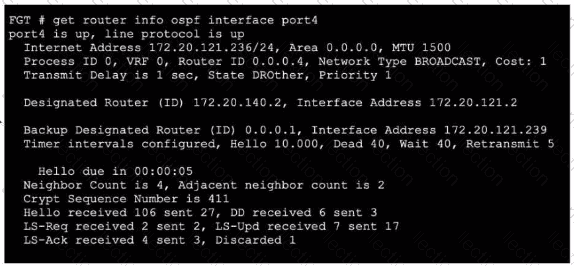
Which two statements about the output are true? (Choose two.)

A.

The interlace is part of the OSPF backbone area.

B.

There are a total of five OSPF routers attached to the vorz4 network segment

C.

One of the neighbors has a router ID of 0.0.0.4.

D.

In the network connected to port4, two OSPF routers are down.

Which three common FortiGate-to-collector-agent connectivity issues can you identify using the FSSO real-time debug? (Choose three.)

A.

Log is full on the collector agent.

B.

Inability to reach IP address of the collector agent.

C.

Refused connection. Potential mismatch of TCP port.

D.

Mismatched pre-shared password.

E.

Incompatible collector agent software version.

Refer to the exhibit, which contains partial output from an IKE real-time debug.
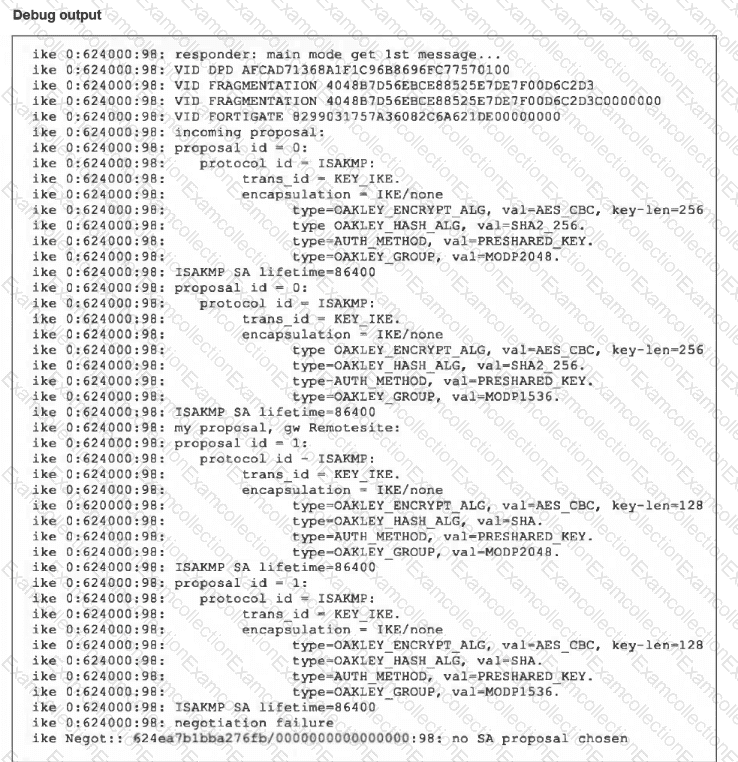
The administrator does not have access to the remote gateway.

Based on the debug output, which configuration change the administrator make to the local gateway to resolve the phase 1 negotiation error?

A.

In the phase 1 proposal configuration, add AES256-SHA256 to the list of encryption algorithms.

B.

In the phase 1 proposal configuration, add AESCBC-SHA2 to the list of encryption algorithms.

C.

In the phase 1 network configuration, set the IKE version to 2.

D.

In the phase 1 proposal configuration, add AES128-SHA128 to the list of encryption algorithms.

Refer to the exhibit, which shows one way communication of the downstream FortiGate with the upstream FortiGate within a Security Fabric.
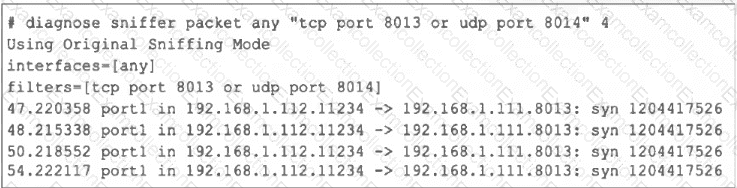
What three actions must you take to ensure successful communication? (Choose three.)

A.

You must authorize the downstream FortiGate on the root FortiGate.

B.

FortiGate must not be in NAT mode.

C.

Ensure TCP port 8013 is not blocked along the way.

D.

You must enable Security Fabric/Fortitelemetry on the receiving interface of the upstream FortiGate.

E.

Ensure the port for Neighbor Discovery has been changed.

Refer to the exhibit.

Partial output of a real-time OSPF debug is shown.
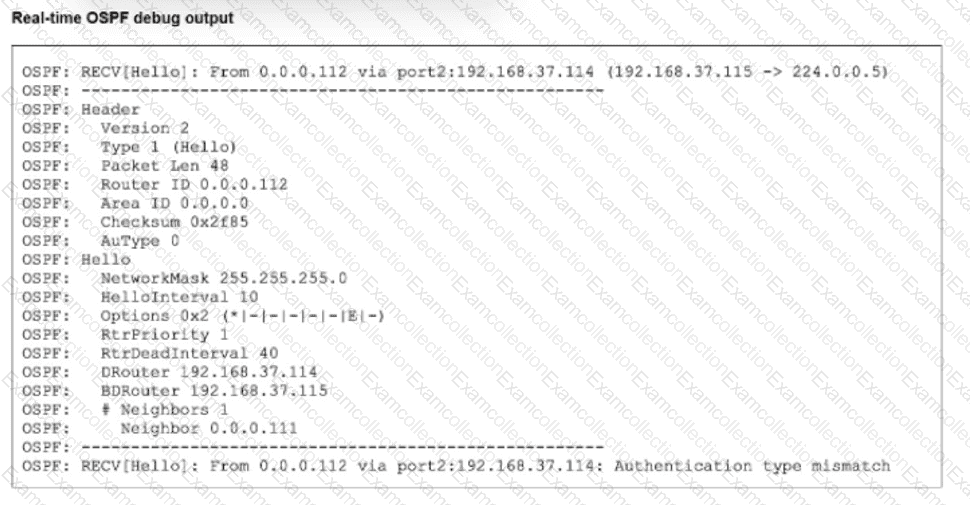
Which two reasons explain why the two FortiGate devices are unable to form an adjacency? (Choose two.)

A.

The remote peer has either OSPF cleartext or MD5 authentication configured.

B.

There is an OSPF authentication configuration mismatch.

C.

The local FortiGate does not have OSPF authentication configured

D.

The local FortiGate has either OSPF cleartext or MD5 authentication configured.