
Summer Sale Special Limited Time 70% Discount Offer - Ends in 0d 00h 00m 00s - Coupon code: xmas50

Fortinet FCSS_NST_SE-7.6 - Fortinet NSE 6 - Network Security 7.6 Support Engineer

Page: 1 / 4
Total 134 questions

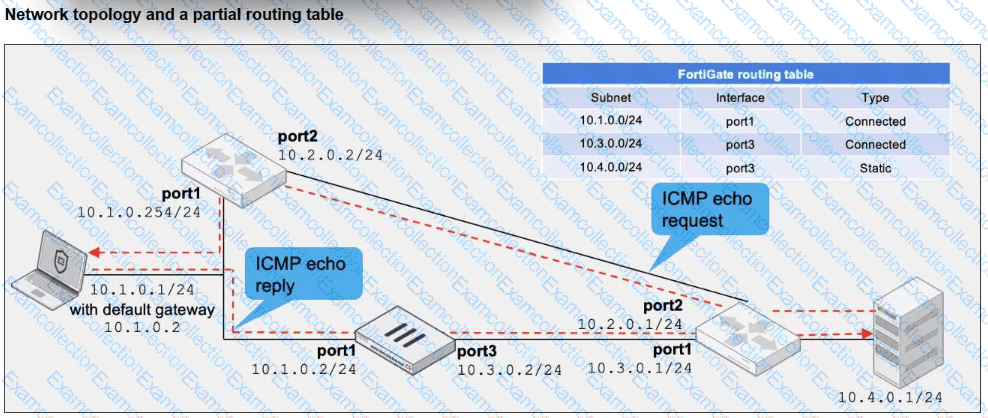
Refer to the exhibit.

A network topology and a partial routing table are shown.

FortiGate has already been configured with a firewall policy that allows all ICMP traffic to flow from port1 to port3.

Which two changes can the administrator perform to ensure the server at 10.4.0.1/24 receives the ICMP echo reply from the laptop at 10.1.0.1/24? (Choose two.)

A.

Enable asymmetric routing under config system settings.

B.

Change the FortiGate configuration from strict RPF check mode to feasible RPF check mode.

C.

Modify the default gateway on the laptop from 10.1.0.2 to 10.1.0.254.

D.

Add a default static route on FortiGate to forward all traffic to port3.

Which two observations can you make from the output? (Choose two.)

A.

The configuration was backed up

B.

A high availability (HA) failover occurred.

C.

The lest was unsuccessful.

D.

The automation stitch test is not being logged.

Refer to the exhibit, which shows the output of a diagnose command.
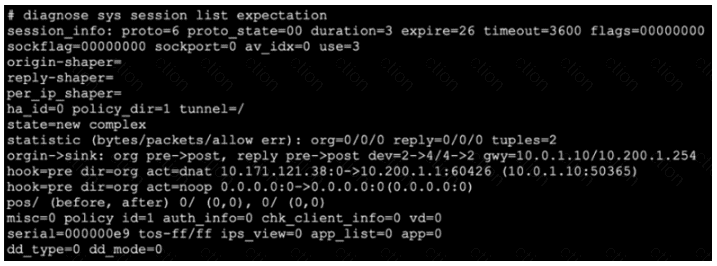
What two conclusions can you draw from the output shown in the exhibit? (Choose two answers)

A.

This is an expected session created by the IPS engine.

B.

Traffic in the original direction (coming from the IP address 10.171.121.38) will be routed to the next-hop IP address 10.0.1.10.

C.

Traffic in the original direction (coming from the IP address 10.171.121.38) will be routed to the next-hop IP address 10.200.1.1.

D.

This is a pinhole session created to allow traffic for a protocol that requires additional sessions to operate through FortiGate.

An administrator wants to capture encrypted phase 2 traffic between two FotiGate devices using the built-in sniffer.

If the administrator knows that there Is no NAT device located between both FortiGate devices, which command should the administrator run?

A.

diagnose sniffer packet any ' udp port 500 '

B.

diagnose sniffer packet any ' lp proto 50 '

C.

diagnose sniffer packet any ' udp port 4500 '

D.

diagnose sniffer packet any ' ah '

A VPN tunnel is up. To monitor traffic flow, the administrator enters the following CLI commands on an SSH session on FortiGate:

# diagnose debug enable

# diagnose sniffer packet any ' udp and port 500 ' 4

However, the sniffer does not show any output. Assuming default configuration values, what are two possible reasons there is no output? (Choose two answers)

A.

The filter should be modified to also capture packets for TCP port 443 or UDP port 4500 .

B.

NAT Traversal is enabled.

C.

The sniffer must be restricted to the remote peer IP address.

D.

The sniffer output will be ignored because running diagnose debug enable shows only application real-time debugs.

Which three conditions are required for two FortiGate devices to form an OSPF adjacency? (Choose three answers)

A.

OSPF link costs match.

B.

OSPF interface priority settings are unique.

C.

OSPF interface network types match.

D.

Authentication settings match.

E.

OSPF router IDs are unique.

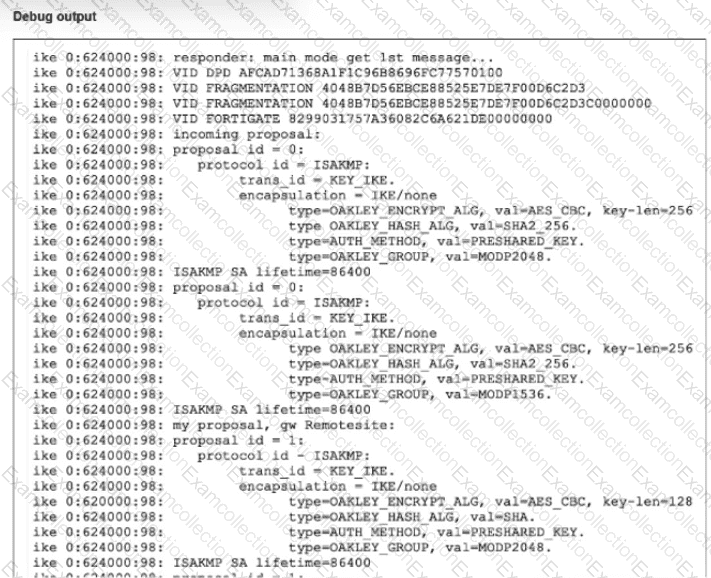
Refer to the exhibit.

A partial output from an IKE real-time debug is shown

The administrator does not have access to (he remote gateway

Based on the debug output, which two conclusions can you draw? (Choose two.)

A.

The remote peer is the initiating peer.

B.

This is a phase1 negotiation.

C.

There is a Diffie-Hellman group mismatch.

D.

This is a phase2 negotiation

Exhibit.

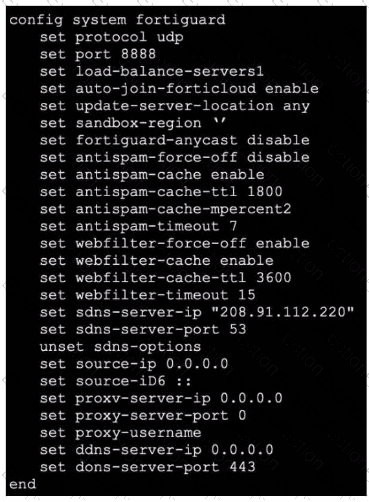
Refer to the exhibit, which shows a FortiGate configuration.

An administrator is troubleshooting a web filter issue on FortiGate. The administrator has configured a web filter profile and applied it to a policy; however the web filter is not inspecting any traffic that is passing through the policy.

What must the administrator do to fix the issue?

A.

Disable webfilter-force-off.

B.

Increase webfilter-timeout.

C.

Enable fortiguard-anycast.

D.

Change protocol to TCP.

Refer to the exhibit showing a debug output.

An administrator deployed FSSO in DC Agent Mode but FSSO is failing on FortiGate. Pinging FortiGate from where the collector agent is deployed is successful.

The administrator then produces the debug output shown in the exhibit.

What could be causing this error message?

A.

The TCP port 445 is blocked between FortiGate and collector agent.

B.

The collector agent preshared password is mismatched.

C.

The FortiGate cannot resolve the active directory server name.

D.

The FortiGate and the collector agent are using different TCP ports.

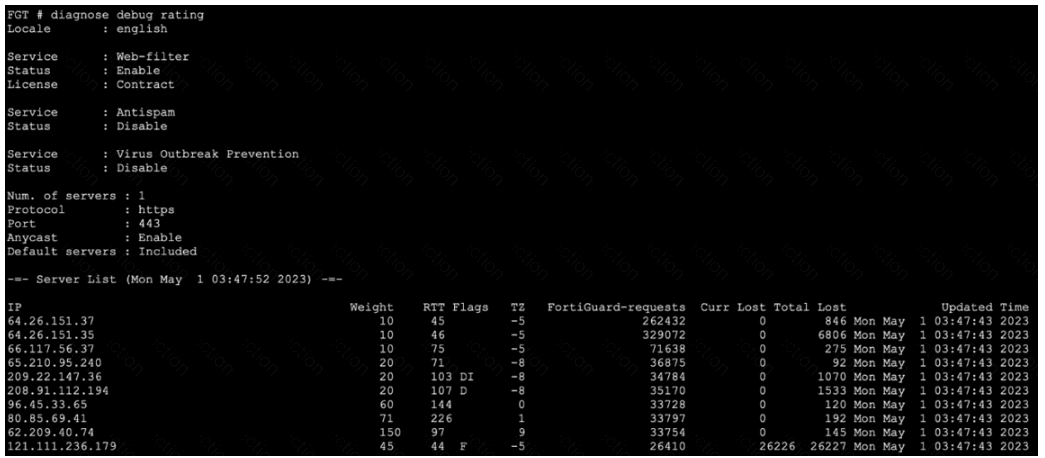
Refer to the exhibit, which shows the output of a diagnose command. What can you conclude from the RTT value?

A.

Its value represents the time it takes to receive a response after a rating request is sent to a particular server.

B.

Its value is incremented with each packet lost.

C.

It determines which FortiGuard server is used for license validation.

D.

Its initial value is statically set to 10.