

New Year Sale Special Limited Time 70% Discount Offer - Ends in 0d 00h 00m 00s - Coupon code: xmas50

Fortinet FCSS_SDW_AR-7.6 - FCSS - SD-WAN 7.6 Architect

Page: 3 / 3
Total 94 questions

Refer to the exhibits.

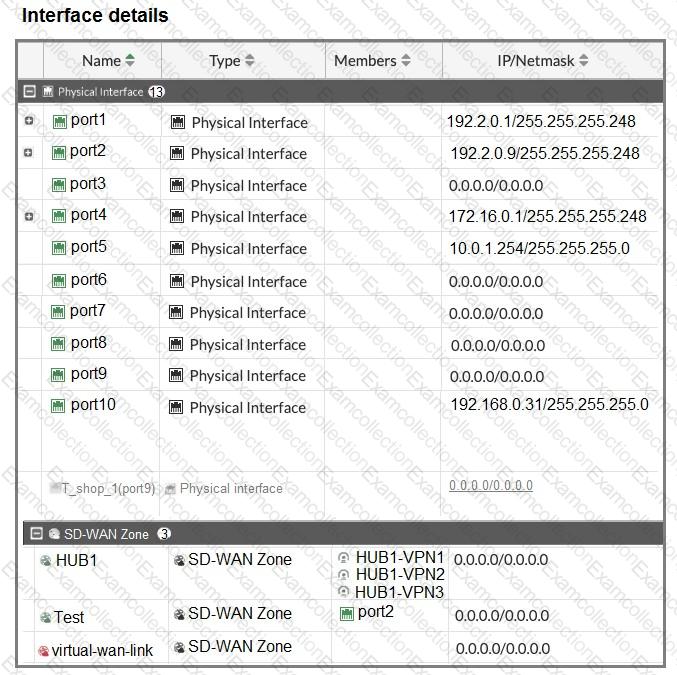
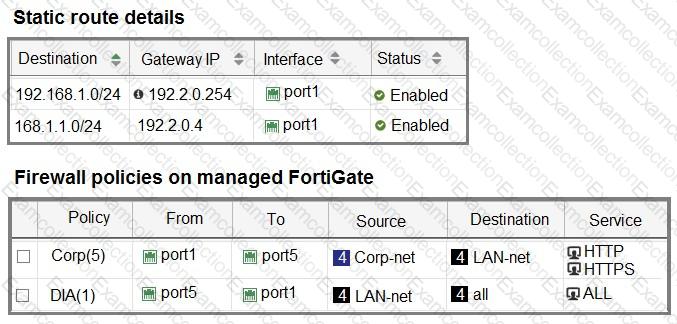
The interface details, static route configuration, and firewall policies on the managed FortiGate device are shown.

You want to configure a new SD-WAN zone, named Underlay, that contains the interfaces port1 and port2.

What must be your first action?

A.

Define port1 as an SD-WAN member.

B.

Delete the static routes.

C.

Delete the SD-WAN Zone Test.

D.

Delete the firewall policies.

Exhibit.

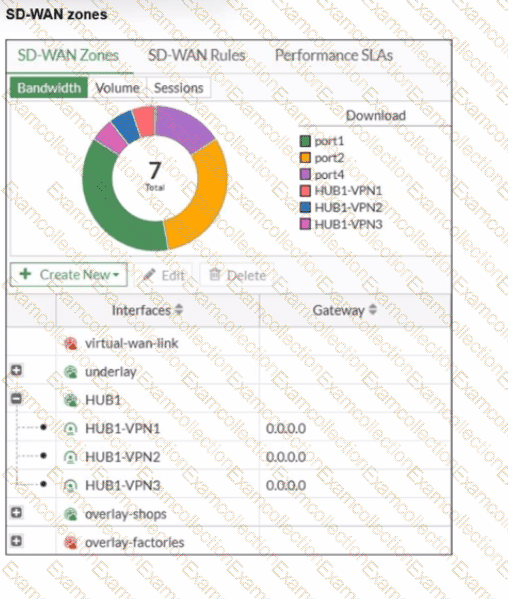
Refer to the exhibit, which shows an SD-WAN zone configuration on the FortiGate GUI. What can you conclude about the zone and member configuration on this device?

A.

The underlay zone contains three members.

B.

You can delete the virtual-wan-link zones.

C.

The overlay-factories zone contains no member.

D.

You can move HUB1-VPN3 from the HUB1 zone to the overlay-shops zone.

Refer to the exhibit.

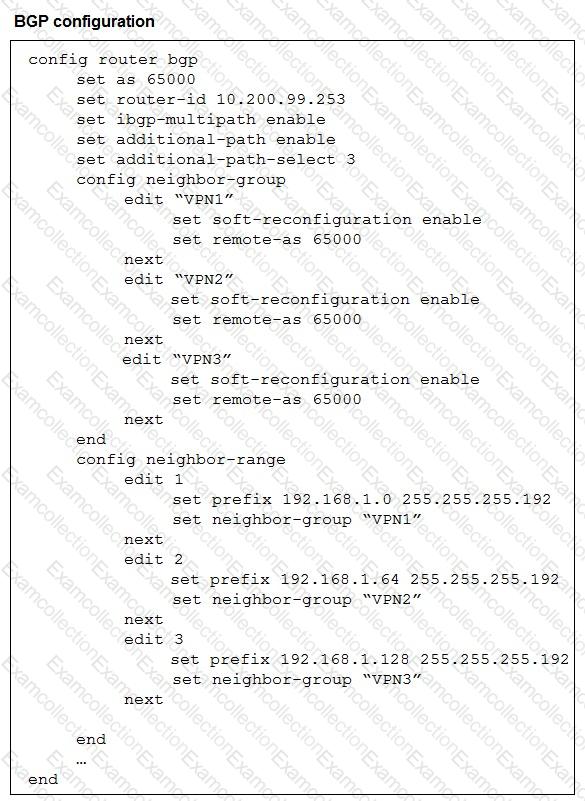
The exhibit shows the BGP configuration on the hub in a hub-and-spoke topology. The administrator wants BGP to advertise prefixes from spokes to other spokes over the IPsec overlays, including additional paths. However, when looking at the spoke routing table, the administrator does not see the prefixes from other spokes and the additional paths

Which three settings must the administrator configure inside each BGP neighbor group so spokes can learn the prefixes of other spokes and their additional paths? (Choose three.)

A.

Set additional-path to send

B.

Set additional-path to forward

C.

Enable route-reflector-server

D.

Enable route-reflector-client.

E.

Set adv-additional-path to the number of additional paths to advertise.

(As an IT manager, you want to delegate the installation and management of your SD-WAN deployment to a managed security service provider (MSSP). Each site must maintain direct internet access and be secure. You expect significant traffic flow between the sites and want to delegate as much of the network administration and management as possible to the MSSP.

Which two MSSP deployment blueprints address your requirements? Choose two answers.)

A.

Use a shared hub on the MSSP premises and a dedicated hub on the customer premises, and install the spokes on the customer premises.

B.

Install a dedicated hub on the MSSP premises for the customer, and install the spokes on the customer premises.

C.

Install the hub and spokes on the customer premises, and enable the MSSP to manage the SD-WAN deployment using FortiManager with a dedicated ADOM.

D.

Use a shared hub on the MSSP premises with a dedicated VDOM for the customer, and install the spokes on the customer premises.

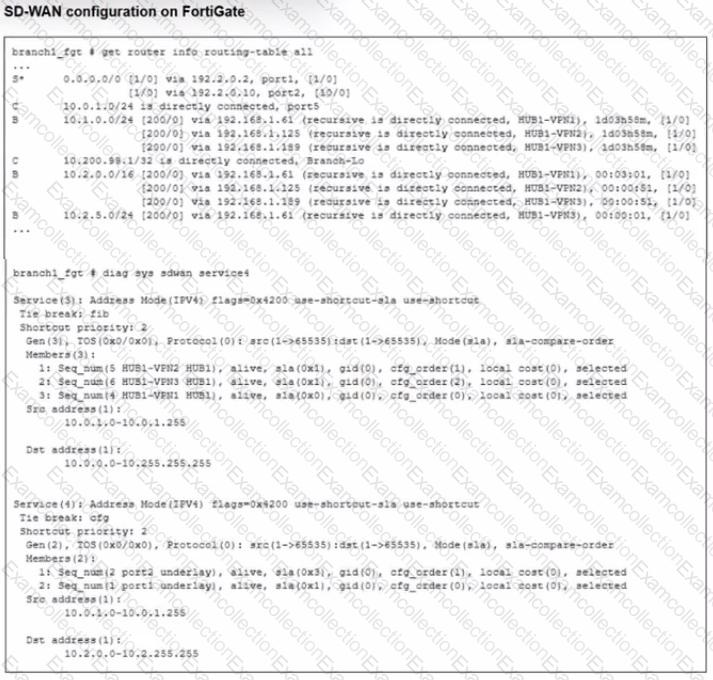
Refer to the exhibit.

Which SD-WAN rule and interface uses FortiGate to steer the traffic from the LAN subnet 10.0.1.0/24 to the corporate server 10.2.5.254?

A.

SD-WAN service rule 3 and interface HUB1-VPN2.

B.

SD-WAN service rule 3 and interface HUB1-VPN3.

C.

SD-WAN service rule 4 and port1 or port2.

D.

SD-WAN service rule 4 and interface port2.

(In which order does FortiGate consider the following elements during the route lookup process? Choose one answer.)

A.

SD-WAN rules, ISDB routes, policy routes, BGP routes

B.

Policy routes, SD-WAN rules, Internet Service Database (ISDB) routes, BGP routes

C.

SD-WAN rules, policy routes, static routes, ISDB routes

D.

Policy routes, ISDB routes, SD-WAN rules, static routes

Which three factors about SLA targets and SD-WAN rules should you consider when configuring SD-WAN rules? (Choose three.)

A.

Member metrics are measured only if a rule uses the SLA target.

B.

SLA targets are used only by SD-WAN rules that are configured with a Lowest Cost (SLA) strategy.

C.

SD-WAN rules can use SLA targets to check whether the preferred members meet the SLA requirements.

D.

When configuring an SD-WAN rule, you can select multiple SLA targets if they are from the same performance SLA.

E.

When configuring an SD-WAN rule, you can select multiple SLA targets from different performance SLAs.

(Refer to the exhibit.

What can you conclude from the output shown? Choose one answer.)

A.

It is a spoke device. SD-WAN rule 3 is configured with nine members.

B.

It is a spoke device. The members of SD-WAN rule 3 are grouped into two zones.

C.

It is a hub device. It allowed the establishment of three auto-discovery VPN (ADVPN) shortcuts.

D.

It is a spoke device. SD-WAN rule 4 allows three shortcut tunnels.