New Year Sale Special Limited Time 70% Discount Offer - Ends in 0d 00h 00m 00s - Coupon code: xmas50

Fortinet FCSS_SDW_AR-7.6 - FCSS - SD-WAN 7.6 Architect

Page: 1 / 3
Total 94 questions

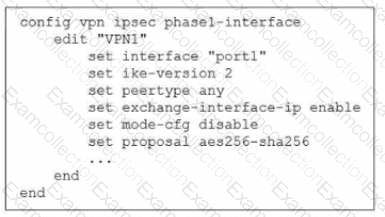
Exhibit.

The administrator configured the IPsec tunnel VPN1 on a FortiGate device with the parameters shown in exhibit.

Based on the configuration, which three conclusions can you draw about the characteristics and requirements of the VPN tunnel? (Choose three.)

A.

The tunnel interface IP address on the spoke side is provided by the hub.

B.

The remote end can be a third-party IPsec device.

C.

The administrator must manually assign the tunnel interface IP address on the hub side

D.

The remote end must support IKEv2.

E.

This configuration allows user-defined overlay IP addresses.

You have a FortiGate configuration with three user-defined SD-WAN zones and two members in each of these zones. One SD-WAN member is no longer in use in health-check and SD-WAN rules. You want to delete it.

What happens if you delete the SD-WAN member from the FortiGate GUI?

A.

FodiGate accepts the deletion and removes routes as required.

B.

FortiGate displays an error message. You must use the CLI to delete an SD-WAN member.

C.

FortiGate displays an error message. SD-WAN zones must contain at least two members

D.

FortiGate accepts the deletion and places the member in the default SD-WAN zone.

(When you deploy SD-WAN, you can choose from several common designs. Each design best applies to specific contexts.

Which two statements correctly associate a common SD-WAN design with its main indication or constraint? Choose two answers.)

A.

Use a cloud on-ramp topology to improve the performance of cloud applications.

B.

Use a standalone design for sites with only one WAN link to the cloud.

C.

Use remote breakout to centralize traffic inspection and limit local management requirements.

D.

Use a direct internet access (DIA) design to increase the traffic security and allow local devices with limited capabilities.

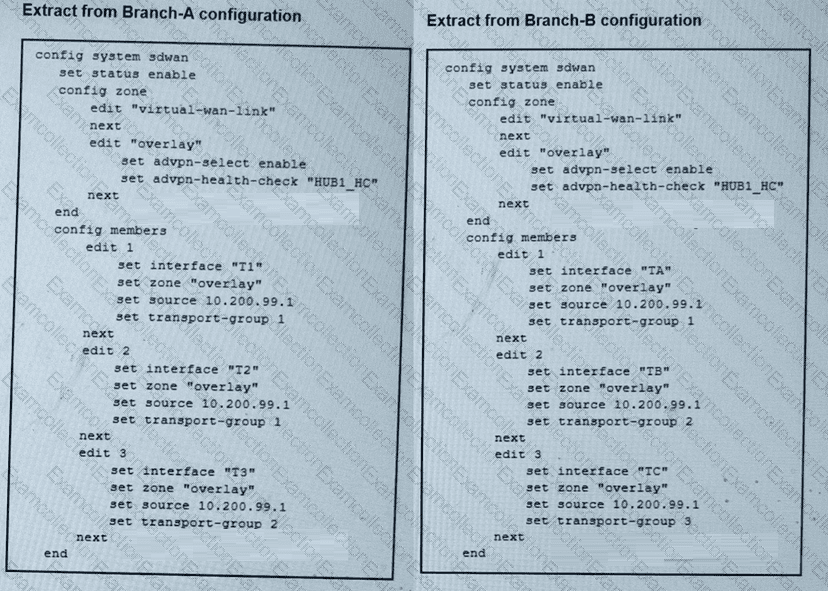
(Refer to the exhibits.

The SD-WAN zones and members configuration of two branch devices are shown. The two branch devices are part of the same hub-and-spoke topology and connect to the same hub. The devices are configured to allow Auto-Discovery VPN (ADVPN). The configuration on the hub allows the initial communication between the two spokes.

When traffic flows require it, between which interfaces can the devices establish shortcuts? Choose one answer.)

A.

Any interface in the overlay zones

B.

Interface connected to HUB only

C.

Between T3 on Branch-A and TC on Branch-B

D.

Between T2 on Branch-A and TA on Branch-B

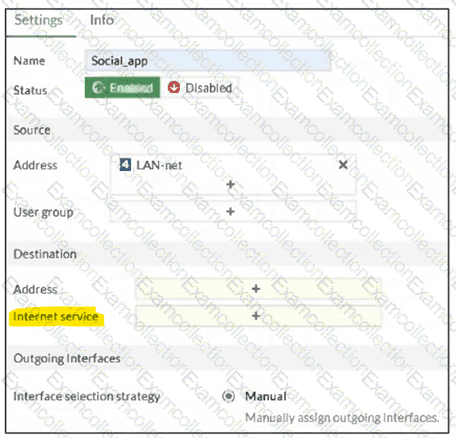
(Refer to the exhibit.

You configure SD-WAN on a standalone FortiGate device.

You want to create an SD-WAN rule that steers traffic related to Facebook and LinkedIn through the less costly internet link.

What must you do to set Facebook and LinkedIn applications as destinations from the GUI? Choose one answer.)

A.

Enable the visibility of the applications field as destinations of the SD-WAN rule.

B.

In the Internet service field, select Facebook and LinkedIn.

C.

You cannot configure applications as destinations of an SD-WAN rule on a standalone FortiGate device.

D.

Install a license to allow applications as destinations of SD-WAN rules.

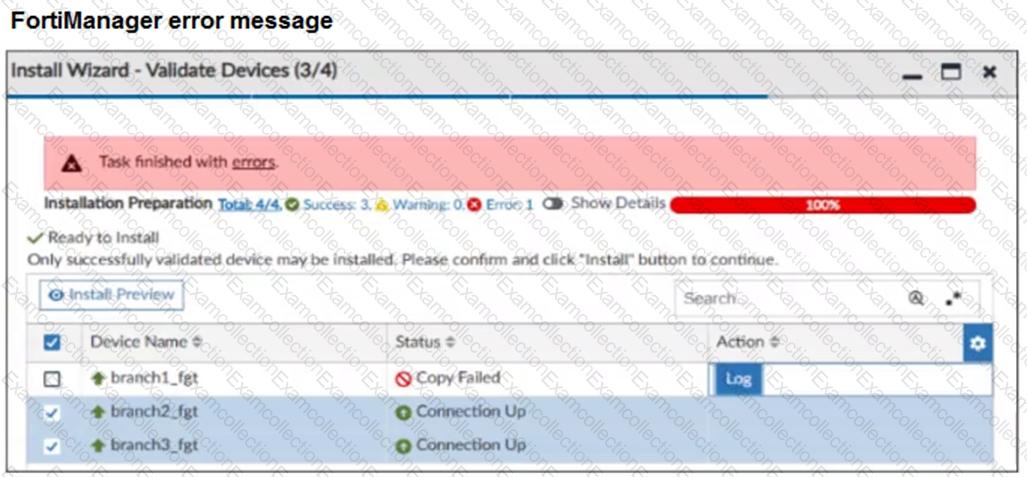
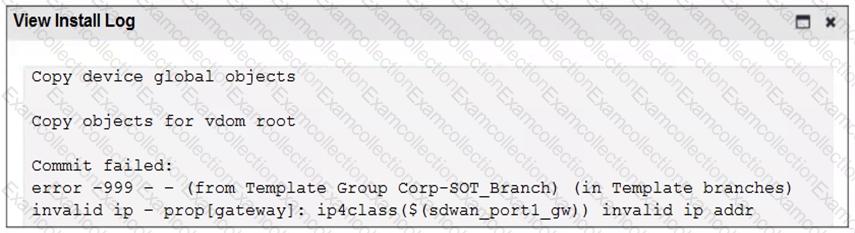
Refer to the exhibits.

You use FortiManager to configure SD-WAN on three branch devices.
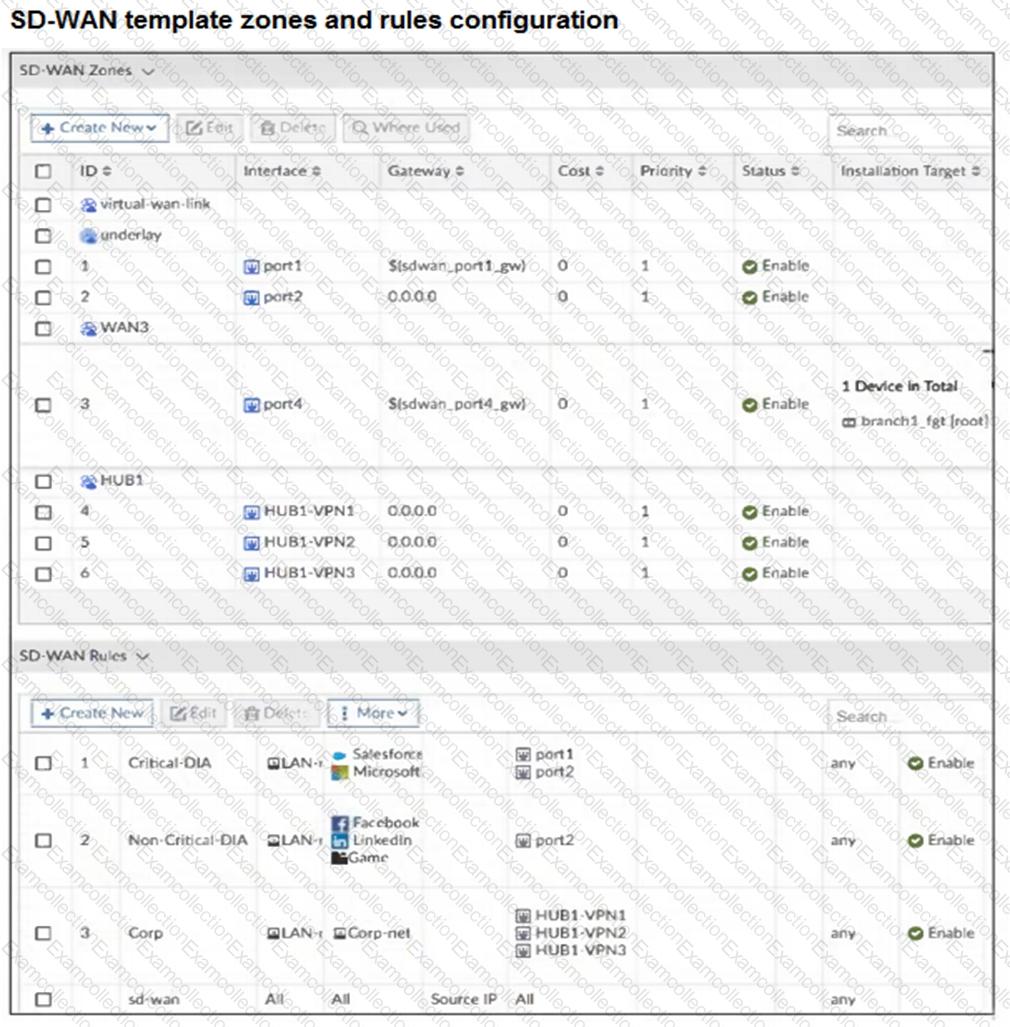
When you install the device settings, FortiManager prompts you with the error “Copy Failed” for the device branch1_fgt. When you click the log button, FortiManager displays the message shown in the exhibit.

There are two different ways to resolve this issue. Based on the exhibits, which methods could you use? (Choose two.)

A.

Update the management IP address of branch1_fgt.

B.

Specify the gateway of the SD-WAN member port1 with an IP address or use the default value.

C.

Do not define installation targets for SD-WAN members.

D.

Review the per-device mapping configuration for metadata variables

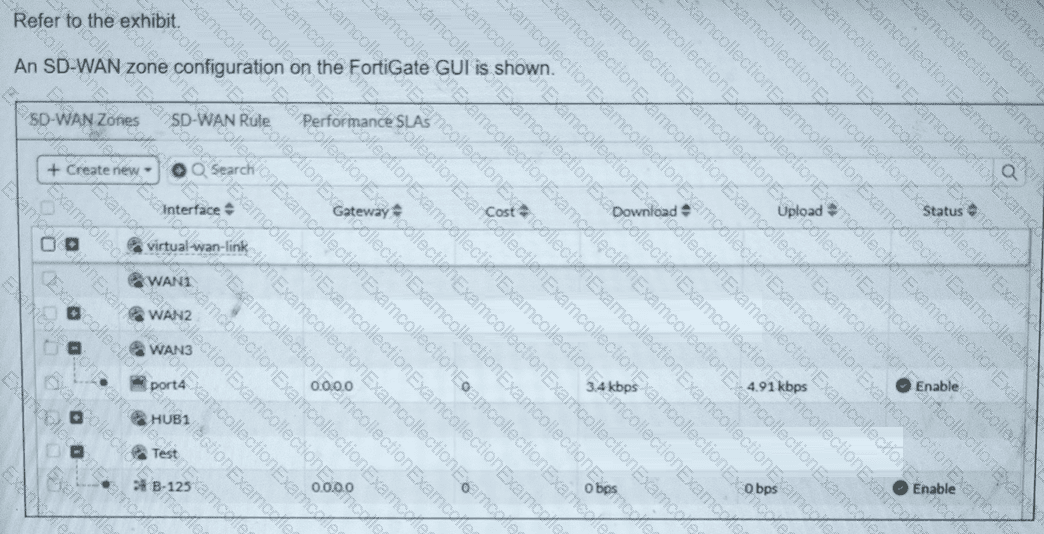
(Refer to the exhibit.

An SD-WAN zone configuration on the FortiGate GUI is shown.

What can you conclude about the zone and member configuration on this device? Choose one answer.)

A.

You can delete the virtual-wan-link zone.

B.

The WAN2 zone contains no member.

C.

You can delete the WAN1 zone.

D.

You can add the member B-125 to the WAN3 zone and keep it as a member of the Test zone.

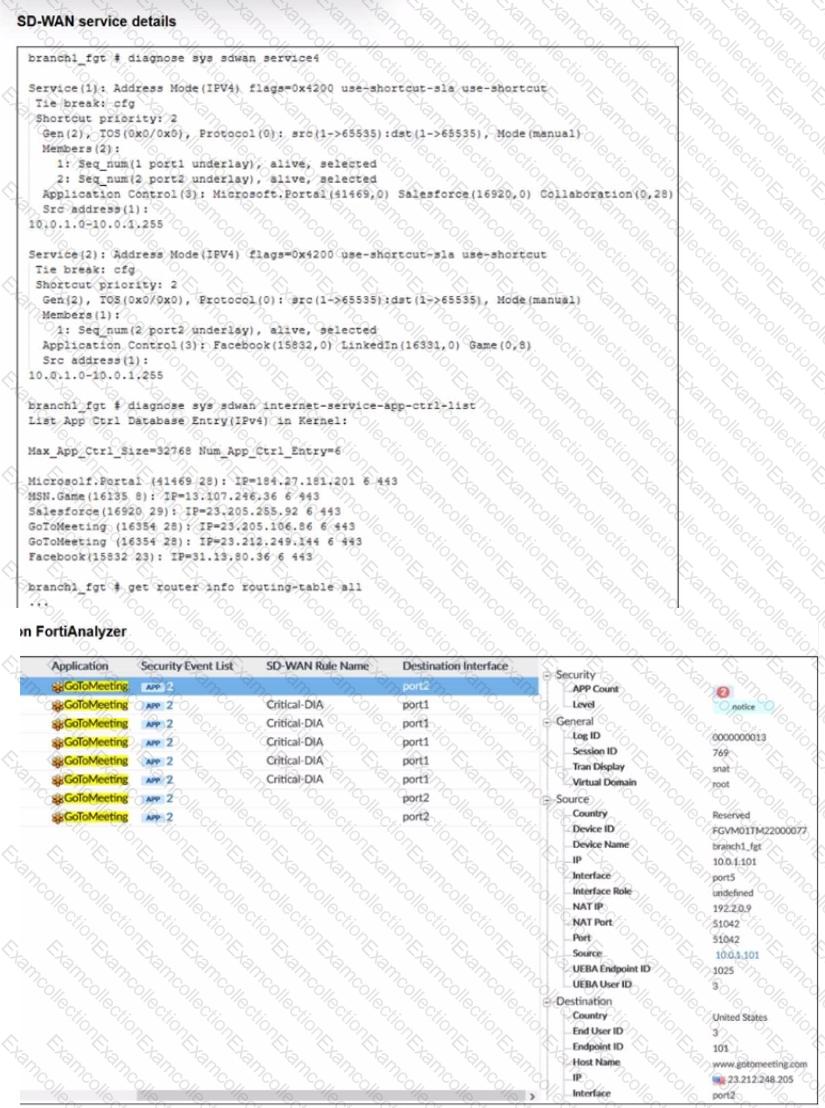
Refer to the exhibits.

An administrator is testing application steering in SD-WAN. Before generating test traffic, the administrator collected the information shown in the first exhibit. After generating GoToMeeting test traffic, the administrator examined the corresponding traffic log on FortiAnalyzer, which is shown in the second exhibit.

The administrator noticed that the traffic matched the implicit SD-WAN rule, but they expected the traffic to match rule ID 1.

Which two reasons explain why some log messages show that the traffic matched the implicit SD-WAN rule? (Choose two.)

A.

Full SSL inspection is not enabled on the matching firewall policy.

B.

The session 3-tuple did not match any of the existing entries in the ISDB application cache.

C.

FortiGate could not refresh the routing information on the session after the application was detected.

D.

No configured SD-WAN rule matches the traffic related to the collaboration application GoToMeeting

What are three key routing principles of SD-WAN? (Choose three.)

A.

Directly connected routes have precedence over SD-WAN rules.

B.

Policy routes have precedence over SD-WAN rules.

C.

SD-WAN rules are skipped if the best route to the destination is a static route

D.

SD-WAN rules are skipped if the best route to the destination is not an SD-WAN member.

E.

SD-WAN members are skipped if they do not have a valid route to the destination.

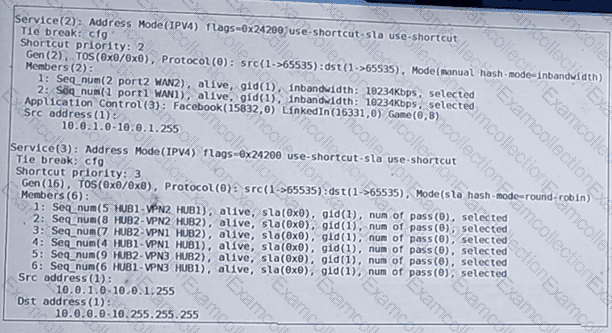
(Refer to the exhibit.

The administrator configured two SD-WAN rules to load balance traffic.

Which interfaces does FortiGate use to steer the traffic from 10.0.1.124 to 10.0.0.254? Choose one answer.)

A.

port1 or port2

B.

FortiGate routes the traffic according to the FIB.

C.

HUB1-VPN2

D.

Any interface in the HUB1 or HUB2 zones