

Summer Sale Special Limited Time 70% Discount Offer - Ends in 0d 00h 00m 00s - Coupon code: xmas50

HP HPE7-V01 - Advanced HPE Edge-to-Cloud Solutions

Page: 1 / 2
Total 50 questions

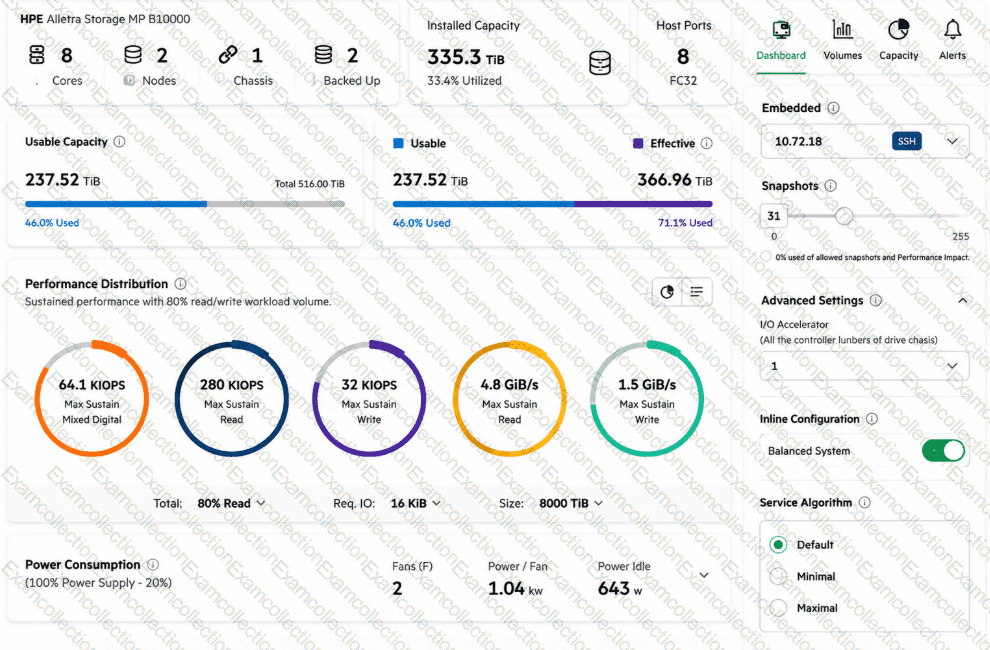
Your customer has a requirement to support 500K IOP/s write speeds in their environment.

What change should you make to the configuration to achieve this?

A.

Replace the nodes with B91160 model and add additional drive shelf and more drives.

B.

Replace the nodes with B91130 model and add additional drive shelf.

C.

Increase the amount of drives supported to achieve the requirement.

D.

Replace the nodes with B10230 model and add additional drive shelf and more drives.

Your customer is currently using an HPE SimpliVity 380 Gen10 solution and is planning for a generation refresh to an HPE SimpliVity 380 Gen11.

The existing cluster is planned to be maintained as a test and dev platform for another 24–36 months while production workloads are moved to the new environment.

The new solution will be purchased as HPE GreenLake for Private Cloud Business Edition, and the customer would like to include the existing Gen10 cluster within the same management platform.

Which statement is true about combining the management of both the old and new generations?

A.

The new PCBE platform can be downgraded for on-prem management for interoperability with the Gen10.

B.

The existing SimpliVity environment needs to be redeployed as PCBE to co-exist with the new solution.

C.

The new PCBE platform can manage the old platform by utilizing the Data Services Connector OVA.

D.

The existing SimpliVity environment can be imported into the HPE GreenLake platform using Data Services Connector.

Your customer would like to implement Peer Persistence for their HPE Alletra 6000 remote replication configuration.

Which statement is true?

A.

Peer Persistence volumes require both arrays to operate as upstream.

B.

HPE Alletra 6000 arrays are always using iSCSI for synchronous replication.

C.

HPE Alletra 6000 arrays are always using FC for synchronous replication.

D.

Peer Persistence volumes are synchronously replicated over 10Gb or 100Gb IP links.

Your customer is planning a Scality RING solution. Approximately 750 TB of data must be stored on the SDS. The customer prefers SSD or NVMe drives.

What is true regarding this solution?

A.

HPE servers, for example, such as Alletra Storage Server 4120, can be used for Scality RING deployments.

B.

The minimum capacity for ordering Scality RING perpetual licenses is 1000TB.

C.

Scality RING Single Site Hardware Lifetime licenses are provided at a lower cost compared to perpetual licenses.

D.

Scality licenses cannot be purchased from HPE.

You are designing a solution for a customer that will support a virtualization workload based on HPE Synergy. Your customer has the following requirements:

    Dual-socket HPE Synergy compute nodes running ESXi 8.x with maximum memory supported

    Each node should have access to shared storage from HPE Alletra Storage MP B10000

    All virtual machines should be protected against host failure

    All virtual machines with vGPU must be protected with Fault Tolerance

    All compute nodes should boot from drives located in the D3940 Storage Modules protected with RAID 1

    All frames should be managed as one logical enclosure to simplify management

    All compute nodes should support two network ports with the maximum Ethernet connectivity speed

You are reviewing a proposal that you must verify. The proposal contains:

    3 HPE Synergy 12000 frames

    2 HPE Synergy Composer2 modules

    4 HPE Virtual Connect SE 100Gb F32 Modules for Synergy

    4 HPE Synergy 50Gb Interconnect Link Modules

    3 HPE Synergy D3940 Storage Modules, each with 20 SSD drives

    1152 core vSphere Enterprise Plus subscriptions

    36 HPE Synergy 480 Gen11 compute nodes

Each SY480 Gen11 is configured with:

    A single Platinum CPU with 32 cores

    HPE Synergy 6820C 25/50Gb Converged Network Adapter

    HPE Synergy 5830C 32Gb Fibre Channel Host Bus Adapter

    HPE MR416i-o Gen11 12G SAS Mezzanine Controller

Which two statements are true regarding the proposal? (Select two.)

A.

2 HPE Synergy 50Gb Interconnect Link Modules should be removed from the proposal, as the total number of interconnects required is six.

B.

HPE MR416i-o Smart RAID controller can be removed because there are no external SAS disk enclosures included in the proposal.

C.

Two HPE Virtual Connect SE 100Gb F32 Modules for Synergy can be removed from the proposal because all requirements are met without them.

D.

To access HPE Alletra MP B10000 arrays, FC upgrade licenses for HPE Virtual Connect SE 100Gb F32 Modules for Synergy must be purchased.

E.

vSphere Enterprise Plus subscriptions can be replaced with vSphere Standard subscriptions.

You presented a solution to your customer that will replace their legacy HPE BladeSystem.

The new solution is based on the HPE Synergy platform and consists of the following components:

    5 HPE Synergy 12000 frames

    2 HPE Virtual Connect SE 100Gb F32 Module for Synergy

    8 HPE Synergy 50Gb Interconnect Link Module

    60 HPE Synergy 480 Gen11

Which statement describes the business and financial benefits for this new solution on the customer?

A.

HPE Synergy supports master/satellite approach that requires less HPE Virtual Connect modules, and so will be more economical.

B.

Compared to the legacy HPE BladeSystem, the HPE Synergy platform supports more interconnect modules which provides better scalability and expansion possibilities.

C.

Compared to the legacy HPE BladeSystem, the HPE Synergy platform supports more expansion slots in the form of mezzanine cards.

D.

HPE Synergy needs more HPE Virtual Connect modules because of the increased bandwidth for Gen11 compute nodes.

You are designing a solution for a customer that will support a virtualization workload based on HPE Synergy. Your customer has the following requirements:

    Dual-socket HPE Synergy compute nodes running ESXi 8.x with maximum memory supported

    Each node should have access to shared storage from HPE Alletra Storage MP B10000

    All virtual machines should be protected against host failure

    All virtual machines with vGPU must be protected with Fault Tolerance

    All compute nodes should boot from disks located in the D3940 Storage Modules protected with RAID 1

    All frames should be managed as one logical enclosure to simplify management

    All compute nodes should support two network ports with the maximum Ethernet connectivity speed

You are reviewing a proposal that you must verify. The proposal consists of:

    3 x HPE Synergy 12000 frames

    2 x HPE Synergy Composer2 modules

    4 x HPE Virtual Connect SE 100Gb F32 Modules for Synergy

    4 x HPE Synergy 50Gb Interconnect Link Modules

    3 x HPE Synergy D3940 Storage Modules, each with 20 SSD drives

    1152 core VMware vSphere Enterprise Plus subscriptions

    36 x HPE Synergy 480 Gen11 compute nodes

Each SY480 Gen11 is configured with:

    A single Platinum CPU with 32 cores

    HPE Synergy 6820C 25/50Gb Converged Network Adapter

    HPE Synergy 5830C 32Gb Fibre Channel Host Bus Adapter

    HPE MR416i-o Gen11 12G SAS Mezzanine Controller

Which two statements are true regarding the proposal? (Select two.)

A.

2 HPE Synergy 50Gb Interconnect Link Modules should be removed from the proposal, as the total number of interconnects required is six.

B.

HPE MR416i-o Smart RAID controller can be removed because there are no external SAS disk enclosures included in the proposal.

C.

Two HPE Virtual Connect SE 100Gb F32 Modules for Synergy can be removed from the proposal because all requirements are met without them.

D.

To access HPE Alletra MP B10000 arrays, FC upgrade licenses for HPE Virtual Connect SE 100Gb F32 Modules for Synergy must be purchased.

E.

vSphere Enterprise Plus subscriptions can be replaced with vSphere Standard subscriptions.

Your customer wants to simplify storage management for their VMware-based environment by configuring HPE Storage Integration Pack for VMware vCenter Server. They want to use HPE OneView for VMware vCenter Server for ESXi deployment.

Currently, they have 30 HPE ProLiant DL360 Gen11 deployed with ESXi 8.x and they plan to add 30 additional systems with exactly the same setup. Storage capacity is provided by HPE Alletra Storage MP B10000.

Which statement about the configuration and customer requirements is true?

A.

HPE Storage Integration Pack for VMware vCenter Server and HPE OneView for VMware vCenter Server only support the HPE Synergy platform managed using HPE Composer2.

B.

Your customer must purchase the appropriate number of licenses for HPE Storage Integration Pack for VMware vCenter Server and HPE OneView for VMware vCenter Server.

C.

Using HPE Storage Integration Pack for VMware vCenter Server for VVol creation is only supported if the ESXi systems have vSphere Enterprise Plus subscriptions.

D.

HPE OneView for VMware vCenter Server supports the Proactive HA feature, which will define the response in case of host health degradation to improve workload availability.

You have proposed that your customer adopts HPE VM Essentials as an alternative hypervisor, but they still want to utilize their existing HPE Synergy 480 Gen10/Plus for existing vSphere workloads.

How can your customer manage both environments from a single management platform?

A.

Use the HPE VM Essentials Manager to manage both vCenter and HPE VM Essentials.

B.

Use the Data Services Connector to connect HPE OneView Composer to HPE GreenLake and HPE VME.

C.

Use the HPE VM Essentials plugin for vCenter to manage both platforms.

D.

Use the HPE GreenLake Data Services disconnected option to manage vCenter and HPE VM Essentials.

Which statement about HPE SimpliVity is true?

A.

HPE SimpliVity 380 Gen11 cluster with compute nodes requires the same CPU in all nodes.

B.

Mixing AMD and Intel chassis in the same federation is fully supported.

C.

A single AMD-based HPE SimpliVity node can support up to 4 non-HPE SimpliVity servers.

D.

A single Intel-based HPE SimpliVity node can support up to 8 non-HPE SimpliVity servers.