

PECB ISO-14001-Lead-Auditor - PECB Certified EMS ISO 14001 Lead Auditor Exam
Showitoff is an organisation specialising in the design and production of wall decorating materials for the domestic market. During an ISO 14001 certification audit of the site, the auditor comes across an open, walled area just outside the maintenance department. It contains various scraps of wood and metal as well as several rusty components. They are lying on an oily floor. When asked about it, the EMS Manager states that he presumes that the materials come from maintenance work.
The auditor interviews the Maintenance Manager in his department. He notes that shelves containing various spares are well labelled and neatly stacked. He asked about the " dump " outside and is told that it contains some excess materials that the Manager likes to keep in case they come in handy at some stage. The auditor points out that the " dump " might be classed under regulations as a landfill site, which requires an operating licence. The Maintenance Manager is not aware of such a licence.
The auditor decides to review the process for evaluation of compliance with environmental regulations in more depth.
Select three options that provide a meaningful audit trail for this process.
Sparkle is an organisation that provides mobile car cleaning services at customers ' premises. It has been certified to ISO 14001 for some time and has appointed a new EMS Manager. The audit plan during a surveillance audit includes the improvement actions and the auditor asks to see the most recent management review meeting minutes.
Which six statements would represent output audit evidence for the management review?
XM, a chain of 25 petrol stations, established an EMS following the requirements of ISO 14001, which was third-party certified 10 years ago. You are performing an internal audit before the fourth certification cycle.
During the audit to the EMS Manager (EM), the following dialogue takes place:
You: Could you please give me some details on the inspection of underground tanks in each station?
EM: It ' s very simple. There is a regulation that requires an annual leak inspection.
You: Who performs these inspections?
EM: I personally contract the inspectors and submit the results to the local authority. These are the certificates submitted last year.
You: I see only 22 certificates. There are three missing.
EM: The tanks of those three stations will be removed next year and replaced by new ones. I phoned the local authority and they told me that I do not need to send any report of the tanks that will be changed.
Which one of the following would be your next question?
You have been nominated audit team leader for the second recertification to ISO 14001 of ABC, a public transport organisation in a big city. The audit is planned to take place in two months ' time. The audit program manager asks you to review the answer provided by ABC to a nonconformity raised during the last surveillance audit carried out eight months ago. The nonconformity reads as follows: " ABC does not always communicate its relevant environmental requirements to external providers. Evidence: A two-month contract signed with a new external provider of the maintenance for ABC ' s buses did not contain any relevant environmental requirements. "
Which two would you consider to be the best acceptable corrections from ABC?
An internal auditor of a manufacturer of aluminium products for the car industry raised a nonconformity against section 6.2.2 of ISO 14001 in Report IA202. The nonconformity (NC3) stated:
" Top management has not analysed why none of the environmental objectives set for the last year have been met. "
A third-party auditor reviewing the internal audit process came across the nonconformity and found that no corrective action was documented. The EMS Manager confirmed no action had been taken, but added he expected a number of objectives to be achieved in the next three months, so there was no need for further action. He explained in confidence that the organisation was fighting a takeover bid and resources for environmental projects had been cut.
From the information, select three nonconformities that the auditor could raise to ISO 14001.
During a second-party audit at a paper mill, you find that the EMS Manager conducted the environmental risk process. In the environmental aspects register, aspects were listed by emissions to air, releases to water, releases to land and other aspects such as energy consumption and waste disposal. They were categorised as either significant or not significant.
The EMS Manager had an action plan only for significant aspects.
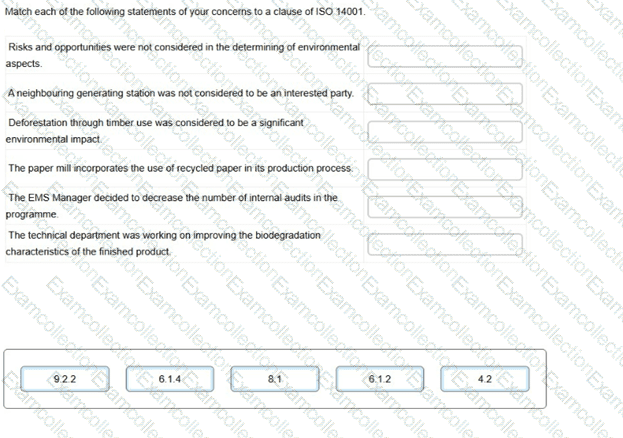
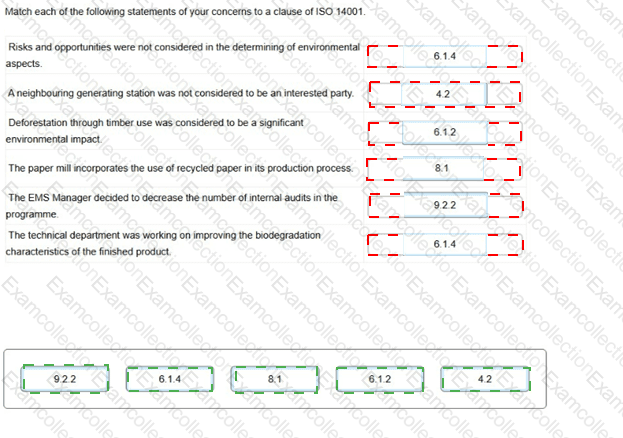
Match each of the following statements of your concerns to a clause of ISO 14001.
The audit team leader presents the audit outcome at the closing meeting attended by the Chief Executive and the senior managers of a care home. The agenda involves the reporting of a low number of minor nonconformities in the EMS to ISO 14001. It becomes clear to the audit team leader and team members that the Chief Executive becomes increasingly agitated as the meeting progresses.
Before the audit team leader can present a summary of the audit results, the Chief Executive interrupts the report and angrily claims that the whole process is flawed and that the organisation has wasted its time on trying to get certification because it has chosen the wrong certification body.
Select the one option you would take as the audit team leader in response to the situation.
A huge public library established an EMS following the requirements of ISO 14001, which was third-party certified 10 years ago. You are performing the second surveillance audit of the third certification cycle. The audit plan included an audit to the Director as the last interview before the closing meeting.
During the interview with the Director, you audit clause 6.2 (Objectives and planning to achieve them). The dialogue is as follows:
You: Could you please tell me which were the environmental objectives defined for last year and show evidence of their achievement?
Director: Yes. We had defined three objectives. As you can see from our Annual Plan, one of them was to separate our waste in four categories: paper, plastics, metals, food — before, we had only three (plastic and paper were disposed together). We developed an Action Plan to achieve this objective.
Which six of the questions would you ask related to the Action Plan?
The audit lifecycle describes the ISO 19011 process for conducting an individual audit.
Which two of the following are part of conducting the audit activities?
The following statements are related to audit methods. Review each one and select the two that are true.