

PECB ISO-14001-Lead-Auditor - PECB Certified EMS ISO 14001 Lead Auditor Exam
A group of 22 Italian restaurants in downtown San Francisco (US) established an EMS following the requirements of ISO 14001. You are performing an internal audit before the fourth certification cycle. The audit plan included an audit of the General Manager (GM) as the last interview before the closing meeting. During the interview with the GM, you audit clause 10.3 (Continual improvement). The dialogue is as follows.
You: Could you please tell me how did you improve the EMS to enhance environmental performance (Clause 10.3)?
GM: One way to improve the EMS is to improve one or several of its processes. We decided to improve the water-consuming processes in all our branches. We use water in many of our processes (e.g. to wash our kitchens, our cutlery, plates, and glasses, to keep our floors clean). The idea was to review these processes in detail to reduce the amount of water used per customer. Each of the 22 branches sent us their results, we analysed the data and found out that the average water consumption per customer was reduced by 13%; therefore, we improved our environmental performance. We are happy about that.
You: What about the results in each branch?
GM: Have a look at this table:
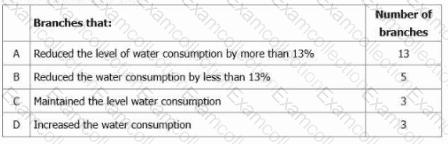
Analysing this table, what would be your decision related to raising nonconformities to clause 10.3? Select two.
ABC is a large lubricant oils manufacturer located in country A. Due to tax exemption and other economic issues, they decided to move the whole plant to a neighbouring country B. They moved every single piece of the plant (equipment, systems); the new plant has the same layout, the same dimensions, the same suppliers of raw materials and the same customers. Even more, most personnel accepted to move to country B.
They operate a third-party certified EMS; the certificate was transferred to the new plant after a half-day audit from the certification body. You are auditing ABC ' s EMS in the new location, representing ABC ' s largest customer. When interviewing the Environmental Manager (EM), you ask:
You: Can I see the plan you developed to keep under control the impact of the EMS due to the change of site?
EM: We listed all elements and processes of the EMS that might need to be changed and selected those that we considered needed a careful review and probably a revision.
Below you will find that list; select six that you consider will need to be revised.
Which two of the following phrases would apply to " audit criteria " ?
You are auditing the ISO 14001 management system of a primary school (School 21st Century) located in downtown Lima, Peru. There are 400 students, attending classes from 9 am until 5.30 pm.
You have presented a nonconformity at the closing meeting:
Non-conformity - No environmental aspect has been identified related to the impact of the education provided by the school on students ' awareness (as future adults) related to generic environmental issues.
Select the three best acceptable corrections that the school may take.
An organisation has ISO 14001 EMS certification from a third-party certification body. Which one of the following represents an advantage of having accredited certification?
When an organisation needs to determine the resources required for the internal audit programme, which one of the following issues does not impact on the achievement of its intended results?
An organisation has the following environmental policy document displayed in the reception area:
" This organisation is committed to providing electric cables to customers ' requirements, in accordance with environmental regulations for their manufacture, use and disposal. The organisation will strive to increase the environmental awareness of its personnel, suppliers, subcontractors and interested parties. Continual environmental improvement is a permanent objective of the organisation. This policy shall be communicated to all employees with the opportunity for them to seek clarification where required. Where required the policy shall be communicated to all interested parties. "
Referring to the above policy statement, select three options for which the organisation is meeting ISO 14001 requirements.
Whistlekleen is a national dry cleaning and laundry organisation with 50 shops. You are conducting an EMS surveillance audit of Head Office and are sampling environmental performance measurement. You find that 80 per cent of failures to meet performance criteria originate from five shops in the same region. Most of these failures relate to the release of volatile organic compounds (VOCs) that exceeded regulations. The Environmental Manager tells you that these are the oldest shops in the organisation. The cleaning equipment needs replacing but the organisation cannot afford it at the moment.
On raising the matter with senior management, you are told that there are plans to replace the equipment in these shops over the next five years.
When reviewing the nonconformity report files, you find that the organisation is facing a legal dispute with the environmental authority over multiple breaches of environmental legislation.
Select the three best options for how this dispute should be handled by the organisation through its EMS.