


New Year Sale Special Limited Time 70% Discount Offer - Ends in 0d 00h 00m 00s - Coupon code: xmas50

ISTQB ISTQB-CTFL - ISTQB Certified Tester Foundation Level (CTFL v4.0)

Page: 3 / 13
Total 406 questions

Which ONE of the following options BEST describes the purpose of confirmation testing versus regression testing?

A.

The purpose of confirmation testing is to confirm that the defect giving rise to a failure has been successfully fixed. The regression test aims to ensure that no defects have been introduced or discovered in unmodified areas of the software as a result of the changes made.

B.

Confirmation testing ensures the entire system functions as expected, whereas regression testing focuses only on modified components.

C.

Confirmation testing verifies all system requirements, while regression testing ensures that no additional test cases are needed.

D.

Regression testing and confirmation testing are interchangeable and serve the same purpose.

A test score indicator for students produces a performance score based on a combination of the number of consecutive hours studied (below 4 hours, 4 to 8 hours. 9 to 12 hours or above 12 hours) and the average intensity of focus on the material during the study time (low, medium or high).

Given the following test cases:

hours intensity score

T1 3 low55

T2 14 high 95

T3 9 low75

What is the minimum number of additional test cases that are needed to ensure full coverage of all valid INPUT equivalence partitions?

A.

1

B.

2

C.

3

D.

4

A typical objective of testing is to

A.

Determine the most appropriate level of detail with which to design test cases.

B.

Verify the compliance of the test object with regulatory requirements.

C.

Plan test activities in accordance with the existing test policy and test strategy

D.

Verify the correct creation and configuration of the test environment

The following 4 equivalence classes are given:

Which of the following alternatives includes correct test values for x. based on equivalence partitioning?

A.

-100; 100:1000; 1001

B.

-500; 0; 100; 1000

C.

-99; 99:101; 1001

D.

-1000; -100; 100; 1000

Consider the following testing levels:

1) Component Testing

2) Integration Testing

3) System Testing

4) Acceptance Testing

Which of the following statements is true?

A.

Integration and system testing are applicable when V-model is used.

Component and acceptance testing are applicable when iterative development models are used.

B.

All the testing levels are applicable to V-model for software development.

Only acceptance testing is applicable for iterative models.

C.

Acceptance testing is applicable for all software development models.

Component and system testing are applicable only for the V-model.

D.

All testing levels are applicable, independent of which software development life-cycle process (V-model. iterative, incremental) is used.

Which of the following statements refers to a good testing practice that applies to all software development lifecycles?

A.

Each test level should have its own specific test objectives that should be consistent with the software development lifecycle phase or type of activities it addresses.

B.

Test analysis and design for any test levels should begin as soon as coding is complete, and all system components are available for testing

C.

The most efficient and effective method of conveying information to and within a development team is face-to-face conversation.

D.

All the tests should be automated and run as part of the continuous integration process with every software change

Which review type, also known as a “buddy check”, is commonly used in Agile development?

A.

Inspection.

B.

Walkthrough.

C.

Technical review.

D.

Informal review.

A tester created a decision table(DT) given below. While reviewing the DT some of the actions for the given conditions were found to be incorrect. The user is trying to view the profile, which of the given conditions has CORRECT action(s) listed?
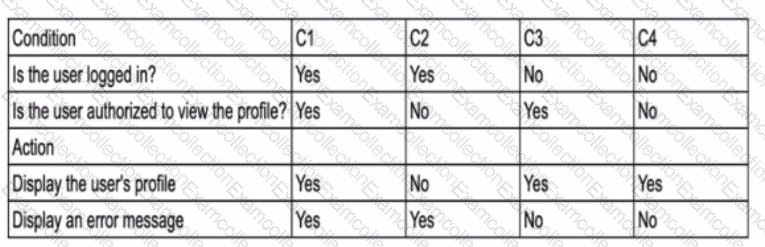
A.

C1

B.

C4

C.

C3

D.

C2

Which of the following is a typical potential risk of using test automation tools?

A.

Reduced feedback times regarding software quality compared to manual testing.

B.

Reduced test execution limes compared to manual testing.

C.

Reduced repeatability and consistency of tests compared to manual testing

D.

Underestimation of effort required to maintain test scripts.

Which ONE of the following options BEST describes black-box test techniques?

A.

Black-box testing techniques are based on experience with the test object without knowing the internal structure.

B.

In black-box testing techniques, test cases are created based on the software's implementation.

C.

Black-box testing techniques are based on analyzing the test object's specified and implied behavior without knowledge of its internal data structure.

D.

Black-box testing techniques involve analyzing the specified behavior of the test object without knowledge of its internal structure.