

Pre-Summer Sale Special Limited Time 70% Discount Offer - Ends in 0d 00h 00m 00s - Coupon code: xmas50

Juniper JN0-351 - Enterprise Routing and Switching Specialist (JNCIS-ENT)

Page: 3 / 4
Total 107 questions

You are asked to configure a redundant trunk group (RTG). Which two requirements would accomplish this task? (Choose two.)

A.

The RTG must be participating in a Spanning Tree topology.

B.

Interfaces within an RTG can be configured as access ports.

C.

Interfaces within an RTG must be configured as trunk ports.

D.

Both interfaces of an RTG must be configured to service the same VLANS

Which three statements are correct about OSPF packet types? (Choose three.)

A.

Link-state request packets are sent after receiving an LSA header not in the OSPF database.

B.

Link-state acknowledgment packets are sent every 30 seconds.

C.

Hello packets are sent every 30 seconds by default.

D.

Database description packets are used during the adjacency formation process.

E.

Link-state update packets contain one or more LSAs.

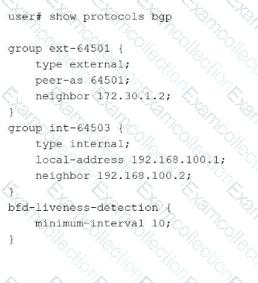
Exhibit

Your BGP neighbors, one in the USA and one in France, are not establishing a connection with each other.

Referring to the exhibit, which statement is correct?

A.

The BFD liveness is set too low.

B.

The BFD liveness must be configured on the BGP neighbor.

C.

The BFD liveness must be configured on the BGP group.

D.

The BFD liveness is set too high.

Which statement is correct about controlling the routes installed by a RIB group?

A.

An import policy is applied to the RIB group.

B.

Only routes in the last table are installed.

C.

A firewall filter must be configured to install routes in the RIB groups.

D.

An export policy is applied to the RIB group.

Which three actions are required for filter-based forwarding? (Choose three.)

A.

Create a firewall filter to match desired traffic.

B.

Create routing policies for source addresses.

C.

Create a RIB group for next-hop entries.

D.

Create a forwarding option for load balancing.

E.

Create routing instances for individual destinations.

Which two multicast IP addresses are used for link-state update packets? (Choose two.)

A.

224.0.0.5

B.

224.0.0.10

C.

224.0.0.9

D.

224.0.0.6

What are two purposes of an aggregate route? (Choose two.)

A.

to decrease the number of route advertisements

B.

to hide internal routes from external peers

C.

to allow external peers to see internal routes

D.

to increase the number of route advertisements

You are configuring an IS-IS IGP network and do not see the IS-IS adjacencies established. In this scenario, what are two reasons for this problem? (Choose two.)

A.

MTU is not at least 1492 bytes.

B.

IP subnets are not a /30 address.

C.

The Level 2 routers have mismatched areas.

D.

The lo0 interface is not included as an IS-IS interface.

You are an operator for a network running 1S-IS. Two routers are failing to form an adjacency. What are two reasons for this problem? (Choose two.)

A.

There are mismatched router IDs on the L2 routers.

B.

There is no configured ISO address on any IS-IS interface.

C.

There is a mismatched area ID between the L2 routers.

D.

The family iso configuration is missing from the adjacency interface.

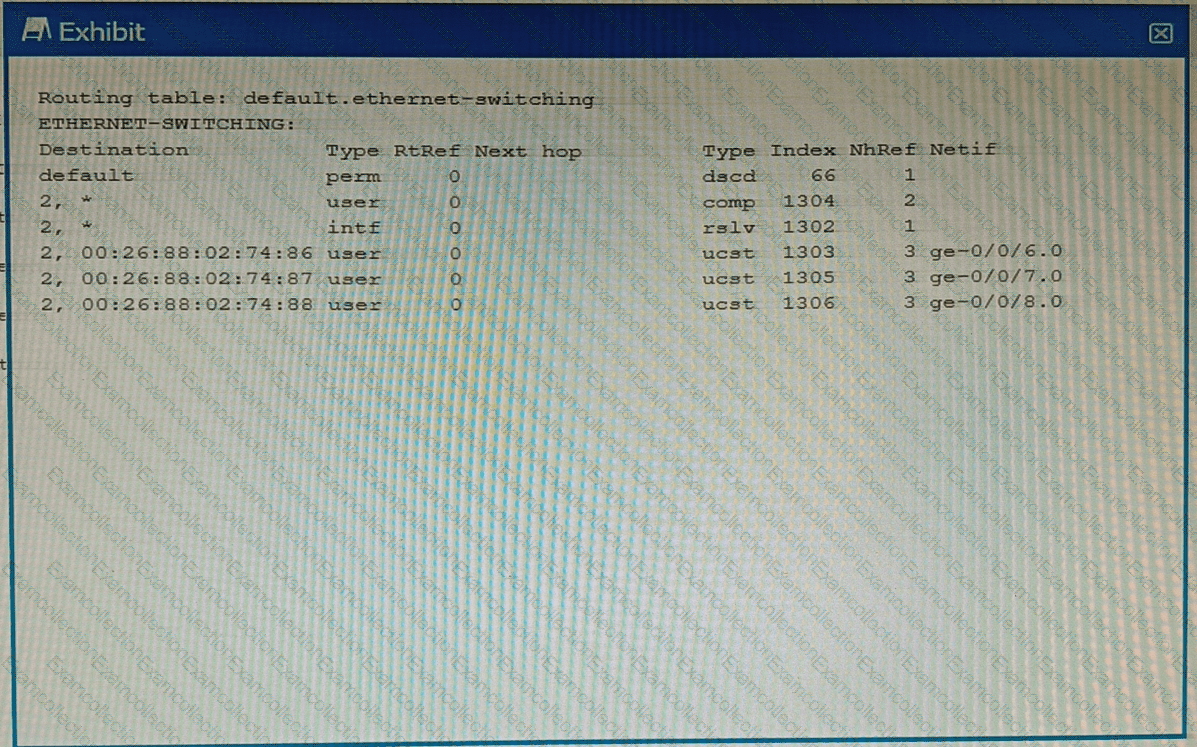
Exhibit

Which command displays the output shown in the exhibit?

A.

show route forwarding-table

B.

show ethernet-switching table

C.

show ethernet—switching table extensive

D.

show route forwarding—table family ethernet-switching