New Year Sale Special Limited Time 70% Discount Offer - Ends in 0d 00h 00m 00s - Coupon code: xmas50

MuleSoft MCPA-Level-1 - MuleSoft Certified Platform Architect - Level 1

Page: 1 / 5
Total 152 questions

A large lending company has developed an API to unlock data from a database server and web server. The API has been deployed to Anypoint Virtual Private Cloud

(VPC) on CloudHub 1.0.

The database server and web server are in the customer's secure network and are not accessible through the public internet. The database server is in the customer's AWS

VPC, whereas the web server is in the customer's on-premises corporate data center.

How can access be enabled for the API to connect with the database server and the web server?

A.

Set up VPC peering with AWS VPC and a VPN tunnel to the customer's on-premises corporate data center

B.

Set up VPC peering with AWS VPC and the customer's on-premises corporate data center

C.

Setup a transit gateway to the customer's on-premises corporate data center through AWS VPC

D.

Set up VPC peering with the customer's on-premises corporate data center and a VPN tunnel to AWS VPC

Which statement is true about identity management and client management on Anypoint Platform?

A.

If an external identity provider is configured, the SAML 2.0 bearer tokens issued by the identity provider cannot be used for invocations of the Anypoint Platform web APIs

B.

If an external client provider is configured, it must be configured at the Anypoint Platform organization level and cannot be assigned to individual business groups and environments

C.

Anypoint Platform supports configuring one external identity provider

D.

Both client management and identity management require an identity provider

An auto manufacturer has a mature CI/CD practice and wants to automate packaging and deployment of any Mule applications to various deployment targets, including CloudHub workers/replicas, customer-hosted Mule runtimes, and Anypoint Runtime Fabric.

Which MuleSoft-provided tool or component facilitates automating the packaging and deployment of Mule applications to various deployment targets as part of the company's

CI/CD practice?

A.

Anypoint Runtime Manager

B.

Mule Maven plugin

C.

Anypoint Platform CLI

D.

Anypoint Platform REST APIs

An API implementation is deployed to CloudHub.

What conditions can be alerted on using the default Anypoint Platform functionality, where the alert conditions depend on the API invocations to an API implementation?

A.

When the API invocations are sent directly to the internal DNS record of the API implementation

B.

When the API invocations are not over-a- secure TLS/SSL communication channel

C.

When the APL invecations originate from a geography different than the API

D.

When the number of API invocations are below a threshold

A Mule application implements an API. The Mule application has an HTTP Listener whose connector configuration sets the HTTPS protocol and hard-codes the port

value. The Mule application is deployed to an Anypoint VPC and uses the CloudHub 1.0 Shared Load Balancer (SLB) for all incoming traffic.

Which port number must be assigned to the HTTP Listener's connector configuration so that the Mule application properly receives HTTPS API invocations routed through the

SLB?

A.

8082

B.

8092

C.

80

D.

443

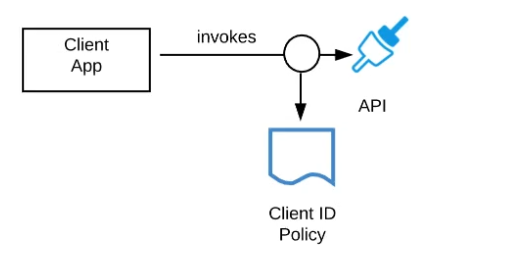
Refer to the exhibit.

A developer is building a client application to invoke an API deployed to the STAGING environment that is governed by a client ID enforcement policy.

What is required to successfully invoke the API?

A.

The client ID and secret for the Anypoint Platform account owning the API in the STAGING environment

B.

The client ID and secret for the Anypoint Platform account's STAGING environment

C.

The client ID and secret obtained from Anypoint Exchange for the API instance in the STAGING environment

D.

A valid OAuth token obtained from Anypoint Platform and its associated client ID and secret

A customer has an ELA contract with MuleSoft. An API deployed to CloudHub is consistently experiencing performance issues. Based on the root cause analysis, it is

determined that autoscaling needs to be applied.

How can this be achieved?

A.

Configure a policy so that when the number of HTTP requests reaches a certain threshold the number of workers/replicas increases (horizontal scaling)

B.

Configure two separate policies: When CPU and memory reach certain threshold, increase the worker/replica type (vertical sealing) and the number of workers/replicas (horizontal sealing)

C.

Configure a policy based on CPU usage so that CloudHub auto-adjusts the number of workers/replicas (horizontal scaling)

D.

Configure a policy so that when the response time reaches a certain threshold the worker/replica type increases (vertical scaling)

A retail company is using an Order API to accept new orders. The Order API uses a JMS queue to submit orders to a backend order management service. The normal load for orders is being handled using two (2) CloudHub workers, each configured with 0.2 vCore. The CPU load of each CloudHub worker normally runs well below 70%. However, several times during the year the Order API gets four times (4x) the average number of orders. This causes the CloudHub worker CPU load to exceed 90% and the order submission time to exceed 30 seconds. The cause, however, is NOT the backend order management service, which still responds fast enough to meet the response SLA for the Order API. What is the MOST resource-efficient way to configure the Mule application's CloudHub deployment to help the company cope with this performance challenge?

A.

Permanently increase the size of each of the two (2) CloudHub workers by at least four times (4x) to one (1) vCore

B.

Use a vertical CloudHub autoscaling policy that triggers on CPU utilization greater than 70%

C.

Permanently increase the number of CloudHub workers by four times (4x) to eight (8) CloudHub workers

D.

Use a horizontal CloudHub autoscaling policy that triggers on CPU utilization greater than 70%

What should be ensured before sharing an API through a public Anypoint Exchange portal?

A.

The visibility level of the API instances of that API that need to be publicly accessible should be set to public visibility

B.

The users needing access to the API should be added to the appropriate role in Anypoint Platform

C.

The API should be functional with at least an initial implementation deployed and accessible for users to interact with

D.

The API should be secured using one of the supported authentication/authorization mechanisms to ensure that data is not compromised

When could the API data model of a System API reasonably mimic the data model exposed by the corresponding backend system, with minimal improvements over the backend system's data model?

A.

When there is an existing Enterprise Data Model widely used across the organization

B.

When the System API can be assigned to a bounded context with a corresponding data model

C.

When a pragmatic approach with only limited isolation from the backend system is deemed appropriate

D.

When the corresponding backend system is expected to be replaced in the near future