


Amazon Web Services MLA-C01 - AWS Certified Machine Learning Engineer - Associate
A company wants to migrate ML models from an on-premises environment to Amazon SageMaker AI. The models are based on the PyTorch algorithm. The company needs to reuse its existing custom scripts as much as possible.
Which SageMaker AI feature should the company use?
A company has an existing Amazon SageMaker AI model (v1) on a production endpoint. The company develops a new model version (v2) and needs to test v2 in production before substituting v2 for v1.
The company needs to minimize the risk of v2 generating incorrect output in production and must prevent any disruption of production traffic during the change.
Which solution will meet these requirements?
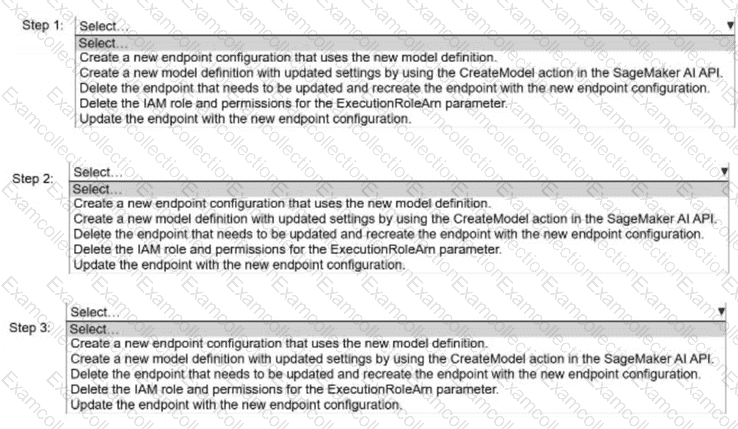
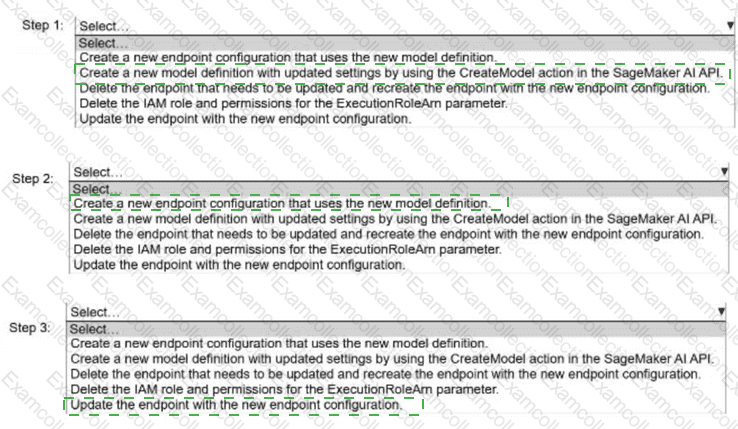
A company needs to update the model definition of an existing Amazon SageMaker Al endpoint.
Select and order the correct steps from the following list to update the model definition settings with the LEAST interruption of inferences. Select each step one time or not
at all. (Select and order THREE.)
Create a new endpoint configuration that uses the new model definition.
Create a new model definition with updated settings by using the CreateModel action in the SageMaker AI API.
Delete the endpoint that needs to be updated and recreate the endpoint with the new endpoint configuration.
Delete the IAM role and permissions for the ExecutionRoleArn parameter.
Update the endpoint with the new endpoint configuration.
A company has developed a computer vision model. The company needs to deploy the model into production on Amazon SageMaker AI. The company has not hosted a model on SageMaker AI previously.
An ML engineer needs to implement a solution to track model versions. The solution also must provide recommendations about which Amazon EC2 instance types to use to host the model.
Which solution will meet these requirements?
Case Study
A company is building a web-based AI application by using Amazon SageMaker. The application will provide the following capabilities and features: ML experimentation, training, a
central model registry, model deployment, and model monitoring.
The application must ensure secure and isolated use of training data during the ML lifecycle. The training data is stored in Amazon S3.
The company needs to run an on-demand workflow to monitor bias drift for models that are deployed to real-time endpoints from the application.
Which action will meet this requirement?
An ML engineer is analyzing potential biases in a customer dataset before training an ML model. The dataset contains customer age (numeric), product reviews (text), and purchase outcomes (categorical).
Which statistical metrics should the ML engineer use to identify potential biases in the dataset before model training?
A company is developing an internal cost-estimation tool that uses an ML model in Amazon SageMaker AI. Users upload high-resolution images to the tool.
The model must process each image and predict the cost of the object in the image. The model also must notify the user when processing is complete.
Which solution will meet these requirements?
An ML engineer is using Amazon SageMaker to train a deep learning model that requires distributed training. After some training attempts, the ML engineer observes that the instances are not performing as expected. The ML engineer identifies communication overhead between the training instances.
What should the ML engineer do to MINIMIZE the communication overhead between the instances?
A company is developing a customer support AI assistant by using an Amazon Bedrock Retrieval Augmented Generation (RAG) pipeline. The AI assistant retrieves articles from a knowledge base stored in Amazon S3. The company uses Amazon OpenSearch Service to index the knowledge base. The AI assistant uses an Amazon Bedrock Titan Embeddings model for vector search.
The company wants to improve the relevance of the retrieved articles to improve the quality of the AI assistant ' s answers.
Which solution will meet these requirements?
A government agency is conducting a national census to assess program needs by area and city. The census form collects approximately 500 responses from each citizen. The agency needs to analyze the data to extract meaningful insights. The agency wants to reduce the dimensions of the high-dimensional data to uncover hidden patterns.
Which solution will meet these requirements?
