


Black Friday Rush: 75% Off All Exam Bundles! Apply the coupon code below before the offer expires! - Ends in 0d 00h 00m 00s - Coupon code: newyear

Fortinet NSE7_SSE_AR-26 - Fortinet NSE 7 - FortiSASE 26 Architect

Page: 3 / 4
Total 110 questions

You manage an SD-WAN topology. You will soon deploy 50 new branches. Which three tasks can you do in advance to simplify this deployment? (Choose three.)

A.

Update the DHCP server configuration.

B.

Create model devices.

C.

Create a ZTP template.

D.

Define metadata variables value for each device.

E.

Create policy blueprint.

Refer to the exhibit. An administrator checks the status of an SD-WAN topology using the FortiManager SD-WAN monitor menus. All members are configured with one or two SLAs. Which two conclusions can you draw from the output shown? (Choose two.)
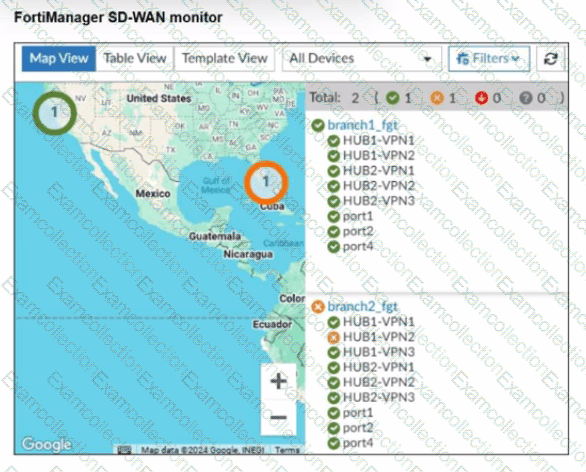
Exhibit 1

A.

The template view should be used to see the hub devices.

B.

One member of branch2_fgt is missing the SLAs.

C.

branch2_fgt establishes six tunnels to the hubs and they are all up.

D.

This SD-WAN topology contains only two branch devices.

Refer to the exhibits. Two SD-WAN event logs, the member status, the SD-WAN rule configuration, and the health-check configuration for a FortiGate device are shown. Immediately after the log messages are displayed, how will the FortiGate steer the traffic based on the information shown in the exhibits? Choose one answer.
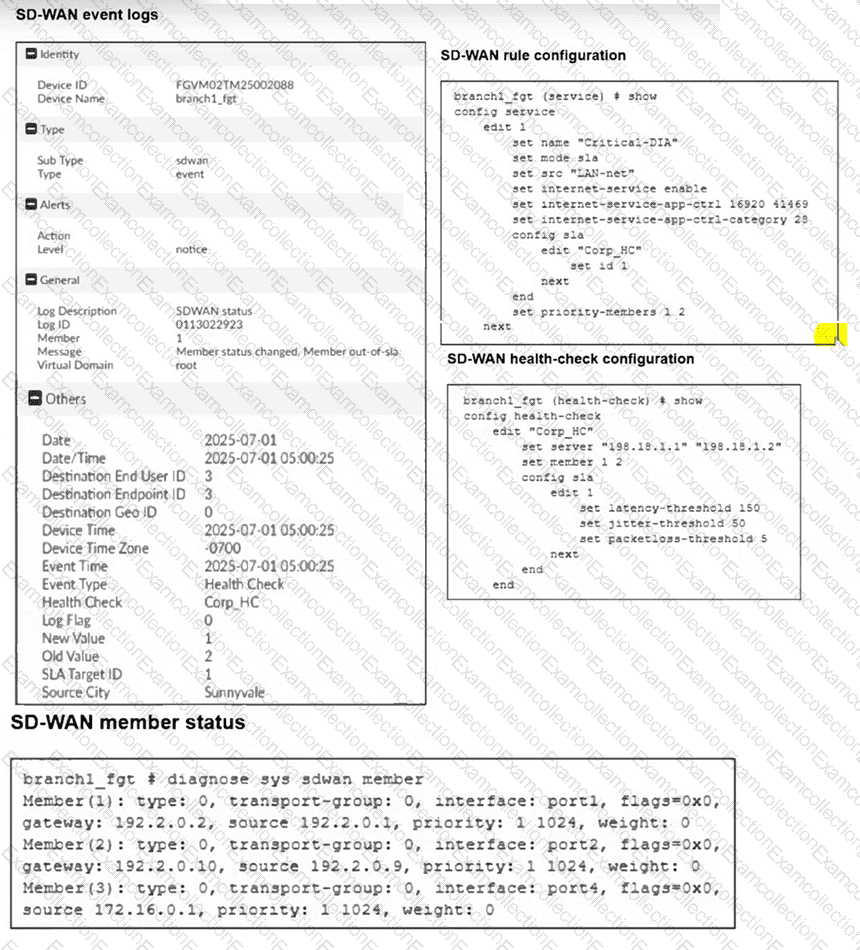
Exhibit 1

A.

FortiGate skips SD-WAN rule ID 1.

B.

FortiGate uses port2 to steer the traffic for SD-WAN rule ID 1.

C.

FortiGate uses port1 to steer the traffic for SD-WAN rule ID 1.

D.

FortiGate uses port1 or port2 to steer the traffic for SD-WAN rule ID 1.

You are tasked with configuring ADVPN 2.0 on an SD-WAN topology already configured for ADVPN. What should you do to implement ADVPN 2.0 in this scenario?

A.

Update the IPsec tunnel configurations on the hub.

B.

Update the SD-WAN configuration on the branches.

C.

Update the IPsec tunnel configuration on the branches.

D.

Delete the existing ADVPN configuration and configure ADVPN 2.0.

Refer to the exhibit. Which statement best describe the role of the ADVPN device in handling traffic?
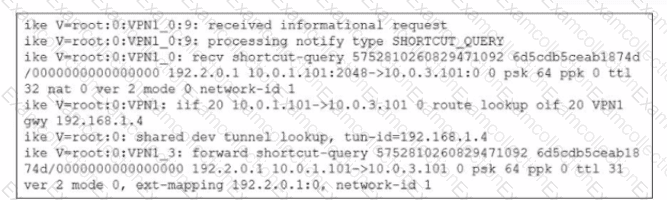
Exhibit 1

A.

This is a hub that has received a query from a spoke and has forwarded it to another spoke.

B.

This is a hub in a dual-region topology. The remote hub tunnel ID is 10.0.2.101.

C.

This is a spoke that has received a shortcut query from another spoke and has forwarded the response to its hub.

D.

This is a spoke. The kernel received a shortcut request and forwards the query to another spoke.

Refer to the exhibits. The exhibits show an SD-WAN event log, the member status, and the SD-WAN rule configuration. Which two conclusions can you draw from the information shown? (Choose two.)
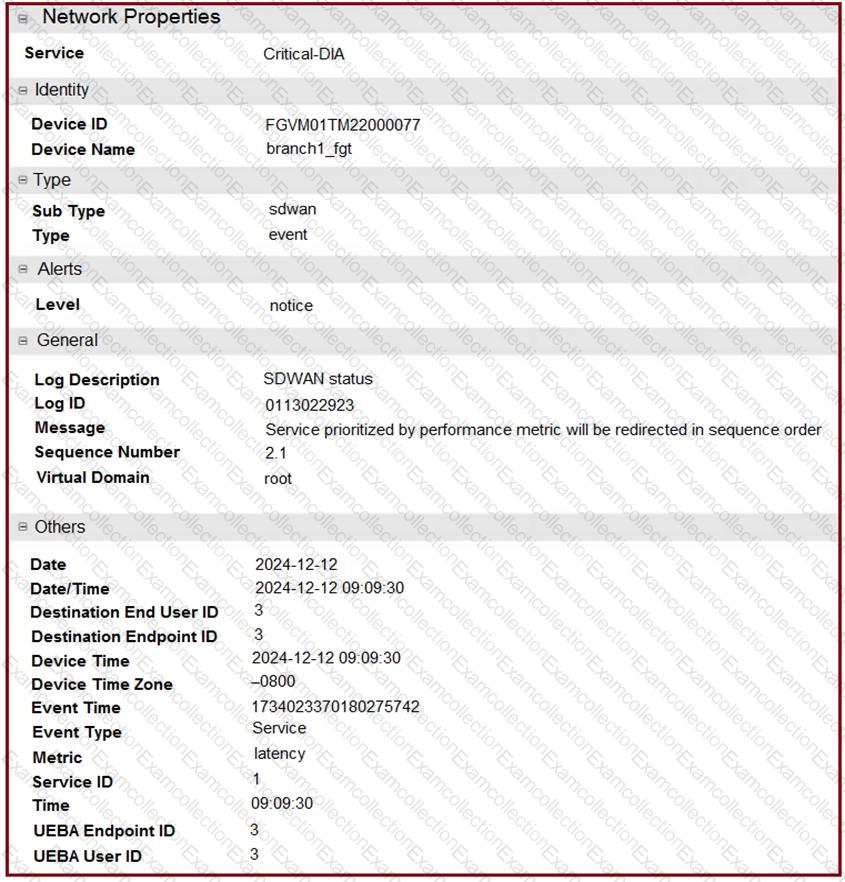
Exhibit 1
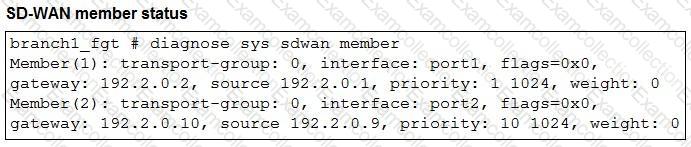
Exhibit 2
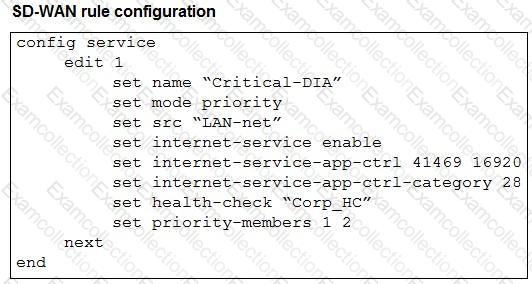
Exhibit 3

A.

The administrator configured the service ID 1 with the highest priority member for port2.

B.

Port2 has a lower latency than port1.

C.

FortiGate updated the outgoing interface list on the rule so it prefers port2.

D.

The administrator configured the SD-WAN rule ID 1 with the default strategy mode.

As an MSSP administrator, you are asked to configure ADVPN on an existing SD-WAN topology. FortiManager manages the customer devices in a dedicated ADOM. The previous administrator used the SD-WAN overlay topology. Which two statements apply to this scenario? (Choose two.)

A.

You can activate auto-discovery VPN in the SD-WAN overlay template only if it is a single hub topology.

B.

When auto-discovery VPN is enabled, FortiManager updates the IPsec and BGP templates in the hub.

C.

After you enable auto-discovery VPN in the overlay template, you must select between ADVPN 2.0 and ADVPN 1.0.

D.

You can activate auto-discovery VPN in the SD-WAN overlay template for any type of topology, including a primary-primary dual-hub topology.

You configured an SD-WAN rule with the best quality strategy and selected the predefined health check, Default_FortiGuard, to check the link performances against FortiGuard servers. For the quality criteria, you selected Custom-profile-1. Which factors does FortiGate use, and in which order. to determine the link that it should use to steer the traffic?

A.

Latency – Member configuration order – Link cost threshold

B.

Link quality index – Member configuration order – Link cost threshold

C.

Links that meet the SLA targets – Member configuration order – Member local cost

D.

Latency – Jitter - Packet loss – Bibandwidth – Member configuration order

How is the geofencing feature used on FortiSASE?

A.

To restrict application access based on time of day in specific countries

B.

To monitor and block access to personal content from specific countries

C.

To encrypt data at rest on endpoints located in specific countries

D.

To allow or block remote user connections to FortiSASE points of presence (POPs) based on source country

Refer to the exhibit.

Two hub-and-spoke groups are connected through redundant site-to-site IPsec VPNs between Hub 1 and Hub 2.

Which two configuration settings are required for spoke A1 to establish an auto-discovery VPN (ADVPN) shortcut with spoke B2? (Choose two.)
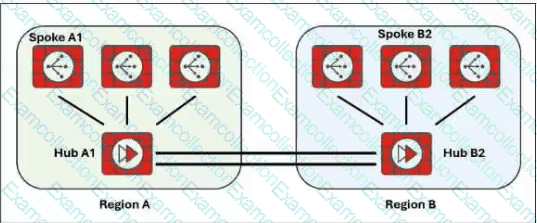
Exhibit — Hub-and-spoke ADVPN topology

A.

On the spokes, auto-discovery-receiver must be enabled on the IPsec VPNs to the hub.

B.

On the spokes, auto-discovery-sender must be enabled on the IPsec VPNs to hubs.

C.

On the hubs, auto-discovery-receiver must be enabled on the IPsec VPNs to spokes.

D.

On the hubs, auto-discovery-forwarder must be enabled on the IPsec VPNs to hubs.